

Home
Class 11
PHYSICS
A cycle followed by an engine (made of o...

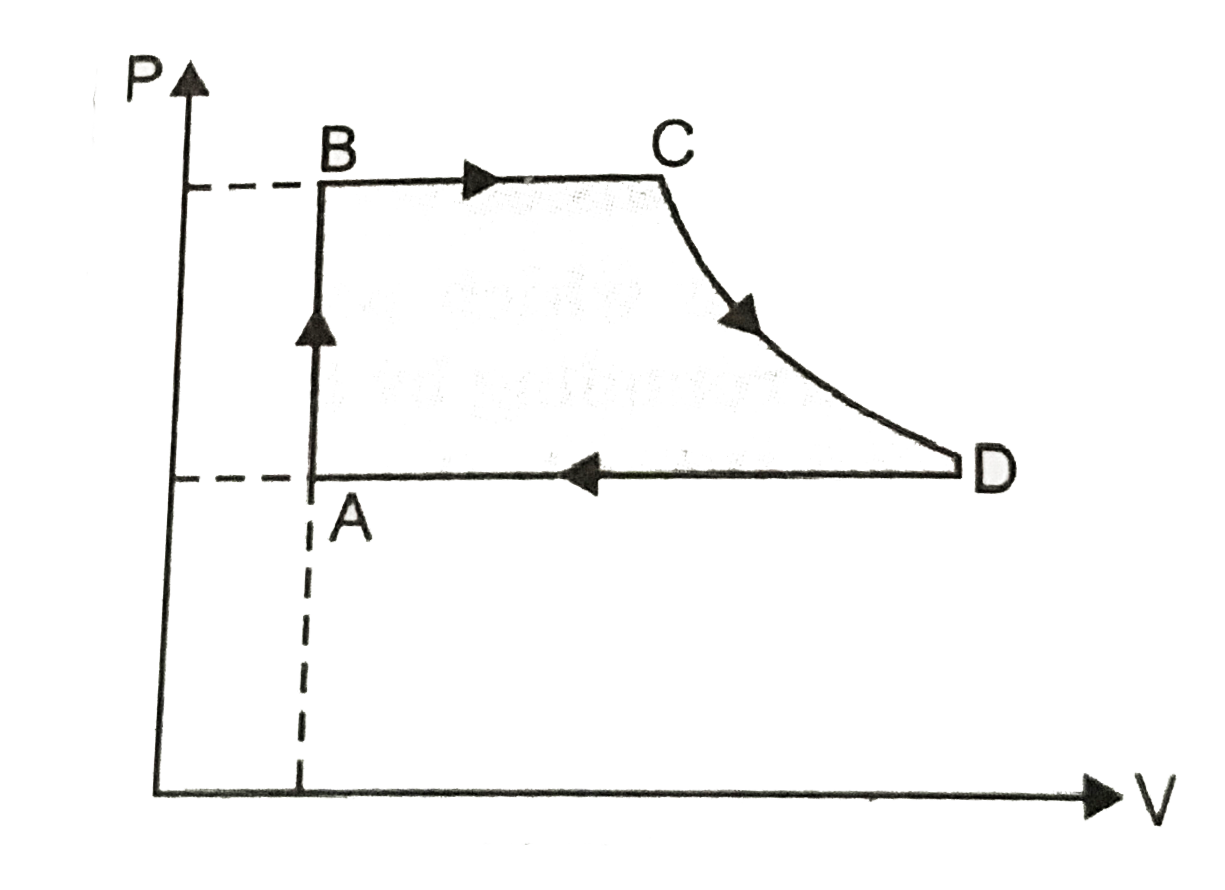
A cycle followed by an engine (made of one mole of an ideal gas in a cyclinder with a piston) is shown in (figure). Find heat exchanged by the engine, with the surrounding for each section of the cycle. `[C_(V)= (3//2)R]`
AB : constant volume BC : constant pressure
CD : adiabatic DA : constant pressure.

Promotional Banner

Similar Questions

Explore conceptually related problems

A cycle followed by an engine (made of one mole of an ideal gas in a cyclinder with a piston ) is shown if figure . Find heat exchanged by the enigen, with the surrodings for each section of the cycle . [C_(V) = (3//2) R]

A cycle followed by an engine (made of one mole of an ideal gas in a cyclinder with a piston ) is shown if figure . Find heat exchanged by the enigen, with the surrodings for each section of the cycle . [C_(V) = (3//2) R]

A cycle followed by an engine (made of one mole of an ideal gas in a cylinder with a piston) is shown in the figure. Find heat exchanged by the engine, with the surroundings at constant volume of the cycle. (C_v = (3/2) R)

A cycle followed by an engine (made of one mole of an ideal gas in a cylinder with a piston) is shown in figure. Find heat exchanged by the engine, with the surroundings for each section of the cycle. C_V=3/2R (a) A to B : constant volume (b) B to C: constant pressure (c) C to D: adiabatic (d) D to A: constant pressure

A cycle followed an engine (made of one mole of an ideal gas in a cylinder with a piston) is shown in figure The heat exchanged by the engine with the surroundings at constant volume is (Take C_(V)=(3)/(2)R)

A cycle followed an engine (made of one mole of an ideal gas in a cylinder with a piston) is shown in figure The heat exchanged by the engine with the surroundings at consttn ovluem is (Take C_(V)=(3)/(2)R)

The cycle in the figure followed by an engine made of an ideal gas in ca cylinder with a piston, the heat exchanged by the engine with the surroundings for adiabatic section AB of cycle is (C_(V)=(3)/(2)R)