Home
Class 12
PHYSICS
An electron and a position are released ...

An electron and a position are released from (0, 0, 0) and `(0, 0, 1*5R)` respectively, in a uniform magnetic field `vecB=B_0hati`, each with an equal momentum of magnitude `p=eBR`. Under what conditions on the direction of momentum will the orbits be non-intersecting circles?

Text Solution

Verified by Experts

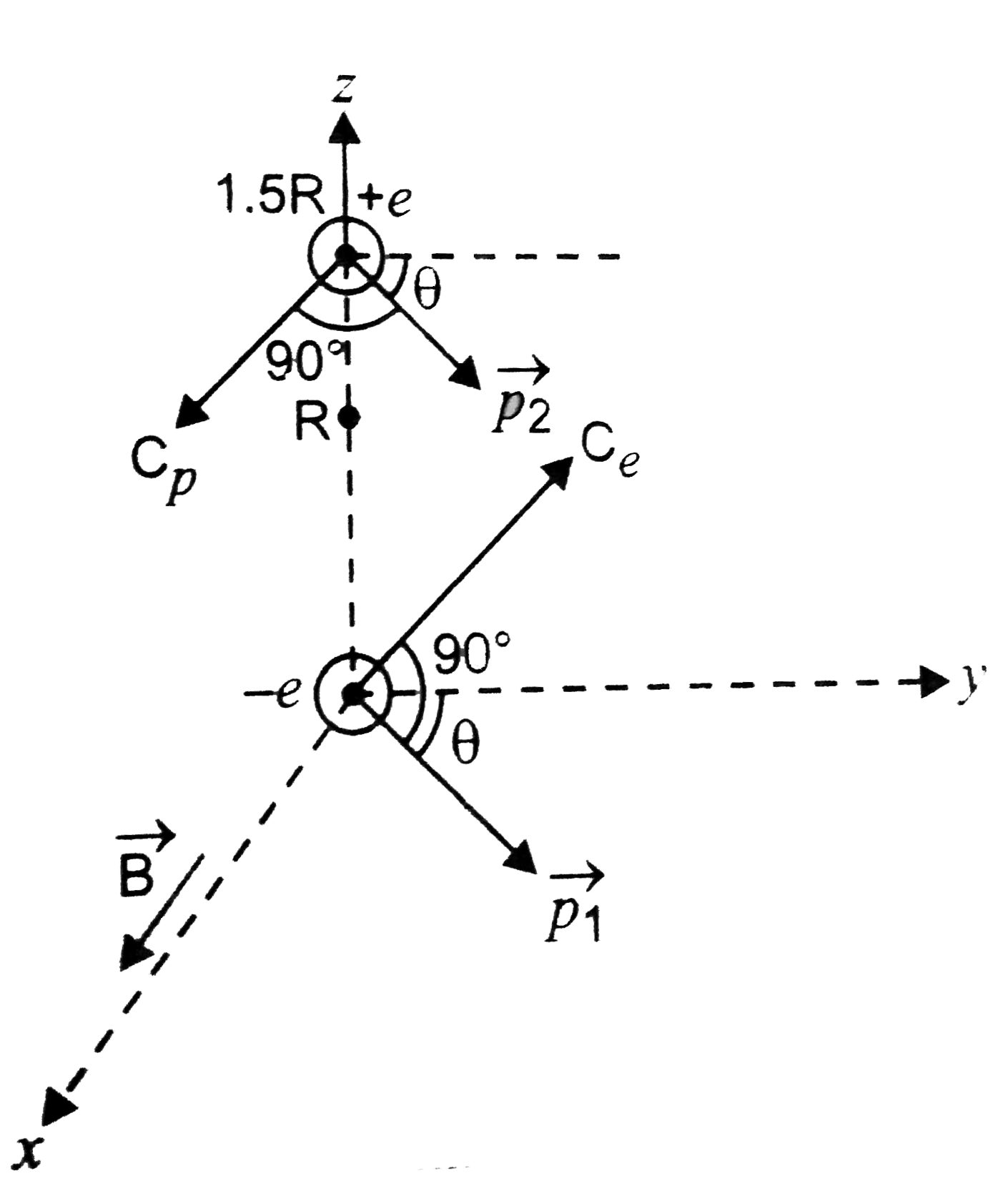
Here, `vecB(=B_0hati)` is acting along the x-axis. For a circular orbit, the momentum of the electron and position are in y-z plane. Let `vecp_1` and `vecp_2` be the momentum of the electron and position respectively. Both of them due to same momentum `(=eBR)` move on circular orbits, each of radius R, but in opposite sense.
Let `vecp_1` make an angle `theta` with the y-axis and `vecp_2` must make the same angle `theta` with y-axis. The centres of the respective circular orbits must be perpendicular to the momenta at a distance R. Let the centre of the circular orbit of the electron be at `C_e` and of the position be at `C_p`.
The coordinates of `C_e` is `(0, R sin theta, R cos theta)`
The coordinates of `C_p` is `[0, -Rsin theta, (3/2R-Rcos theta)]`
The two circular orbits will not intersect if the distance between their two centre is greater than 2R.
Let d be the distance between `C_p` and `C_e`. Then
`d^2=[-Rsintheta-(Rsintheta)]^2+[(3/2R-Rcostheta)-(Rcostheta)]^2`
`=4R^2sin^2theta+9/4R^2-6R^2costheta+4R^2cos^2theta=4R^2(sin^2theta+cos^2theta)+9/4R^2-6R^2costheta`
`=25/4R^2-6R^2costheta`
The two circular orbits will not intersect each other if `dgt2R` or `d^2gt4R^2`
`:. 25/4R^2-6R^2costhetagt4R^2` or `25/4-6costhetagt4` or `9/4gt6costheta` or `cos thetalt3//8`
Promotional Banner

Topper's Solved these Questions

  • MAGNETIC EFFECT OF CURRENT AND MAGNETISM

    PRADEEP|Exercise Conceptual Problems (d)|2 Videos
  • MAGNETIC EFFECT OF CURRENT AND MAGNETISM

    PRADEEP|Exercise Very Short Answer Questions (a)|2 Videos
  • ELECTROSTATICS

    PRADEEP|Exercise ASSERTION-REASON TYPE QUESTIONS|2 Videos
  • OPTICS

    PRADEEP|Exercise Multiple choice questions|1 Videos

Similar Questions

Explore conceptually related problems

A proton is fired from origin with velocity vecv=v_0hatj+v_0hatk in a uniform magnetic field vecB=B_0hatj .

Two point charges q and –q are at positions (0,0,d) and (0,0, –d) respectively . What is the electric field at (a,0,0 ) ?

A charged particle of mass m and charge q is released from rest the position (x_0,0) in a uniform electric field E_0hatj . The angular momentum of the particle about origin.

An electron is moving with an initial velocity vecv=v_(0)hati and is in a magnetic field vecB=B_(0)hatj . Then it's de-Broglie wavelength

A particle of specific charge alpha is projected from origin with velocity v=v_0hati-v_0hatk in a uniform magnetic field B=-B_0hatk . Find time dependence of velocity and position of the particle.

A particle of specific charge alpha enters a uniform magnetic field B=-B_0hatk with velocity v=v_0hati from the origin. Find the time dependence of velocity and position of the particle.

Under what condition is E_("cell")^(@)=0 or Delta_(r)G=0 ?

