Home
Class 12
CHEMISTRY
It is known fact that gases expand to fi...

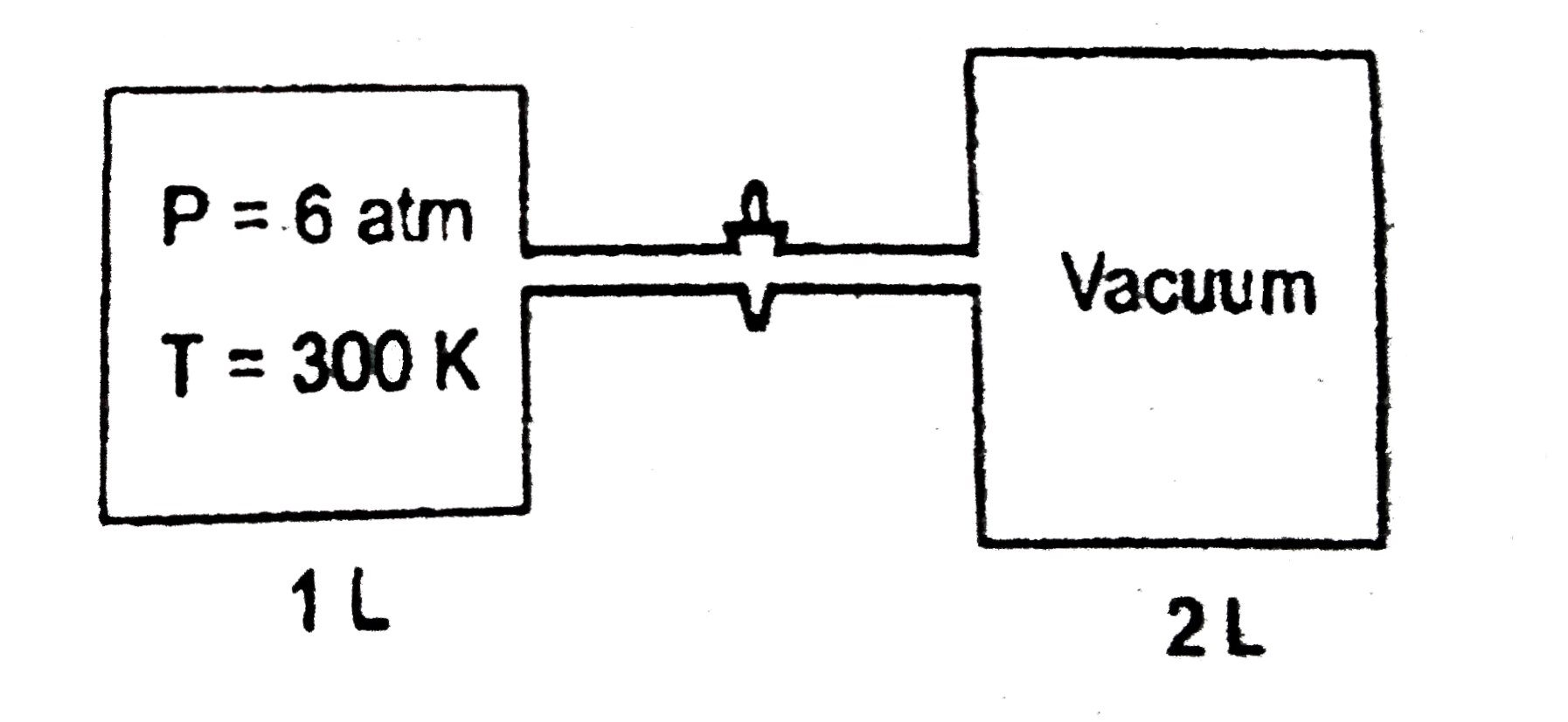
It is known fact that gases expand to fill all available volume and their final pressure becomes equal at every point in connected systeam.

in the given arrangement, temperature is maintained constant and the knob is opened. After the gas spreads in the second chamber also, the pressure will be:

A

`3` atm

B

`2` atm

C

`6` atm

D

`12` atm

Text Solution

Verified by Experts

The correct Answer is:

B
Promotional Banner

Topper's Solved these Questions

  • TEST PAPERS

    RESONANCE|Exercise PART - III CHEMISTRY|20 Videos
  • TEST PAPERS

    RESONANCE|Exercise PT-03|1 Videos
  • TEST PAPERS

    RESONANCE|Exercise PART - III CHEMISTRY SEC - 2|18 Videos
  • SURFACE CHEMISTRY

    RESONANCE|Exercise Section - 5|1 Videos
  • TEST SERIES

    RESONANCE|Exercise CHEMISTRY|50 Videos

Similar Questions

Explore conceptually related problems

It is known fact that gases expand to fill all available volume and their final pressure becomes equal at every point in connected systeam. If the gas in the above part weigh 15.36 g , then select the correct statement(s) : (R = (1)/(12) l. atm//mol.K)

A vessel A of volume 5 litre has a gas at pressure of 80 cm column of Hg. This is joined to another evacuated vessel B of volume 3 litre. If now the stopcock S is opened and the apprature is maintained at constant temperature then the common pressure will become -

An unspecified quantity of an ideal gas has an initial pressure of 5 atm and temperature of 30^@C . The gas is expanded at 30^@C until the volume has increased by 60% of the initial value. Next, the quantity of the gas in the vessel is increased by 20% of the initial value while the volume is maintained constant. Finally the temperature is adjusted at constant volume until the gas pressure is again 5 atm. What is the final temperature?

An unspecified quantity of an ideal gas was at initial pressure of 5 atm and temperature of 300K. The gas is expanded at 300K until the volume has increased by 60% of the initial value. Next, the quantity of the gas in the vessel is increased by 20% of the initial value while the volume is maintained constant. Finally, the temperature is adjusted at constant volume until the gas pressure is again 5 atm. If the final temperature is 'T'K, then the value of T/(100) is

One mole of an ideal monoatomic gas expands isothermally against constant external pressure of 1 atm from initial volume of 1L to a state where its final pressure becomes equal to external pressure. If initial temperature of gas is 300K then total entropy change of system in the above process is: [R=0.082L atm mol^(-1) K^(-1)-=8.3J mol^(-1) K^(-1)]

One mole of an ideal monoatomic gas expands isothermally against constant external pressure of 1 atm from intial volume of 1L to a state where its final pressure becomes equal to external pressure. If initial temperature of gas in 300 K then total entropy change of system in the above process is: [R=0.0082L atm mol^(-1)K^(-1)=8.3J mol^(-1)K^(-1)]

The molar gas constant is the same for all gases because at the same temperature and pressure, equal volumes of gases have the same

Two vessels A and B of equal volume (V_0) are connected by a narrow tube which can be closed by a value. The vessels are fitted with piston which can be moved to change the volumes. Initially, the valve is open and the vessels contain an ideal gas (C_p / C_v = gamma ) at atomspheric pressures (P_0) and atmoshpeheric temperature (T_0) . The walls of the vessels A are diathermic and those of B are adiabatic. The value is now closed and the pistons are slowly pulled out to increase the volumes of the of the vessels to dobuled the original value.(a) Find the temperatures and pressures in the two vessels. (b) The value is now opened for sufficeint time so that the gases acquire a common tempertures and pressures . Find the new values of the temperatuere and the pressures.

Two containers A and B of equal volume V_(0)//2 each are connected by a narrow tube which can be closed by a value. The containers are fitted with pistons which can be moved to change the volumes. Initially the value is open and the containers contain an ideal gas (C_(p)//C_(v)=gamma) at atmospheric pressure P_(0) and atmospheric temperature 2T_(0) . The walls of the containers A are highly conducting and of B are non-conducting. The value is now closed and the pistons are slowly pulled out to increase the volumes of the containers to double the original value. (a) Calculate the temperature and pressure in the two containers. (b) The value is now opened for sufficient time so that the gases acquire a common temperature and pressure. Find the new values of the temperature and the pressure.

RESONANCE-TEST PAPERS-PART - III CHEMISTRY
  1. When a sample of N(2) gas is passed through a liquid (N(2) is insolubl...

    Text Solution

    |

  2. When a sample of N(2) gas is passed through a liquid (N(2) is insolubl...

    Text Solution

    |

  3. It is known fact that gases expand to fill all available volume and th...

    Text Solution

    |

  4. It is known fact that gases expand to fill all available volume and th...

    Text Solution

    |

  5. Adenine is a substituted form of a heterocyclic nitrogenous base Purin...

    Text Solution

    |

  6. Adenine is a substituted form of a heterocyclic nitrogenous base Purin...

    Text Solution

    |

  7. Valence shell electron pair repusin theory (VSEPR) can be used to perd...

    Text Solution

    |

  8. Valence shell electron pair repusin theory (VSEPR) can be used to perd...

    Text Solution

    |

  9. HCN and HNC molcules are formed by the same atoms. Which of the foll...

    Text Solution

    |

  10. HCN and HNC molcules are formed by the same atoms. What is correct a...

    Text Solution

    |

  11. The energy levels in a certain single electron species are all 800% hi...

    Text Solution

    |

  12. The slope of 'P' v/s "T" plot at constant volume for a fixed amount of...

    Text Solution

    |

  13. Consider the reaction C(6)H(12)O(6) + 12H(2)SO(4) rarr 6CO(2) + 12SO...

    Text Solution

    |

  14. Calculate the molecular weight of a gas X which diffuses four times as...

    Text Solution

    |

  15. Total number of electrons having n + l = 4 in V(23) atom in its ground...

    Text Solution

    |

  16. How many of the following elements show +2 as their most stable oxidat...

    Text Solution

    |

  17. How many of following anions have 1.5 bond order ? IO(4^(-)), CH(3)C...

    Text Solution

    |

  18. How many of the following have sp^(3) hydridisation around the central...

    Text Solution

    |

  19. Cl-O band order in perchlorate ion is M and number of resonating struc...

    Text Solution

    |

  20. Write the sum of lone pairs of electron on central atom of SF(4), CF(4...

    Text Solution

    |
