Home
Class 12
PHYSICS
A hydrogen like atom (atomic number Z) i...

A hydrogen like atom (atomic number Z) is in a higher excited state of quantum number n. The excited atom can make a transition to the first excited state by successively emitting two photons of energy 10.2 eV and 17.0 eV, respectively. Alternatively, the atom from the same excited state can make a transition to the second excited state by successively emitting two photons of energies 4.25 eV and 5.95 eV, respectively Determine the values of n and Z. (lonization energy of H-atom = 13.6 eV)

Text Solution

Verified by Experts
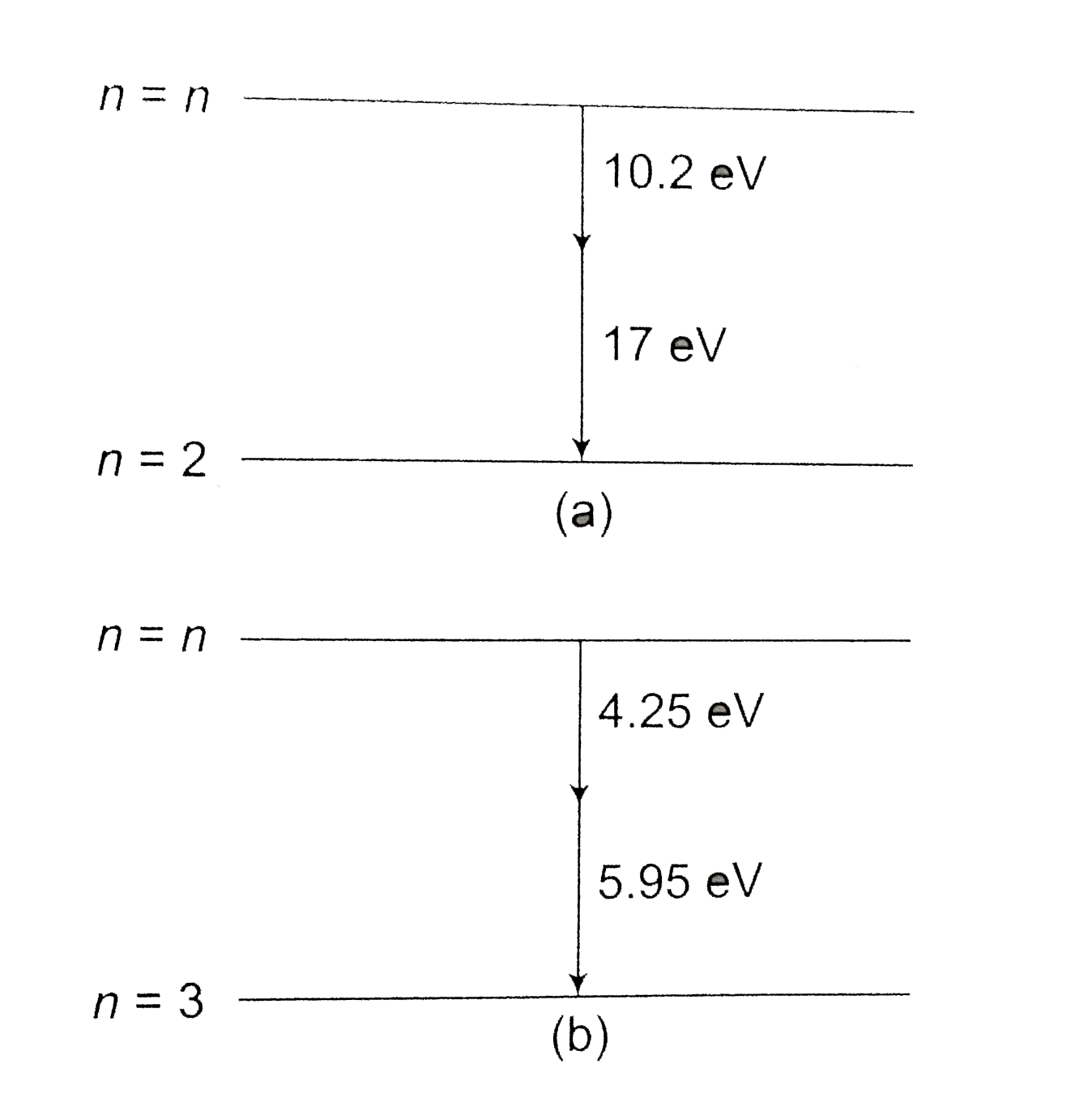
`10.2+17=13.6Z^(2)((1)/(2^(2))-(1)/(n^(2)))`
`27.2=13.6 Z^(2)((1)/(4)-(1)/(n^(2)))`
`4.25+5.95=13.6Z^(2)((1)/(3^(2))-(1)/(n^(2)))`
`10.2=13.6Z^(2)((1)/(9)-(1)/(n^(2)))`
`(27.2)/(10.2)=(27.2)/(10.2)=(1//4-1//n^(2))/(1//9-1//n^(2))`
`(27.2)/(9)-(27.9)/(9)-(10.2)/(4)`
`n^(2)=37impliesn-6`
`27.2=13.6Z^(2)((1)/(4)-(1)/(n^(2)))`
`=13.6Z^(2)((1)/(4)-(1)/(6^(2))=(1)/(4)-(1)/(36)=(9-1)/(36))`
`=13.6Z^(2)xx(2)/(9)`
`Z^(2)=9impliesZ=3`
Promotional Banner

Topper's Solved these Questions

Similar Questions

Explore conceptually related problems

A hydrogen like atom (atomic number z ) is in a higher excited state of quantum number n . This excited atom can make a transition to the first excited state by successively emitting two photons of energies 10.2 eV and 17.0 eV respectively. Alternatively the atom from the same excited state can make a transition to the second excited state by successively emitting 2 photons of energy 4.25 eV and 5.95 eV respectively. Determine the value of (n+z)

A hydrogen-like atom (aatomic number Z ) is in a hight excited state of quantum number n . This excited atom can make a transition to the first excited state by successively emitting two proton of energy 10.20 e V and 17.00 e V , respectively. Alternatively , the atom from the same excited state can make a transition to the second excited state by successively emitting two proton of energy 4.25 e V and 5.954 e V , respectively. Determine the value of n and Z (ionization energy of hydrogen atom = 13.6 eV)

A hydrogen like species (atomic number Z) is present in a higher excited state of quantum number n. This excited atom can make a transitionn to the first excited state by successive emission of two photons of energies 10.20 eV and 17.0 eV respectively. Altetnatively, the atom from the same excited state can make a transition to the second excited state by successive of two photons of energy 4.25 eV and 5.95 eVv respectively. Determine the value of Z.

A hydrogen like atom (atomic number Z) is in a higher excited satte of quantum number n .This excited atom can make a transition to the first excited state by succesively emitting two photon of energies 10.20 eV and 17.00 eV .Alternatively, the atom from the same excited state can make a transition to the second excited state by successively emitting twio photon of energy 4.25 ev and 5.95 eV Determine the followings: The value of atomic number (Z) is

A hydrogen like atom (atomic number Z) is in a higher excited satte of quantum number n .This excited atom can make a transition to the first excited state by succesively emitting two photon of energies 10.20 eV and 17.00 eV .Alternatively, the atom from the same excited state can make a transition to the second excited state by successively emitting twio photon of energy 4.25 ev and 5.95 eV Determine the followings: The excited sate (n) of the atom is

A hydrogen like atom (atomic number Z) is in a higher excited satte of quantum number n .This excited atom can make a transition to the first excited state by succesively emitting two photon of energies 10.20 eV and 17.00 eV .Alternatively, the atom from the same excited state can make a transition to the second excited state by successively emitting twio photon of energy 4.25 ev and 5.95 eV Determine the followings: The hydrogen -like atom in the question is

A hydrogen like atom (atomic number = Z) is in higher excited state of quantum number n. This excited atom can make a transition to first excited state by successively emitting two photons of energy 22.94 eV and 5.15 eV . The atom from the same state n can make transition to second excited state by successively emitting two photons of energies 2.4 eV and 8.7 eV . Find values of n and Z.

A hydrogen like atom (atomic number Z) is in a higher excited satte of quantum number n .This excited atom can make a transition to the first excited state by succesively emitting two photon of energies 10.20 eV and 17.00 eV .Alternatively, the atom from the same excited state can make a transition to the second excited state by successively emitting twio photon of energy 4.25 ev and 5.95 eV Determine the followings: The atom during transition from n = 1 to n = 2 emit radiation in the region of

CP SINGH-BOHR THEORY-Exercises
  1. A hydrogen like atom (atomic number Z) is in a higher excited state o...

    Text Solution

    |

  2. A beam of fast moving alpha particles were directed towards a thin fil...

    Text Solution

    |

  3. In a Rutherford scattering experiment when a projectile of change Z(1)...

    Text Solution

    |

  4. An alpha-particle of 5MeV energy strikes with a nucleus of uranium at ...

    Text Solution

    |

  5. An alpha nucleus of energy (1)/(2)m nu^(2) bombards a heavy nucleus o...

    Text Solution

    |

  6. In Rutherford scattering experiment, what will b ethe correct angle fo...

    Text Solution

    |

  7. Which of the following is correct regarding Bohr's theory for hydrogen...

    Text Solution

    |

  8. In the Bohr model of the atom (i) the radius of the n^(th) orbit is ...

    Text Solution

    |

  9. The minimum orbital angular momentum of the electron in a hydrogen ato...

    Text Solution

    |

  10. Which of the following parameters are the same for all hydrogen like a...

    Text Solution

    |

  11. As one considers orbits with higher value of n is a hydrogen atom, the...

    Text Solution

    |

  12. The enrgy of an atom (or ion) in the ground state is - 54.4 eV .If ma...

    Text Solution

    |

  13. The angular speed of the electron in the n^(th) Bohr orbit of the hydr...

    Text Solution

    |

  14. According to Bohr's theory, the ratio of the times taken by the electr...

    Text Solution

    |

  15. The ratio of the binding energies of the hydrogen atom in the first an...

    Text Solution

    |

  16. The radius of the shortest orbit in a one electron system is 18 pm it...

    Text Solution

    |

  17. Which of the following curve may represent the speed of the electron i...

    Text Solution

    |

  18. In hydrogen atom, if the difference in the energy of the electron in n...

    Text Solution

    |

  19. An orbit electron in the ground state of hydrogen has an angular momen...

    Text Solution

    |

  20. In Bohr's model of hydrogen atom, let PE represents potential energy a...

    Text Solution

    |

  21. The ratio of the speed of the electrons in the ground state of hydroge...

    Text Solution

    |

