Home
Class 12
MATHS
The graph above shows the positions of P...


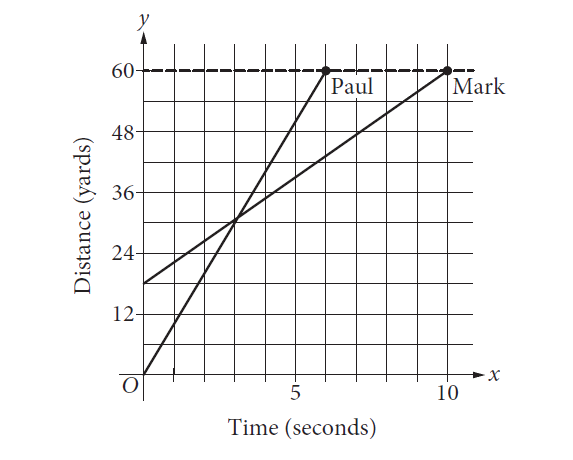
The graph above shows the positions of Paul and Mark during a race. Paul and Mark each ran at a constant rate, and Mark was given a head start to shorten the distance he needed to run. Paul finished the race in 6 seconds, and Mark finished the race in 10 seconds. According to the graph, Mark was given a head start of how many yards?

A

3

B

12

C

18

D

24

Text Solution

Verified by Experts

The correct Answer is:

C

The lines shown on the graph give the positions of Paul and Mark during the race. At the start of the race, 0 seconds have elapsed, so the y-intercept of the line that represents Mark’s position during the race represents the number of yards Mark was from Paul’s position (at 0 yards) at the start of the race. Because the y-intercept of the line that represents Mark’s position is at the grid line that is halfway between 12 and 24, Mark had a head start of 18 yards.
Choices A, B, and D are incorrect. The y-intercept of the line that represents Mark’s position shows that he was 18 yards from Paul’s position at the start of the race, so he did not have a head start of 3, 12, or 24 yards.
Promotional Banner

Similar Questions

Explore conceptually related problems

The figure on the left above show saw heel with a mark on its rim. The wheel is rolling on theground at a constant rate along a level straight path from a starting point to an ending point. The graph of y=d(t)on the right could represent which of the following as a function of time from when the wheel began to roll?

Nicky and Cristina are running a 1,000 meter race. Because Cristina is faster than Nicky, she gives him a 12 - second head start. If Cristina runs at a pace of 5 meters per second and Nicky runs at a pace of only 3 meters per second, how many seconds will Nicky have run before Cristina catches up to him?

Given below (figure) is the bar graph indicating the marks obtained out of 50 in mathematics paper by 100 students. Read the bar graph and answer the following questions: It is decided to distribute work books on mathematics to the students obtaining less then 20 marks, giving one workbook to each of such students. If a work book costs Rs.5, what sum is required to buy the work books? Every student belonging to the highest mark group is entitled to get a prize of Rs. 10. How much amount of money is required for distributing the prize money? Every student belonging to the lowest mark-group has to solve 5 problems per day. How many problems, in all, will be solved by the students of this group per day? State whether true or false. 17% students have obtained marks ranging from 40 to 49. 59 students have obtained marks ranging from 10 to 29. What is the number of students getting less than 20 marks? What is the number of students getting more than 29 marks? What is the number of students getting marks between 9 to 40? What is the number of students belonging to the highest mark group? What is the number of students obtaining more than 19 marks?

a. Mark the follllowing statements as true offalse. i. A ball thrown vertically up takes moretime to go up than to come down. ii. If a ball starts fallig from the position of rest, then it travels a distance of 25 m during the third secons of tis fall. iii. A packet dropped from a rising balloon ferst moves upwards and then moves sownward as observed by a stationary observer on the ground. iv. In the absence of air resistance, all bodies fall on the surface of earth at the same rate. b. Fill in the blanks. i. When a body is thrown vertically upwards, at the highest point.........................(both belocity and accelenation are zero//only velocity is zero//ony acceleration is zero). ii. If air drag is not neglected, then which is greater: time of ascent or time of descent? iiii. A body is projected upward. Up to the maximum height time taken will be greater to travel...................... (first half//second half).
