Home
Class 12
PHYSICS
Find the equatio of the equipotentials f...

Find the equatio of the equipotentials for an infinite cylinder of radius `r_(0)` carrying charge of linear density `lamda`.

Text Solution

Verified by Experts
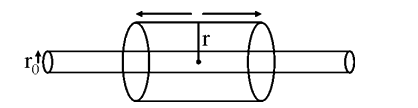
There is an infinite cylinder of radius `r_0` and having linear charge density `lamda` . Assume a Gaussian surface of radius r and length l. According of Gauss’s theorem,
`int E.ds=q/e_0`
`int E.ds =(lamda 1)/e_0 (because q=lamda 1)` (`because` Angle between E and ds is zero.)
`E int dS=E.2 pi rl= (lamda l)/e_0` [ where `(2pirl)` is area of the curved surface of the cylinder]
`E=lamda/(2pie_0r)`..........(i)
If the radius is `r_0`, to find the potential difference at distance r from the line, consider the electric field. According to the formula of potential gradient,
`V_(r)-V_(r_0)=int_(r_0)^r lamda/(2pie_0r).dr` (angle between E and dr to zero)
`=- lamda/(2pi e_0) int_(r_0)^r (dr)/r=-lamda/(2pie_0).[log_e r]_(r_0)^r=(-lamda)/(2pie_0)[log_e r-log_e r_0]=lamda/(2pi e_0).[ log_e r_0-log_e r]=lamda/(2pie_0).log r_0/r`
`log_e r_0/r=(2pir_0)/lamda[V_(r)-V_(r_0)], log_e r/r_0=-(2pie_0)/lamda[V_(r)-V_(r_0)]`
`r/r_=e^((pie_)/lamda) [V_(r)-V_(r_0)], r=r_0e^((2pie_0)/lamda) [V_(r)-V_(r_0)]`
This is the equation of required equipotential surfaces.
Promotional Banner

Similar Questions

Explore conceptually related problems

Find the magntiude and diraction of the magnitude induction vector B (a) of an infinite palne carrying a current of linear density I, the vector i is the same at all points of the plane, (b) of two parallel infinite planes carrying currents of linear densities a dn -1, the vectors i and -i are cohnstant at all points of the corresponding planes.

Find the electric field at the centre of a uniformly charged semicircular ring of radius R. Linear charge density is lamda

Find the electric field due to an infinitely long cylindrical charge distribution of radius R and having linear charge density lambda at a distance half of the radius from its axis.

A particle of charge -q and mass m moves in a circle of radius r around an infinitely long line charge of linear charge density +lamda . Then, time period will be where , k=1/4piepsilon_0)

State Gauss's law in electrostatics. Use this law to derive an expression for the electric field due to an infinitely long straight wire of linear charge density lamda cm^(-1)

Find ratio of electric at point A and B. Infinitely long uniformly charged wire with linear charge density lamda is kept along z-axis:

Draw the electric field vs distance (from the centre ) graph for (i) a long charged rod having linear charge density lamda gt 0 (ii) spherical shell of radius R and charge Q gt 0 .

