Home
Class 12
PHYSICS
A block of mass m slides down along the ...

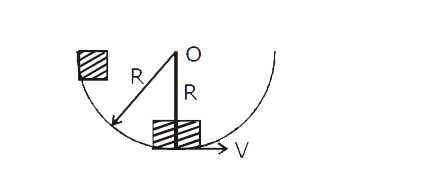
A block of mass m slides down along the surface of the bowl from the rim to the bottom as shown in fig. The velocity of the block at the bottom will be-

A

`sqrt((pi Rg))`

B

`2sqrt((pi Rg))`

C

`sqrt((2Rg))`

D

`sqrt((gR))`

Text Solution

Verified by Experts

The correct Answer is:

C
Promotional Banner

Similar Questions

Explore conceptually related problems

A block of mass 1kg slides down a curved track which forms one quadrant of a circle of radius 1m as shown in figure. The speed of block at the bottom of track is v=2 ms^(-1) . The work done by the of friction is .

A block of mass m slides down a smooth vertical circular track. During the motion, the block is in

A block of mass m slides down a smooth vertical circular track. During the motion, the block is in:

A block of mass m is placed on the inclined sufrace of a wedge as shown in fig. Calculate the acceleration of the wedge and the block when the block is released. Assume all surfaces are frictionless.

A block of A is released from rest from the top of wedge block of height h shown in figure-4.55. If velocity of block when it reaches the bottom of inclive is v_(0) , find the time os sliding.

A block of mass 4kg is released from the top of a rough inclines plane of height 10 m . If velocity of the block is 10 m/s at the bottom of the inclined then work done by the friction force on the block will be

A block of mass M slides down a rough inclined surface of inclination theta and reaches the bottom at speed at 'v' . However , if it slides down a smooth inclined surface of same length and same inclination , it reaches the bottom with the speed kv. Coefficient of friction between the block and the rough incline is :

(i) There is a vertical loop of radius R. A small block of mass m is slowly pushed along the loop from bottom to a point at height h. Find the work done by the external agent if the coefficient of friction is mu . Assume that the external agent pushes tangentially along the path. (ii) A block of mass m slides down a smooth slope of height h, starting from rest. The lower part of the track is horizontal. In the beginning the block has potential energy U = mgh which gets converted into kinetic energy at the bottom. The velocity at bottom is v=sqrt(2gh) . Now assume that an observer moving horizontally with velocity v=sqrt(2gh) towards right observes the sliding block. She finds that initial energy of the block is E=mgh+1/2 mv^(2) and the final energy of the block when it reaches the bottom of the track is zero. Where did the energy disappear?

A block of mass m slides down a wedge of mass M as shown . The whole system is at rest , when the height of the block is h above the ground. The wedge surface is smooth and gradually flattens. There is no friction between wedge and ground. As the block slides down, which of the following quantities associated with the system remains conserved ?

A small block slides down from the top of hemisphere of radius R = 3 m as shown in the figure. The height 'h' at which the block will lose contact with the surface of the sphere is __________ m. (Assume there is no friction between the block and the hemisphere)
