

Home
Class 9
MATHS
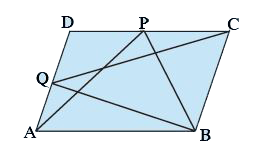
P and Q are any two points lying on the ...

P and Q are any two points lying on the sides DC and AD respectively of a parallelogram ABCD show that `ar(DeltaAPB) = ar Delta(BQC)`

Promotional Banner

Topper's Solved these Questions

  • AREAS

    NCERT BANGLISH|Exercise EXERCISE 11.3|9 Videos
  • AREAS

    NCERT BANGLISH|Exercise EXERCISE 11.1|4 Videos
  • CIRCLES

    NCERT BANGLISH|Exercise EXERCISE 12.5|5 Videos

Similar Questions

Explore conceptually related problems

If E, F G and H are respectively the midpoints of the sides AB, BC, CD and AD of a parallelogram ABCD, show that ar(EFGH) =1/2 ar (ABCD) .

In the figure D, E are points on the sides AB and AC respectively of DeltaABC such that ar(DeltaDBC) = ar(DeltaEBC) . Prove that DE || BC.

ABCD is a quadrilateral,AB and CD are parallel, P and Q are the midpoints of the sides BC and AD respectively. They, the value of bar(AB)+bar(DC) is -

P is any point on the diagonal BD of the parallelogram ABCD. Prove that DeltaAPD=DeltaCPD .

P is a point in the interior of a parallelogram ABCD. Show that (i) ar (DeltaAPB) +ar (DeltaPCD)=1/2ar (ABCD) (ii) ar(DeltaAPD)+ar (DeltaPBC)=ar(DeltaAPB)+ar(DeltaPCD) (Hint : Throught , P draw a line parallel to AB)

In the figure, ΔABC, D, E, F are the midpoints of sides BC, CA and AB respectively. Show that (i) BDEF is a parallelogram (ii) ar(DeltaDEF)=1/4ar(DeltaABC) (iii) ar(BDEF)=1/2ar(DeltaABC)

P is any point in the interior of the parallelogram ABCD. Prove that DeltaAPD+DeltaBPC = 1/2 parallelogram ABCD.

ABCD is a parallelogram, P and Q are the mid-points of the sides bar(AB) " and " bar(DC) respectively. Show that bar(DP) " and " bar(BQ) trisect bar(AC) and are trisected by bar(AC) .

In the figure, ΔABC and ΔABD are two triangles on the same base AB. If line segment CD is bisected by bar(AB) at O, show that ar (DeltaABC) = ar (DeltaABD).

In trapezium ABCD, AB || DC. E and F are points on non-parallel sides AD and BC respectively such that EF || AB. Show that (AE)/(ED) = (BF)/(FC)