

Home
Class 11
PHYSICS
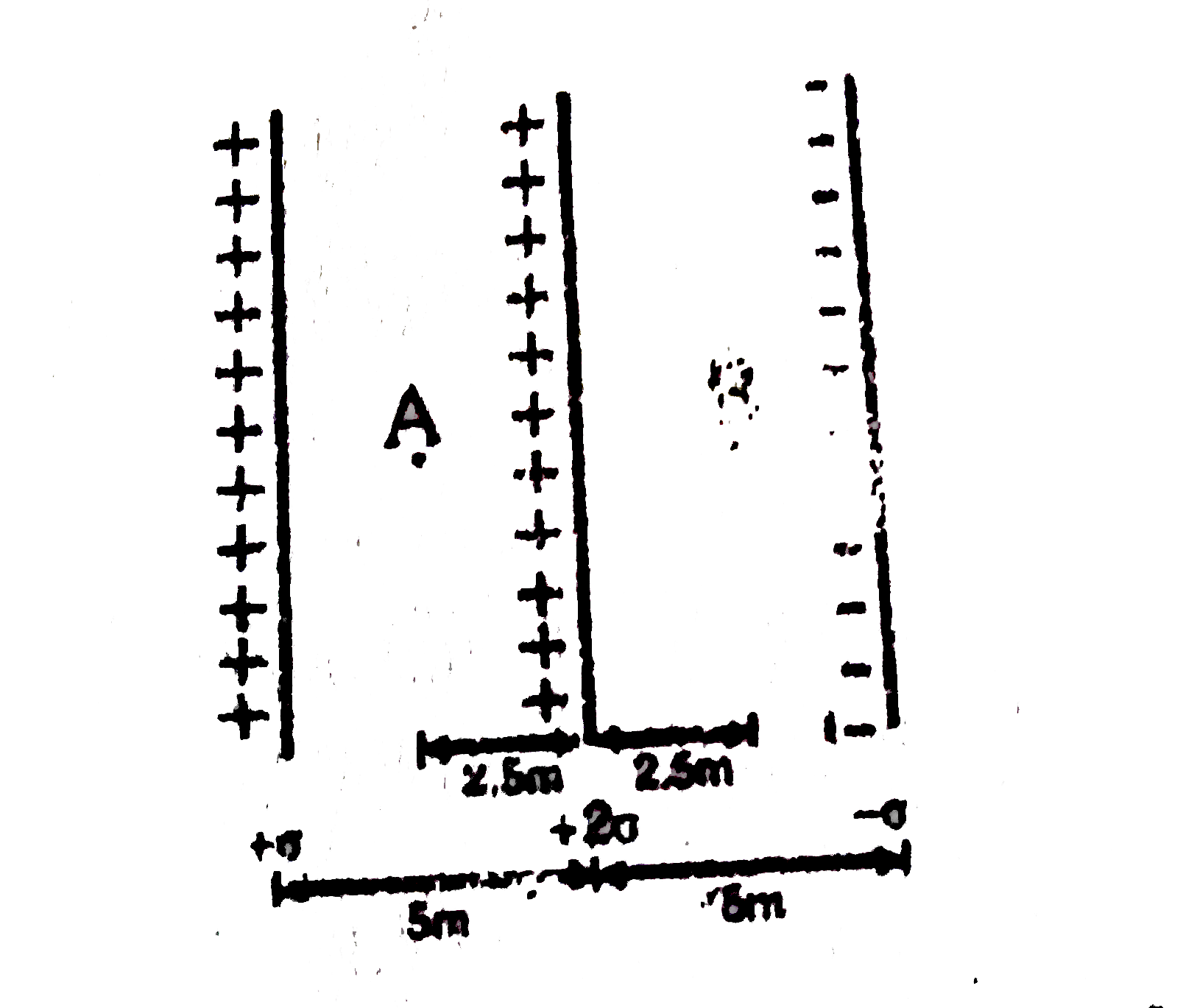
The figure shows three infinite non-cond...

The figure shows three infinite non-conducting plates of charge perpendicular to the plane of the paper with charge per unit area `+sigma, +2sigma` and `-sigma`. Find the ratio of the net electric field at that point a to that at point B.

Promotional Banner

Similar Questions

Explore conceptually related problems

The figure shows thrednfinite non-conducting plates of charge perpendicular to the plane of the paper with charge per unit area +sigma, + 2sigma" and " -sigma . Find the ratio of the net electric field atthat point A to that at point B. The points A and Bare located midway between the plates :

Three non-conducting large parallel plates have surface charge densities sigma, -2 sigma and 4 sigma respectively as shown in the figure. The electric field at the point P is

Three non-conducting large parallel plates have surface charge densities sigma, -2 sigma and 4 sigma respectively as shown in the figure. The electric field at the point P is

Two uniform infinite planes of charge having charge densities (+sigma) and (-sigma) intersect at right angle. The magnitude of electric field at any position in the space is

Two plane sheets of charge densities +sigma and -sigma are kept in air as shown in Fig. What are electric field intensities at points A and B ?

The line AA' is on a charged infinite conducting plane which is perpendicular to the plane of the paper. The plane has a surface density of charge sigma and B is a ball of mass m with a like charge of magnitude q, B is connected by a string from a point on the line AA . The tangent of the angle (0) formed between the line AA' and the string is:

If three infinite charged sheets of uniform surface charge densities sigma, 2sigma and -4 sigma are placed as shown in figure, then find out electric field intensities at points A, B, C and D.

If three infinite charged sheets of uniform surface charge densities sigma, 2sigma and -4 sigma are placed as shown in figure, then find out electric field intensities at points A, B, C and D.

a)State Gauss’s law in electrostatics. Show that with help of suitable figure that outward flux due to a point charge Q, in vacuum within gaussian surface, is independent of its size and shape. b) In the figure there are three infinite long thin sheets having surface charge density +2sigma, -2sigma and +sigma respectively. Give the magnitude and direction of electric field at a point to the left of sheet of charge density +2sigma and to the right of sheet of charge density +sigma

Two infinite sheets of unifrom charge density +sigma and -sigma are parallel to each other as shown in the figure. Electric field at the