Home
Class 12
MATHS
Prove that the area in the first quadran...

Prove that the area in the first quadrant enclosed by the axis, the line `x=sqrt(3)y` and the circle `x^2+y^2=4\ i s\ pi//3.`

Text Solution

Verified by Experts
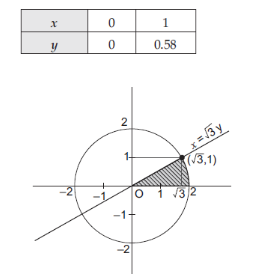
Obviously` x^2 + y^2 = 4` is a
circle having centre at` (0, 0)` and radius` 2` units.
For graph of line x `=sqrt3y`
For intersecting point of given circle and line
putting `x=sqrt3y "in" x^2+y^2=4`
we get
`(sqrt3y)^2+y^2=4`
`3y^2+y^2=4`
`4y^2=4`
`y=pm1`,`y=pm1`
Intersecting points are`(sqrt3,1),(-sqrt3,-1)`
Shaded region is required region
Now required area`= int_0^sqrt3 x/sqrt3dx+int_sqrt3^2 sqrt(4-x^2)`
`=1/sqrt3[x^2/2]_0^sqrt3+[(xsqrt(4-x^2))/2+4/2sin^-1(x/2)]_sqrt3^2`
`=1/(2sqrt3)(3-0)+[2sin^-1(1)-(sqrt3/2+2sin^-1(sqrt3/2)]`
`=sqrt3/2+[2(pi/2)-sqrt3/2-(2pi)/3]`
`=sqrt3/2+pi-sqrt3/2-(2pi)/3`
`=pi-(2pi)/3=pi/3`sq.unit
Promotional Banner

Similar Questions

Explore conceptually related problems

Find the area of the region in the first quadrant enclosed by x-axis, line x=sqrt(3)y and the circle x^2+y^2=4 .

Find the area of the region in the first quadrant enclosed by x-axis, the line y=sqrt(3\ )x and the circle x^2+y^2=16

Area of the region in the first quadrant exclosed by the X-axis, the line y=x and the circle x^(2)+y^(2)=32 is

Find the area of the region in the first quadrant enclosed by the y-axis, the line y=x and the circle x^2+y^2=32 , using integration.

Find the area of the region in the first quadrant enclosed by the x-axis, the line y" "=" x" , and the circle x^2+y^2=32 .

Area lying in the first quadrant and bounded by the circle x^(2)+y^(2)=4 the line x=sqrt(3)y and x-axis , is

Find the area enclosed by the curves y= sqrtx and x= -sqrty and the circle x^(2) + y^(2) =2 above the x-axis.

Find the area lying in the first quadrant and bounded by the curve y=x^3 and the line y=4xdot

Area lying in the first quadrant and bounded by the circle x^2+y^2=4 and the lines x= 0 and x= 2 is:

The radius of the larger circle lying in the first quadrant and touching the line 4x+3y-12=0 and the coordinate axes, is

