

Home
Class 12
PHYSICS
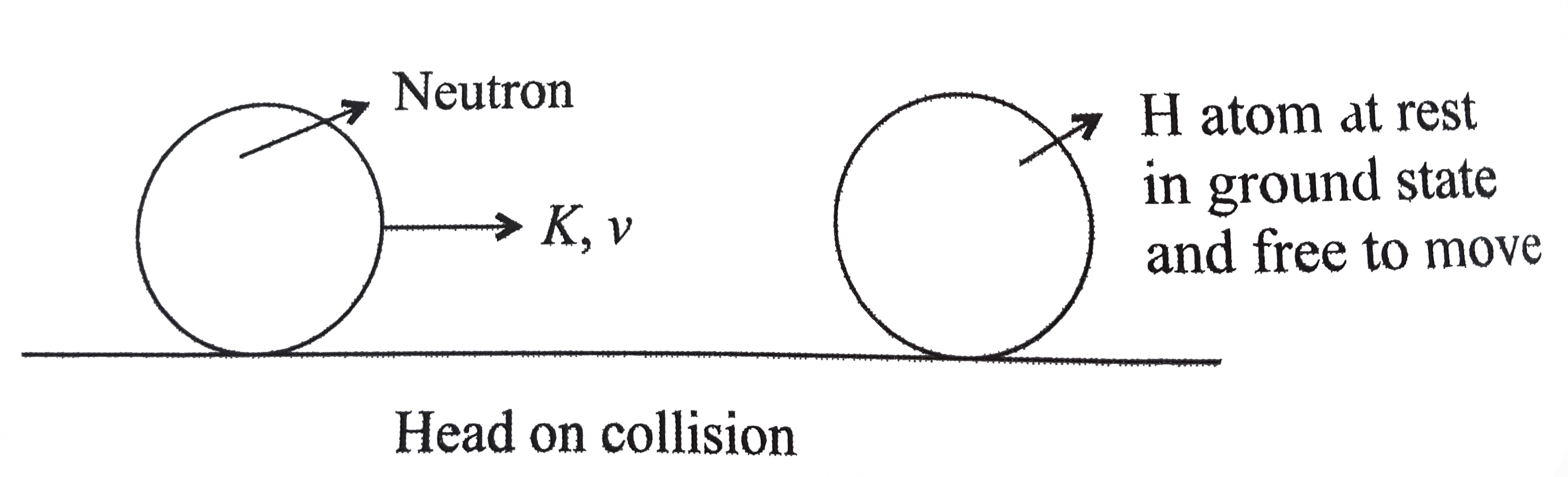
In the figure , what type of collision c...

In the figure , what type of collision can be possible , if `K = 14 eV, 20.4 eV,22 eV, 24.18 eV,(elastic // inelastic // perfectly inelastic).

Promotional Banner

Similar Questions

Explore conceptually related problems

A free hydrogen atom in its ground state is at rest. A neutron having kinetic energy k_(0) collides head one with the atom. Assume that mass of both neutron and the atom is same. (a) Find minimum value of k_(0) so that this collision can be inelastic. (b) If k_(0) = 25 eV , find the kinetic energy of neutron after collision if its excites the hydrogen atom to its second excited state. Take ionization energy of hydrogen atom in ground state to be 13.6 eV .

What is coefficient of restitution? What is its value for perfectly elastic and inelastic collisions?

Which of the following statements is false for collisions- (1)Momentum is conserved in elastic collisions but not in inelastic collisions. (2)Total-kinetic energy is conserved in elastic collisions but momentum is not conserved. (3)Total kinetic energy and momentum both are conserved in all types of collisions (4)Total kinetic energy is not conserved in inelastic collisions but momentum is conserved

A particle of mass m strikes a wedge of mass M horizontally as shown in the figure. Statement - 1 : If collision is perfectly inelastic then, it can be concluded that the particle sticks to the wedge. Statement - 2 : In perfectly inelastic collision velocity of both bodies is same along common normal just after collision.

The work function for AI, K and Pt is 4.28 eV, 2.30 eV and 5.65 eV respectively. Their respective threshold frequencies would be

The work function for Al, K and Pt is 4.28 eV, 2.30 eV and 5.65 eV respectively. Their respective threshold frequencies would be

The work function for Al, K and is 4.28 eV, 2.30 eV and 5.65 eV respectively. Their respective threshold frequencies would be