Home
Class 12
PHYSICS
In a quark model of elementary particles...

In a quark model of elementary particles a neutron is made of one up quarks is made of one up quarks
[ charge `(2)/(3) `e ] and two down quarks [ charges `-(1)/(3) e` ]. Assume that they have a triangle configuration with slde length of the order of `10^(-15)` m. Calculate electrosatic potential energy of neutron and compare it with it, mass 939 MeV.

Text Solution

Verified by Experts
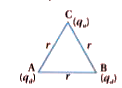
Electrostatic potential energy `U= (kq_(1)q_(2))/(r)`
The system of three charges is as below
`r = 10^(-15) ` m
`q_(u)` = up quarks =`(2)/(3)` e

qd = down quarks = `-(1)/(3)` e
Electrostatic potential energy
`U = k ((qdqd)/(r)+(quqd)/(r)+(quqd)/(r))`
`U=k[((-(1)/(3)e)(-(1)/3e))/(r)+(((2)/3e)(-(1)/(3)e))/(r)+(((2)/(3)e)(-(1)/(3)e))/(r)]`
`U=(k)/(r)[(1)/(9)e^(2)-(2)/(9)e^(2)-(2)/(9)e^(2)]`
`= (ke^(2))/(9r)xx(-3)`

`=(9xx 10^(9)xx(1.6xx10^(-19))^(2)xx(-3))/(9xx10^(-15))`
`=-7.68xx10^(-14)`J

`: U=(-7.69xx10^(14))/(-1.6xx10^(-19))eV`
`:.U= 4.8xx10^(5)` eV
`= 0.48xx10^(6) eV= 0.48` Me V
The ratio of potential energy of neutron to its mass is
`(U)/(m) = (0.48xx10^(6))/(939xx10^(6))`
`=0.00051112`
`5.11xx10^(-4) m_(0)C^(2))`
Promotional Banner

Topper's Solved these Questions

  • ELECTROSTATIC POTENTIAL AND CAPACITANCE

    KUMAR PRAKASHAN|Exercise Section D ( Multiple Choice Questions (MCQs) )|93 Videos
  • ELECTROSTATIC POTENTIAL AND CAPACITANCE

    KUMAR PRAKASHAN|Exercise Section D ( MCQs asked in Cometitive Exams )|39 Videos
  • ELECTROSTATIC POTENTIAL AND CAPACITANCE

    KUMAR PRAKASHAN|Exercise Section C ( NCERT Exemplar Solution ) (Short ,Aswer Type Questions )|5 Videos
  • ELECTROMAGNETIC WAVES

    KUMAR PRAKASHAN|Exercise BOARD.S QUESTION PAPER MARCH - 2020 (PART - B) SECTION - C|5 Videos
  • MAGNETISM AND MATTER

    KUMAR PRAKASHAN|Exercise SECTION D Multiple Choice Questions (MCQs) (MCQs asked in Competitive Exams) MCQs asked in Board Exam and GUJCET|7 Videos

Similar Questions

Explore conceptually related problems

Repeal above exercise for a proton which is made of two up and one down quark.

The neutron is a particle with zero charge still it has a non-zero magnetic moment with z-component 9.66 xx 10^(-27) A-m^(2) . This can be explained by the internal structure of the neutron. The evidence indicates that a neutron is composed of three fundamental particles calleed quarks : an "up" (u) quark, of charge + (2e)/(3) , and two "down" (d) quarks, each of change - (e)/(3) . The combinations of the three quarks prodcues a net charge of (2e)/(3) - e/3 - e/3 = 0 . If the quarks are in motion they can produce a non-zero magnetic moment. As a very simple model, suppose the u quark moves in a counter clockwise circular path and the d quarks move in a clockwise circular path, all of the radius r and all with the same speed v see figure. If all Quarks start moving in the same direction then what will be the magnetic moment of the neutron :-

The neutron is a particle with zero charge still it has a non-zero magnetic moment with z-component 9.66 xx 10^(-27) A-m^(2) . This can be explained by the internal structure of the neutron. The evidence indicates that a neutron is composed of three fundamental particles calleed quarks : an "up" (u) quark, of charge + (2e)/(3) , and two "down" (d) quarks, each of change - (e)/(3) . The combinations of the three quarks prodcues a net charge of (2e)/(3) - e/3 - e/3 = 0 . If the quarks are in motion they can produce a non-zero magnetic moment. As a very simple model, suppose the u quark moves in a counter clockwise circular path and the d quarks move in a clockwise circular path, all of the radius r and all with the same speed v see figure. Determine the magnitude of the magnetic moment due of the circular u quark :-

The neutron is a particle with zero charge still it has a non-zero magnetic moment with z-component 9.66 xx 10^(-27) A-m^(2) . This can be explained by the internal structure of the neutron. The evidence indicates that a neutron is composed of three fundamental particles calleed quarks : an "up" (u) quark, of charge + (2e)/(3) , and two "down" (d) quarks, each of change - (e)/(3) . The combinations of the three quarks prodcues a net charge of (2e)/(3) - e/3 - e/3 = 0 . If the quarks are in motion they can produce a non-zero magnetic moment. As a very simple model, suppose the u quark moves in a counter clockwise circular path and the d quarks move in a clockwise circular path, all of the radius r and all with the same speed v see figure. Determine the magnitude of the three-quark system :-

The neutron is a particle with zero charge still it has a non-zero magnetic moment with z-component 9.66 xx 10^(-27) A-m^(2) . This can be explained by the internal structure of the neutron. The evidence indicates that a neutron is composed of three fundamental particles calleed quarks : an "up" (u) quark, of charge + (2e)/(3) , and two "down" (d) quarks, each of change - (e)/(3) . The combinations of the three quarks prodcues a net charge of (2e)/(3) - e/3 - e/3 = 0 . If the quarks are in motion they can produce a non-zero magnetic moment. As a very simple model, suppose the u quark moves in a counter clockwise circular path and the d quarks move in a clockwise circular path, all of the radius r and all with the same speed v see figure. The current due to the circular motion of the u quark :-

It is now believed that protons and neutrons (which constitute nuclei of ordinary matter) are themselves built out of more elementary units called quarks. A proton and a neutron consist of three quarks each. Two types of quarks, the so called 'up' quark (denoted by u) of charge +2/3 e and the down quark denoted by d) of charge (-1/3e) , together with electrons build up ordinary matter. (Quarks of other types have also been found which give rise to different unusual varieties of matter.) Suggest a possible quark composition of a proton and neutron.

Answer the following questions: (a) Quarks inside protons and neutrons are thought to carry fractional charges [(+2//3)e , (-1//3)e] . Why do they not show up in Millikan’s oil-drop experiment?

A small bottle contains powered beryllium Be & gaseous radon which is used as a source of alpha -particles. Netrons are produced when alpha- particles of the radon react with beryllium. The yield of this reaction is (1//4000) i.e. only one alpha -particle out of induced the reaction. Find the amount of radon (Rn^(222)) originally introduced into the source, if it prouduces 1.2 xx 10^(6) neutrons per second after 7.6 days. [ T_(1//2) of R_(n) = 3.8 days]

When a particle is restricted to move aong x axis between x =0 and x = a , where a is of nanometer dimension. Its energy can take only certain specific values. The allowed energies of the particle moving in such a restricted region, correspond to the formation of standing waves with nodes at its ends x = 0 and x = a . The wavelength of this standing wave is realated to the linear momentum p of the particle according to the de Breogile relation. The energy of the particl e of mass m is reelated to its linear momentum as E = (p^(2))/(2m) . Thus, the energy of the particle can be denoted by a quantum number 'n' taking values 1,2,3,"......." ( n=1 , called the ground state) corresponding to the number of loop in the standing wave. Use the model decribed above to answer the following three questions for a particle moving in the line x = 0 to x =a . Take h = 6.6 xx 10^(-34) J s and e = 1.6 xx 10^(-19) C . If the mass of the particle is m = 1.0 xx 10^(-30) kg and a = 6.6 nm , the energy of the particle in its ground state is closet to

A light rod AC of length 2.00 m is suspended from the ceiling horizontally by means of two vertical wires of equal length tied to its ends. One of the wires is made of steel and is of cross-section 10^(-3) m^(2) and the other is of brass of cross-section 2xx10^(-3) m^(2) . The position of point D from end A along the rod at which a weight may be hung to produce equal stress and strain in both the wires is [Young's modulus of steel is 2xx10^(11) Nm^(2) and for brass is 1xx10^(11) Nm^(-2) ]

