Home
Class 12
CHEMISTRY
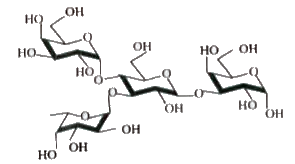
Given below is a branched, substituded o...

Given below is a branched, substituded oligosaccharide in which 'All' represents allyl group. If the number of acetic anhydride molecules require to completely acylate one mole of this compound is 2y, the value of y is

Text Solution

Verified by Experts

The correct Answer is:

6

12 acetates are formed
Promotional Banner

Topper's Solved these Questions

  • CARBOHYDRATES

    AAKASH SERIES|Exercise Practice Sheet-5|30 Videos
  • CARBOHYDRATES

    AAKASH SERIES|Exercise Practice Sheet-3|30 Videos
  • BIOMOLECULES

    AAKASH SERIES|Exercise OBJECTIVE EXERCISE-4 (ASSERTION (A) & REASON (R) TYPE QUESTIONS :)|84 Videos
  • CARBOXYLIC ACIDS

    AAKASH SERIES|Exercise PRACTICE SHEET-4 (Integer Type Questions)|9 Videos

Similar Questions

Explore conceptually related problems

Ideal gas equation is represented as PV=nRT . Gases present in the universe were found ideal n the Boyle's temperature range only. The compressibility factor for an ideal gas, Z= (PV)/(nRT) . The main cause to show deviations were due to wrong assumptions made bout forces of attractions (which becomes significant at high pressure). olume occupied by molecules V, in PV = nRT, is supposed to be volume of as or, the volume of container in which gas is placed by assuming that aseous molecules do not have appreciable volume. Actual volume of the as is that volume in which each molecule of a gas can move freely. If olume occupied by gaseous molecule is not negligible, then the term V hould be replaced by the ideal volume which is available for free motion of ach molecule of gas. Similarly for n moles of gas V_("actual") = V-nb The excluded volume can be calculated by considering bimolecular collisions. The excluded volume is the volume occupied by the sphere of 2r for each pair of molecule. Thus, excluded volume for one pair of molecules = 4/3 pi (2r)^3 = (4 xx 8 pi r^3)/3 The excluded volume for 1 molecule = 2/3 xx 8 pi r^3 = 4 xx (4/3 pi r^3) = 4V The excluded volume for N molecules = 4NV = b (where N is Avogadro's No.) The compressibility factor for N_2 at -50^@C and 800 atm pressure is 1.95. Number of moles of N_2 required to fill a balloon of 100 L capacity is :

If T is the time required by electron in taking one round in an orbit, n represents the number of waves in an orbit, r represents the radius of orbit, then which have the value of 1/2 for 2^(nd) orbit of H and 4^(th) orbit of He^(+) ?

The necessary condition for a molecule to exhibit optical isomerism is dissymmetry or chiral. Thus all organic compounds which contain one as symetric carbon atom are chiral and exist in two stereoisomers. Although the two forms have the same structure, they have different arrangements of groups about the as symmetric carbon. In fact, they represent as symetric molecules. They do not have a plane of symmetry. They are related to each other as an object to its mirror image and are non superimposable. The two structures actually stand for dextro or (+) and leavo or (-) isomers. Since they are related each other as mirror images, they are commonly called enantiomers. Which of the following statements is correct regarding compounds I to III

The necessary condition for a molecule to exhibit optical isomerism is dissymmetry or chiral. Thus all organic compounds which contain one assymetric carbon atom are chiral and exist in two stereoisomers. Although the two forms have the same structure, they have different arrangements of groups about the assymmetric carbon. In fact, they represent assymetric molecules. They do not have a plane of symmetry. They are related to each other as an object to its miror image and are non superimposable. The two structures actually stand for dextro or (+) and leavo or (-) isomers. Since they are related each other as mirror images, they are commonly called enantiomers. Which of the following compounds is optically inactive

The necessary condition for a molecule to exhibit optical isomerism is dissymmetry or chiral. Thus all organic compounds which contain one as symetric carbon atom are chiral and exist in two stereoisomers. Although the two forms have the same structure, they have different arrangements of groups about the as symmetric carbon. In fact, they represent as symetric molecules. They do not have a plane of symmetry. They are related to each other as an object to its mirror image and are non superimposable. The two structures actually stand for dextro or (+) and leavo or (-) isomers. Since they are related each other as mirror images, they are commonly called enantiomers. Consider the following structures A,B,C,D Which of the following statements is not correct

The necessary condition for a molecule to exhibit optical isomerism is dissymmetry or chiral. Thus all organic compounds which contain one assymetric carbon atom are chiral and exist in two stereoisomers. Although the two forms have the same structure, they have different arrangements of groups about the assymmetric carbon. In fact, they represent assymetric molecules. They do not have a plane of symmetry. They are related to each other as an object to its miror image and are non superimposable. The two structures actually stand for dextro or (+) and leavo or (-) isomers. Since they are related each other as mirror images, they are commonly called enantiomers. Consider the following structers A,B,C,D Which of the following statements is not correctConsider the following structers A,B,C,D Which of the following statements is not correct

Hyperconjugation describes the orbital interactions between the p-systems and the adjacent s-bond of the substituent group(s) in organic compounds. Hyperconjugation is also called as Baker and Nathen effect. The necessary and sufficient condition for the hyperconjugation are : i) Compound should have at least on sp2 hybrid carbon of either alkene, carbocation or alkyl free radical. ii) A-carbon with respect to sp2 hybrid carbon should have at least one hydrogen. Hyperconjugation are of three types: (i) s(C-H), p-conjugation. (iii) s(C-H), positive charge conjugation iv) s(C-H), odd electron conjugation The hyperconjugation may be represented as Number of resonating structures due to hyperconjugation = (n + 1) where n is the number of a-hydrogen. Greater is the number of such forms, more is the stability of the species under considersation. Which of the following carbocations will show highest number of Hyperconjugation forms?

Hyperconjugation describes the orbital interactions between the p-systems and the adjacent s-bond of the substituent group(s) in organic compounds. Hyperconjugation is also called as Baker and Nathen effect. The necessary and sufficient condition for the hyperconjugation are : i) Compound should have at least on sp2 hybrid carbon of either alkene, carbocation or alkyl free radical. ii) A-carbon with respect to sp2 hybrid carbon should have at least one hydrogen. Hyperconjugation are of three types: (i) s(C-H), p-conjugation. (iii) s(C-H), positive charge conjugation iv) s(C-H), odd electron conjugation The hyperconjugation may be represented as Number of resonating structures due to hyperconjugation = (n + 1) where n is the number of a-hydrogen. Greater is the number of such forms, more is the stability of the species under considersation. Which of the following carbocations will show highest number of Hyperconjugation forms?

It is not possible to measure the atomic radius precisely since the electron cloud surrounding the atom doesnot have sharp boundary. One practical approach to estimate the size of an atom of a non-metallic element is to measure the distance between two atoms when they are bound together by a single bond in a covalent molecule and then dividing by two. For metals we define the term "metallic radius" which is taken as half the internuclear distance separating the metal cores in the metallic crystal. The vander Waal's radius represents the overall size of the atoms which includes its valence shell in a nonbonded situation. It is the half of the distance between two similar atoms in separate molecules in a solid. The atomic radius decreases across a period and increases down the group. Same trends are observed in case of ionic radius. Ionic radius of the species having same number of electrons depends on the number of protons in their nuclei. The size of iso electronic species -F^(-) , Na^(+) and Mg^(2+) is effected by

AAKASH SERIES-CARBOHYDRATES-Practice Sheet-4
  1. The following carbohydrate is

    Text Solution

    |

  2. Which of the following statements are correct

    Text Solution

    |

  3. Similarities between D(+) Glucose and D(-) Fructose : correct statemen...

    Text Solution

    |

  4. Glucose does not react with

    Text Solution

    |

  5. Consider the following statements, correct statements

    Text Solution

    |

  6. The number of correct statements are

    Text Solution

    |

  7. Which two of the following aldohexoses give the same osazone derivativ...

    Text Solution

    |

  8. D underset((A))("Glucopyranose") underset("dry HCl")overset(MeOH)rarr ...

    Text Solution

    |

  9. D underset((A))("Glucopyranose") underset("dry HCl")overset(MeOH)rarr ...

    Text Solution

    |

  10. D underset((A))("Glucopyranose") underset("dry HCl")overset(MeOH)rarr ...

    Text Solution

    |

  11. Three carbohydrate molecules A, B and C were analysed by a scientist f...

    Text Solution

    |

  12. Three carbohydrate molecules A, B and C were analysed by a scientist f...

    Text Solution

    |

  13. Three carbohydrate molecules A, B and C were analysed by a scientist f...

    Text Solution

    |

  14. Match the following columns

    Text Solution

    |

  15. Match the following columns

    Text Solution

    |

  16. What is the ratio of possible aldohexoses and 2-ketohexoses

    Text Solution

    |

  17. Given below is a branched, substituded oligosaccharide in which 'All' ...

    Text Solution

    |

  18. When methyl -D- glucopyranoside is oxidized with periodic acid, how ma...

    Text Solution

    |

  19. The number of correct statements about the following compound (I)...

    Text Solution

    |

  20. Observe the following reaction and find out that how many number of re...

    Text Solution

    |
