Home
Class 12
PHYSICS
An electron initially at rest falls a di...

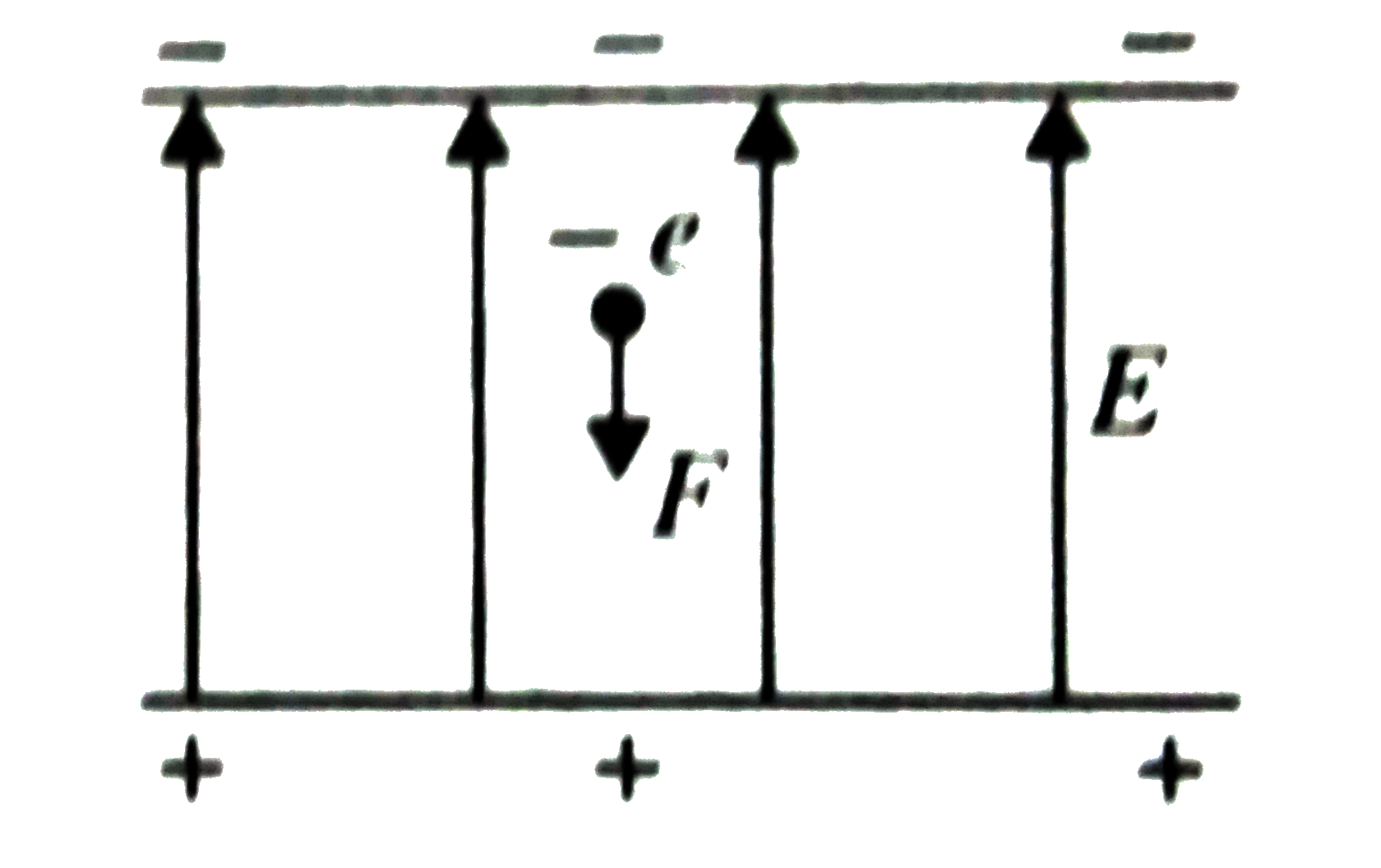
An electron initially at rest falls a distance of 1.5 cm in a uniform electric field of magnitude `2 xx10^(4) N//C`. The time taken by the electron to fall this distance is

A

`1.3xx10^(2)s`

B

`2.1xx10^(-12)s`

C

`1.6xx10^(-10)s`

D

`2.9xx10^(-9)s`

Text Solution

Verified by Experts

The correct Answer is:
D

Here, the direction of field is upward,
So the negatively charged electron experiences a dowanward force.

`therefore` The acceleration of electron is
`a_(e)=(eE)/m_(e)`
The time required by the electron to fall through a distance h is
`t_(e)=sqrt(((2h)/a_(e)))=sqrt((2hm_(e))/(eE))`
`=[(2xx1.5xx10^(-2)xx9.11xx10^(-31))/(1.6xx10^(-19)xx2xx10^(4))]^(1//2)=2.9xx10^(-9)s`
Promotional Banner

Topper's Solved these Questions

  • ELECTRIC CHARGES AND FIELDS

    NCERT FINGERTIPS ENGLISH|Exercise ASSERTION & REASON|15 Videos
  • ELECTRIC CHARGES AND FIELDS

    NCERT FINGERTIPS ENGLISH|Exercise Electric Charges|5 Videos
  • DUAL NATURE OF RADIATION AND MATTER

    NCERT FINGERTIPS ENGLISH|Exercise Assertion And Reason|15 Videos
  • ELECTROMAGNETIC INDUCTION

    NCERT FINGERTIPS ENGLISH|Exercise NCERT Exemplar|6 Videos

Similar Questions

Explore conceptually related problems

An electron falls through a distance of 1.5 cm in a uniform electric field of magnitude 2.0xx10^(4)N//C(Fig.a) Calculate the time it takes to fall through this distance starting from rest. If the direction of the field is reversed (fig .b) keeping its magnitude unchanged , calculate the time taken by a proton to fall through this distance starting from rest.

An electron falls through a distance of 1.5 cm in a uniform electric field of magnitude 2.4xx10^(4) NC^(-1) [Fig.1.12 (a)] . The direction of the field is reversed keeping its magnitude unchagned and a proton falls through the same distance [Fig. 1.12 (b) ]. Complute the time of fall in each case. Contrast the situation (a) with that of free fall under gravity.

An electron falls through a small distance in a uniform electric field of magnitude 2xx10^(4)NC^(-1) . The direction of the field reversed keeping the magnitude unchanged and a proton falls through the same distance. The time of fall will be

An electron falls through a small distance in a uniform electric field of magnitude 2xx10^(4)NC^(-1) . The direction of the field reversed keeping the magnitude unchanged and a proton falls through the same distance. The time of fall will be

An electron (mass m_(e ) )falls through a distance d in a uniform electric field of magnitude E. , The direction of the field is reversed keeping its magnitudes unchanged, and a proton(mass m_(p) ) falls through the same distance. If the times taken by the electrons and the protons to fall the distance d is t_("electron") and t_("proton") respectively, then the ratio t_("electron")//t_("proton") .

An electron (q = 1.6 × 10^(-19) C) is moving at right angles to a uniform magnetic field of 3.534 xx10^(-5) T The time taken by the electron to complete a circular orbit is

A charge of mass .m. charge .2e. is released from rest in a uniform electric field of strength .E.. The time taken by it to travel a distance .d. in the field is

An electron of mass m_(e ) initially at rest moves through a certain distance in a uniform electric field in time t_(1) . A proton of mass m_(p) also initially at rest takes time t_(2) to move through an equal distance in this uniform electric field.Neglecting the effect of gravity, the ratio of t_(2)//t_(1) is nearly equal to

An electron of mass m_(e ) initially at rest moves through a certain distance in a uniform electric field in time t_(1) . A proton of mass m_(p) also initially at rest takes time t_(2) to move through an equal distance in this uniform electric field.Neglecting the effect of gravity, the ratio of t_(2)//t_(1) is nearly equal to

NCERT FINGERTIPS ENGLISH-ELECTRIC CHARGES AND FIELDS-Assertion And Reason
  1. An electron initially at rest falls a distance of 1.5 cm in a uniform ...

    Text Solution

    |

  2. Assertion : When bodies are charged through friction, there is a trans...

    Text Solution

    |

  3. Assertion : When we rub a glass rod with silk, the rod gets positively...

    Text Solution

    |

  4. Assertion : The charge on any body can be increased or decreased in te...

    Text Solution

    |

  5. Assertion : When a body acquires negative charge, its mass decreases. ...

    Text Solution

    |

  6. Assertion. When charges are shared between any two bodies, no charge i...

    Text Solution

    |

  7. Assertion : Coulomb force and gravitational force follow the same inve...

    Text Solution

    |

  8. Assertion: If there exists coulombic attracation between two bodies bo...

    Text Solution

    |

  9. Assertion :The force with which two charges attract or repel each othe...

    Text Solution

    |

  10. Assertion : The electric field due to a discrete charge configuration ...

    Text Solution

    |

  11. Assertion : Protons carrying positive charges are compactly residing i...

    Text Solution

    |

  12. Assertion : In a uniform electric field electrons move in the opposite...

    Text Solution

    |

  13. Assertion : Electrostatic field lines start at positive charges and en...

    Text Solution

    |

  14. Assertion : Surface charge density of an irregularly shaped conductor ...

    Text Solution

    |

  15. Assertion: The whole charge of a conductor cannot be transferred to an...

    Text Solution

    |

  16. Assertion : Total flux through a closed surface is zero if no charge i...

    Text Solution

    |

