Home
Class 10
PHYSICS
In the diagram below, PQ is a ray of lig...

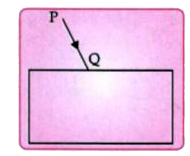
In the diagram below, PQ is a ray of light incident on a rectangular glass block.

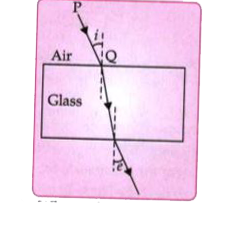
Copy the diagram and complete the path of the ray of light through the glass block. In your diagram, mark the angle of incidence by letter 'i' and the angle of emergence by the letter 'e'.

Text Solution

Verified by Experts
Promotional Banner

Topper's Solved these Questions

  • SAMPLE PAPER 2011

    ICSE|Exercise SECTION-II|41 Videos
  • SAMPLE PAPER 2 (PHYSICAL EDUCATION)

    ICSE|Exercise MULTIPLE CHOICE QUESTIONS|50 Videos
  • SAMPLE PAPER 2012

    ICSE|Exercise SECTION-II|43 Videos

Similar Questions

Explore conceptually related problems

In the diagram below, PQ is a ray of light incident on a rectangular glass block. How are the angles i and 'e' related to each other?

In the adjacent diagram, AO is a ray of light incident on a rectangular glass slab. (a) Complete the path of the ray till it emerges out of the slab. (b) In the diagram, mark the angle of incidence (i) and the angle of refraction (r) at the first interface. how is the refractive index of glass related to the angles i and r ? (c) Mark angle of emergence by the letter e. how are the angles i and e related ? (d) Which two rays are parallel to each other ? Name them (e) Indicate in the diagram the lateral displacement between the emergent ray and the incident ray. state one factor that affects the lateral displacement.

A ray of light falls normally on a rectangular glass slab. Draw a ray diagram showing the path of the ray till it emerges out of the slab.

The diagram alongside shows a light source P embedded in a rectangular glass block ABCD of critical angle 42^@ . Complete the path of the ray PQ till it emerges out of the block. [Write necessary angles.]

Copy the diagram given below and complete the path of the light ray till it emerges out of the prism. The critical angle of glass is 42^(@) . In your diagram mark the angles wherever necessary.

The following diagram shows a 60^(@),30^(@),90^(@) glass prism of critical angle 42^(@) . Copy the diagram and complete the path of incident ray AB emerging out of the prism marking the angle of incidence on each surface.

When a ray of light passes from air to glass, for what angle of incidence, the ray will not be deviated?

A ray of light travels from water to air as shown in the diagram given below: Copy the diagram and complete the path of the ray. Given the critical angle for water is 48^(@) .

In figure, a ray of light PQ is incident normally on the hypotenuse of an isosceles right angled prism ABC. (a) complete the path of the ray PQ till it emerges from the prism. Mark in the diagram the angle wherever necessary. (b) what is the angle of deviation of the ray PQ ? (c) Name a device in which this action is used.

Draw a neat diagram for the passage of a ray of light through an equilateral glass prism, showing clearly (a) angle of incidence (b) angle of emergence ( c ) angle of deviation (d) angle of prism

ICSE-SAMPLE PAPER 2011-SECTION-II
  1. In the diagram below, PQ is a ray of light incident on a rectangular g...

    Text Solution

    |

  2. What do you understand by an ideal machine ? How does it differ from a...

    Text Solution

    |

  3. Write a relationship between the mechanical advantage (M. A.) and velo...

    Text Solution

    |

  4. A coolie carrying a load on his head and moving on a frictionless hori...

    Text Solution

    |

  5. Draw a diagram to show the energy changes in an oscillating simple pen...

    Text Solution

    |

  6. A uniform metre scale can be balanced at the 70.0 cm mark when a mass ...

    Text Solution

    |

  7. A uniform metre scale can be balanced at the 70.0 cm mark when a mass ...

    Text Solution

    |

  8. State the laws of refraction of light. State at least three examples o...

    Text Solution

    |

  9. Write a relation between the angle of incidence (i), angle of emerge...

    Text Solution

    |

  10. Suggest one way, in each case, by which we can detect the presence of:...

    Text Solution

    |

  11. State any one use of infrared radiations.

    Text Solution

    |

  12. An object is placed in front of a lens between its optical centre and ...

    Text Solution

    |

  13. An object is placed in front of a lens between its optical centre and ...

    Text Solution

    |

  14. Name the type of waves which are used for sound ranging.

    Text Solution

    |

  15. Why are these waves mentioned in (i) above, not audible to us?

    Text Solution

    |

  16. Give one use of sound ranging.

    Text Solution

    |

  17. A man standing 25 m away from a wall produces a sound and receives the...

    Text Solution

    |

  18. A man standing 25 m away from a wall produces a sound and receives the...

    Text Solution

    |

  19. Name two safety devices which are connected to the live wire of a hous...

    Text Solution

    |

  20. Give one important function of each of these two devices. i) Switch ii...

    Text Solution

    |

  21. Draw a graph of Potential difference (V) versus Current (I) for an ohm...

    Text Solution

    |

