Home
Class 12
PHYSICS
A cubical region of side a has its centr...

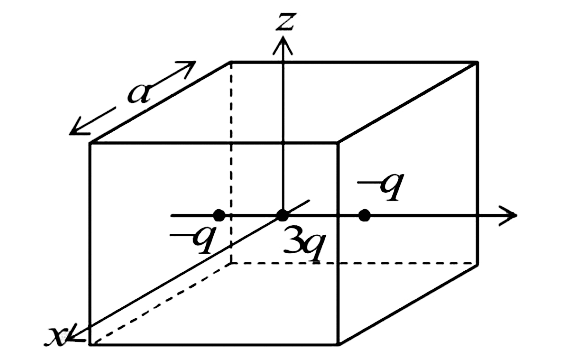
A cubical region of side a has its centre at the origin. It encloses three fixed point charges, `-q` at `(0,-a//4,0)`, `+3q` at `(0, 0, 0)` and `-q` at `(0, +a//4, 0)`. Choose the correct options(s)

A

The net electric flux crossing the plane `x = +a//2` is equal to the net electric flux crossing the plane ` x = -a//2` .

B

The net electric flux crossing the plane `y = +a//2` is more than the net electric flux crossing the plane ` y = -a//2`.

C

The net electric flux crossing the entire origin is `q//epsilon_0`.

D

The net electric flux crossing the plane `z = +a//2` is equal to the net electric flux crossing the plane `x = +a//2` .

Text Solution

Verified by Experts

Position of all the charges are symmetric about the planes `x = + a//2` and `x = - a//2`. So net electric flux then will be same. Similarly, flux through `y = + a//2`is equal to flux through `y = - a//2`/
`phi = (q_("in))/(epsilon_(0)) = (3q - q - q)/(epsilon_(0)) = (q)/(espilon_(0))`
By symmetry flux through `z = + q//2` is equal to flux through `x = + q//2`
Promotional Banner

Similar Questions

Explore conceptually related problems

A regular hexagon of side a has a charge Q at each vertex. Potential at the centres of hexagon is (k= (1/4piepsilon_0) )

A circle has its centre at the origin and a point P (5,0) lies on it . The point Q (6,8) lies outside the circle.

A point charge q_1 = -1.0 muC is held stationary at the origin. A second point charge q_2 = + 2.0 muC moves from the point (1.0 m, 0, 0) to (2.0 m, 0, 0) . How much work is done by the electric force on q_2 ?

Consider a spherical surface of radius 4 m cenred at the origin. Point charges +q and - 2q are fixed at points A( 2 m, 0,0) and B( 8 m, 0, 0), respectively. Show that every point on the shperical surface is at zero potential.

Consider a spherical surface of radius 4 m cenred at the origin. Point charges +q and - 2q are fixed at points A( 2 m, 0,0) and B( 8 m, 0, 0), respectively. Show that every point on the shperical surface is at zero potential.

A charge of 8 mC is located at the origin. Calculate the work done in taking a small charge of -2xx10^(-9) from a point P(0, 0, 3cm) to a point Q (0, 4cm, 0) via a point R(0, 6cm, 9cm).

A point charge q_1 =-5.8muC is held stationary at the origin. A second point charge q_2=+4.3muC moves from the point (0.26m 0,0) to (0.38m, 0, 0) . How much work is done by the electric force on q_2 ?

A point charge q_1 =-5.8muC is held stationary at the origin. A second point charge q_2=+4.3muC moves from the pont (0.26m 0,0) to (0.38m, 0, 0) . How much work is done by the electric force on q_2 ?

Two point charges q and –q are at positions (0,0,d) and (0,0, –d) respectively . What is the electric field at (a,0,0 ) ?

Two point charges q and –q are at positions (0,0,d) and (0,0, –d) respectively . What is the electric field at (a,0,0 ) ?

