Home
Class 11
PHYSICS
An ideal gas is taken from the state A (...

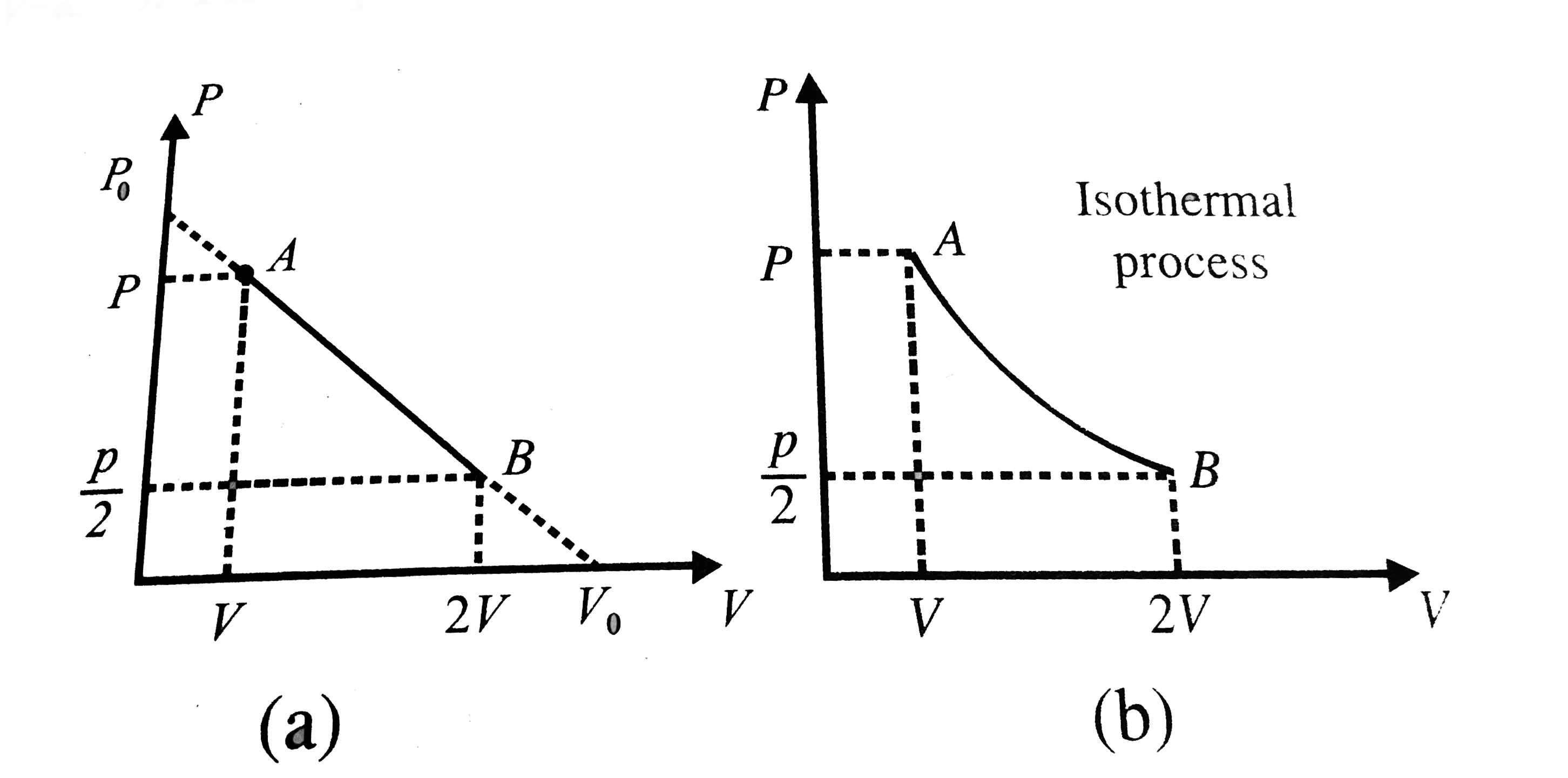
An ideal gas is taken from the state A (pressure p, volume V) to the state B (pressure `p/2`, volume 2V) along a straight line path in the p-V diagram. Select the correct statement(s) from the following.

A

The work done by the gas in process A to B exceeds the work that would be done by it if F62the system were taken from A to B along the isotherm.

B

In the T-V diagram, the path AB becomes a part of a parabola.

C

In the P-T diagram, the path AB becomes a part of a hyperbola.

D

In going from A to B, the temperature T of the gas first increases to a maximum value and then decreases.

Text Solution

Verified by Experts

The correct Answer is:
A, B, D

Work done by the gas in the process `A` to `B` exceeds the work that would be done by it if the system were taken from `A` to `B` along the isotherm. This is because the work done is the area under the `P-V` inicator diagram will be more than that in the second diagram. When we extrapolate the graph shown in fig let `P_(0)` be theh intercept on the `P`-axis and `V_(0)` be the intercept on the `V`-axis. The equation of the line `AB` can be written as

`P=-(P_(0))/(V_(0))V+P_(0)` , `[:. y=mx+c]` (i)
To find a relationship between `P` and `T` , we use
`PV=RT implies V=(RT)/(P)` (ii)
From Eqs. (i) and (ii),
`p=-(P_(0))/(V_(0))xx(RT)/(P)+P_(0)`
`implies P^(2)V_(0)-PP_(0)V_(0)=-P_(0)RT` (iii)
Relation between `P` and `T` is the equation of a parabola.
Also `PV=RT`
`:. P=(RT)/(V)` (iii)
From Eqs. (i) and (ii),
`(RT)/(V)=-(P_(0))/(V_(0))V+P_(0)`
`implies Rt=-(p_(0))/(v_(0))v^2+p_(0)V` (iv)
The above equation is of a parabola (between `T` and `V`)
`T=-(P_(0))/(V_(0)R)V^(2)+(P_(0))/(R)V`
Differentiating the above equation w.r.t. `V` we get
`(dT)/(dV)=-(P_(0))/(V_(0)R)xx2V+(P_(0))/(R)`
when `(dT)/(dV)=0` ,
then `(P_(0))/(V_(0)R)xx2V=(P_(0))/(R)` `implies V=(V_(0))/(2)`
Also `(d^(2)T)/(d^(2)V)=(-2P_(0))/(V_(0)R)=-ve`
`implies V=V_(0)//2` is the value of maximum of temperature
Also `P_(A)V_(A)=P_(B)V_(B) implies T_(A)=T_(B)` (From Boyle's law)
`implies` In going from `A` and `B` , the temperature of the gas first inceases to a maximum (at `V=V_(0)//(2)` and the decreases and reaches back to the same value.
Promotional Banner

Topper's Solved these Questions

  • ARCHIVES 1 VOLUME 6

    CENGAGE PHYSICS ENGLISH|Exercise Assertion-Reasoning|1 Videos
  • ARCHIVES 1 VOLUME 6

    CENGAGE PHYSICS ENGLISH|Exercise Comprehension|3 Videos
  • ARCHIVES 1 VOLUME 6

    CENGAGE PHYSICS ENGLISH|Exercise Single Correct|54 Videos
  • ARCHIVES 2 VOLUME 6

    CENGAGE PHYSICS ENGLISH|Exercise Integer|4 Videos

Similar Questions

Explore conceptually related problems

The pressure and volume of a gas are changed as shown in the p-V diagram in the figrue ahead. The thmperature of the gas

The pressure p and volume V of an ideal gas both increase in a process.

An ideal monatomic gas is at P_(0), V_(0) . It is taken to final volume 2V_(0) when pressure is P_(0)//2 in a process which is straight line on P -V diagram. Then

An ideal gas has pressure P, volume V and temperature T. Select the correct option.

The pressure P and volume V of an ideal gas both decreases in a process.

One mole of an ideal gas is taken from state A to state B by three different processes (a) ACB , (b) ADB and (c ) AEB as shown in the P - V diagram. The heat absorbed by the gas is

One mole of an ideal gas is taken from state A to state B by three different processes (a) ACB , (b) ADB and (c ) AEB as shown in the P - V diagram. The heat absorbed by the gas is

An ideal gas undergoes an expansion from a state with temperature T_(1) and volume V_(1) through three different polytropic processes A, B and C as shown in the P - V diagram. If |Delta E_(A)|, |Delta E_(B)| and |Delta E_(C )| be the magnitude of changes in internal energy along the three paths respectively, then :

P - V diagram of an ideal gas is shown. The gas undergoes from initial state A to final state B such that initial and final volumes are same. Select the correct alternative for given process AB.

The state of a mole of an ideal gas changed from state A at pressure 2P and volume V follows four different processes and finally returns to initial state A reversibly as shown below in the graph. By interpreting the graph, answer the following questions. Which is the kind of process followed from state A to state, B ?

