


Home
Class 12
CHEMISTRY
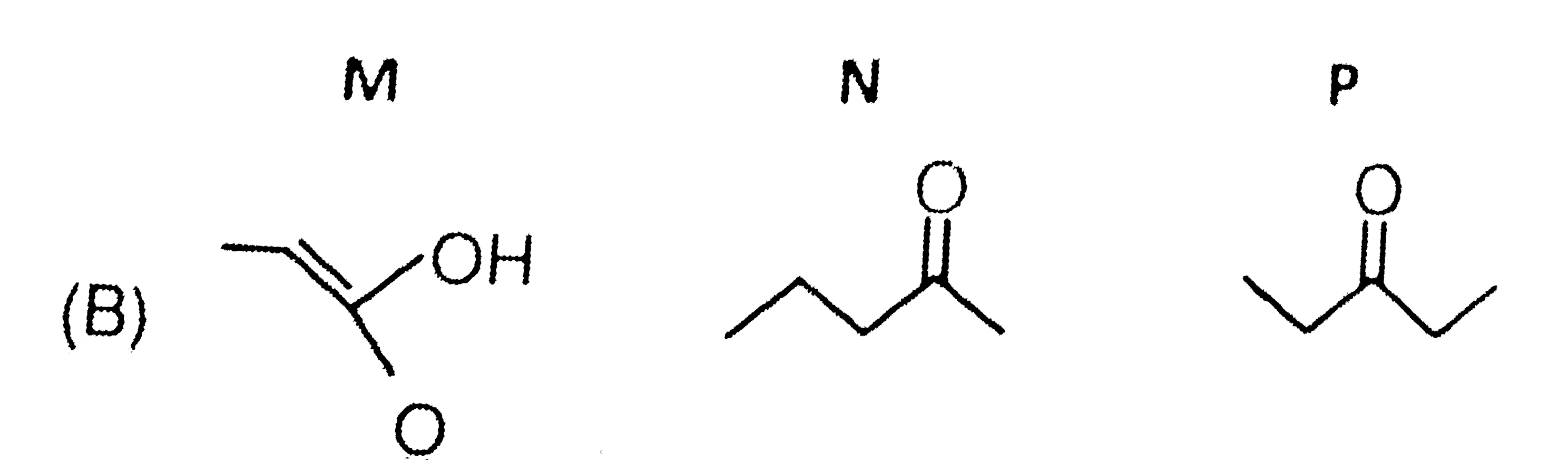
Three isometic compounds M,N and P (C(5)...

Three isometic compounds M,N and P `(C_(5)H_(10)O)` give the following tests
(i) M and P react with sodium bisulfite to form an adduct J
(ii) N Comsumes I mol of bromine and also gives turbidity with conc. HCl/anhydrous `ZnCl_(2)` after prolong heating
(iii) M reacts with excess of iodine in alkaline solution to give yellow crystalline compound with a characterstics smell.
(iv) p-Rosaniline treated with sulphur dioxide develops pink colour on shaking with P the structure of M,N and P, respectively are

A

B

C

D

Text Solution

AI Generated Solution

The correct Answer is:

To solve the problem, we need to analyze the information given about the three isomeric compounds M, N, and P (C5H10O) based on the tests they undergo. ### Step-by-Step Solution: 1. **Identifying Compound M:** - **Test:** M and P react with sodium bisulfite to form an adduct J. - **Conclusion:** This indicates that both M and P contain a carbonyl group (aldehyde or ketone). 2. **Identifying Compound N:** - **Test:** N consumes 1 mol of bromine and gives turbidity with concentrated HCl/anhydrous ZnCl2 after prolonged heating. - **Conclusion:** The consumption of bromine suggests that N has a double bond (alkene) or an alcohol group. The turbidity with ZnCl2 indicates that N is likely an alcohol, specifically a secondary or tertiary alcohol, which can react with ZnCl2 to form an alkyl halide. 3. **Identifying Compound M (continued):** - **Test:** M reacts with excess iodine in alkaline solution to give a yellow crystalline compound with a characteristic smell. - **Conclusion:** This indicates that M is a methyl ketone, which can undergo the iodoform reaction to form a yellow precipitate (iodoform). 4. **Identifying Compound P:** - **Test:** P-rosaniline treated with sulfur dioxide develops a pink color on shaking with P. - **Conclusion:** This reaction is characteristic of aldehydes, indicating that P is likely an aldehyde. ### Structures of Compounds M, N, and P: - **Compound M:** Methyl ketone, likely 3-pentanone (CH3COCH2CH2CH3). - **Compound N:** A secondary or tertiary alcohol, likely 2-pentanol (CH3CH(OH)CH2CH2CH3). - **Compound P:** An aldehyde, likely pentanal (CH3(CH2)3CHO). ### Final Structures: - **M (3-pentanone):** CH3COCH2CH2CH3 - **N (2-pentanol):** CH3CH(OH)CH2CH2CH3 - **P (pentanal):** CH3(CH2)3CHO ### Summary: - The structures of M, N, and P are: - M: 3-Pentanone - N: 2-Pentanol - P: Pentanal
Promotional Banner

Topper's Solved these Questions

  • CARBONYL COMPOUNDS (ALDEHYDES & KETONES ) & CARBOXYLIC ACID

    RESONANCE ENGLISH|Exercise Part -III|31 Videos
  • CARBONYL COMPOUNDS (ALDEHYDES & KETONES ) & CARBOXYLIC ACID

    RESONANCE ENGLISH|Exercise Part -IV|23 Videos
  • CARBONYL COMPOUNDS (ALDEHYDES & KETONES ) & CARBOXYLIC ACID

    RESONANCE ENGLISH|Exercise APSP|1 Videos
  • BIOMOLECULES & POLYMER

    RESONANCE ENGLISH|Exercise ORGANIC CHEMISTRY(Biomolecules & Polymer)|34 Videos
  • CHEMICAL KINETICS

    RESONANCE ENGLISH|Exercise PHYSICAL CHEMITRY (CHEMICAL KNIETICS & RADIOACTIVITY)|49 Videos

Similar Questions

Explore conceptually related problems

From amongest the following alcohols, the one that would react fastest with conc. HCl and anhydrous ZnCl_(2) is

p-cresol reacts with chloroform in alkaline medium to give the compound A which adds hydrogen cyanide to form, the compound B. the latter on acidic hydrolysis gives chiral caboxylic acid. The structure of the carboxylic acid is

X' compound (C_(4)H_(8)O) decolorises bromine water react with I_(2) & NaOH it give yellow ppt identify 'X'

A compound (C_(5)H_(8)) reacts with ammoniacal AgNO_(3) to give a white precipitate and reacts with excess of KMnO_(4) solution to give (CH_(3))_(2)CH-COOH . The compound is

A compound P(C_(5)H_(6)) gives positive Bayer test and on hydrogentation from a hydrocarbon B(C_(5)H_(10)) which gives only monochloro product. The compound 'P' is.

A compound D(C_(8)H_(10)O) upon treatement with alkaline solution of iodine gives a yellow precipitate. The fibtrate on acidification gives a white solid E(C_(7)H_(6)O_(2)) . Write the structures of D,E .

A colourless liquid A(b.p. 184^(@)C) is sparingly soluble in warm water to which it gives feebly alkaline. On treating with NaNO_(2) and dil HCl in the cold solution, it yields a solution which reacts with an alkaline solution of beta -naphthol to give an orange yellow precipitate. Compound A is -

A compound (A) C_(5)H_(10) Cl_(2) on hydrolysis gives C_(5)H_(10)O which reacts with NH_(2)OH , forms iodoform but does not give Fehling test (A) is :

RESONANCE ENGLISH-CARBONYL COMPOUNDS (ALDEHYDES & KETONES ) & CARBOXYLIC ACID -Part -II
  1. Compound "X" undergoes the following sequences of reactions to form "Y...

    Text Solution

    |

  2. The product ("X") of the following sequences of reactions is

    Text Solution

    |

  3. Three isometic compounds M,N and P (C(5)H(10)O) give the following tes...

    Text Solution

    |

  4. Give the structure of 4-Hydroxy-4-methylpentanal

    Text Solution

    |

  5. Compound "X" in the following reaction is

    Text Solution

    |

  6. Compound "X" in the following reaction is

    Text Solution

    |

  7. Compound 'P' that undergoes the sequence of reactions given below to g...

    Text Solution

    |

  8. The major product of the following reaction is

    Text Solution

    |

  9. The reaction , RCH(2)CH(2)COOH overset("Red P") underset(Br(2)) to R ...

    Text Solution

    |

  10. Formic acid and acetic acid can be distinguished with

    Text Solution

    |

  11. One of the product formed in the electrolysis of sodium salt of succin...

    Text Solution

    |

  12. The compound that gives a lactone on heating is

    Text Solution

    |

  13. The compound that undergoes decarboxylation most readily under mild co...

    Text Solution

    |

  14. The most unstable compounds fo the following are :

    Text Solution

    |

  15. The product obtained when propanamide is distilled with phosphorous pe...

    Text Solution

    |

  16. The product B of the following sequence of reactions is C(6)H(5)CONH...

    Text Solution

    |

  17. What is the major product obtained from the following reactions ? HO...

    Text Solution

    |

  18. What is the major product obtained from the following reactions ? CH...

    Text Solution

    |

  19. The compound X(C(7)H(9)N) reacts with benzensulfonyl chloride to give ...

    Text Solution

    |

  20. CH(3)CH(2)CH(OH)CH(CH(3))(2)+CH(3)COCI overset("base")rarr CH(3)CH(2)C...

    Text Solution

    |
