Home
Class 12
PHYSICS
The mass of hydrogen molecule is 3.32xx1...

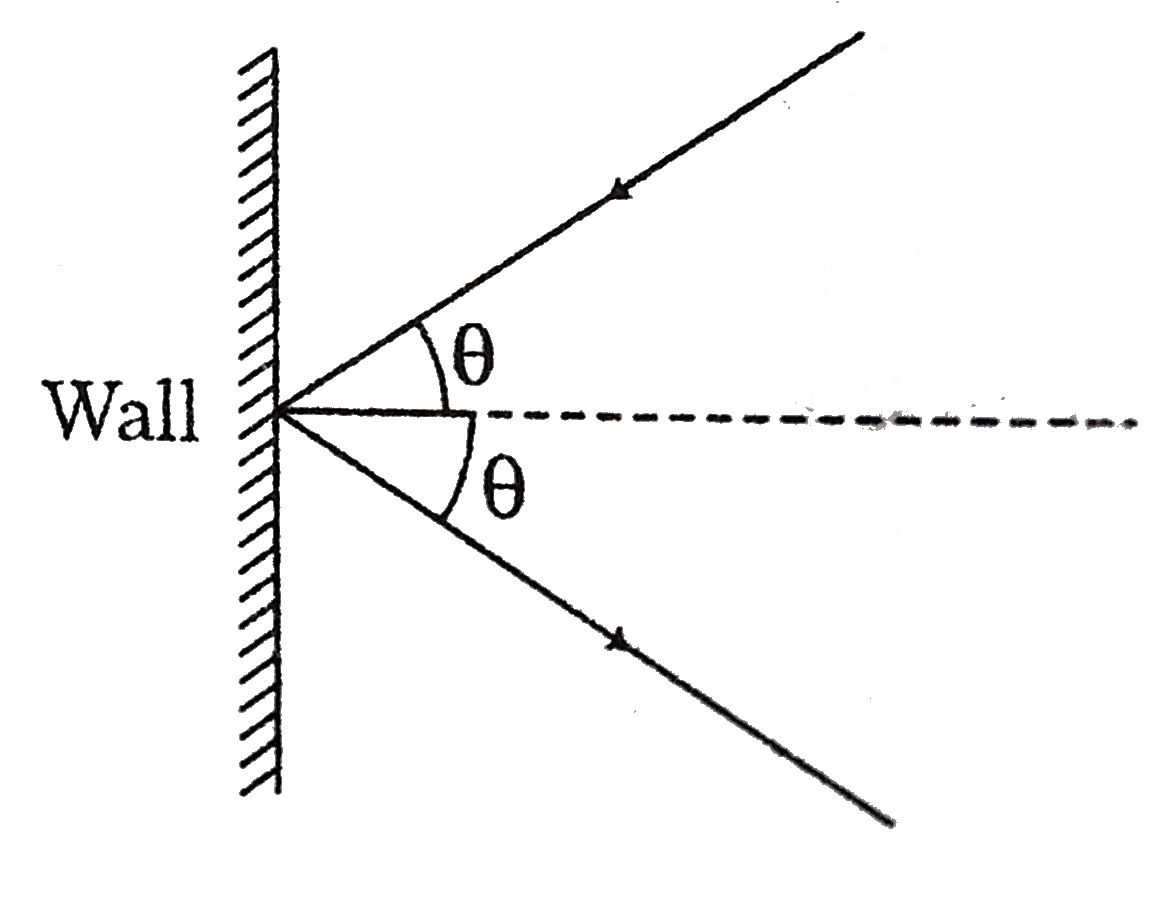
The mass of hydrogen molecule is `3.32xx10^(-27)` kg. If `10^(23)` hydrogen molecules strick per second at 2 `cm^(2)` area of a rigid wall at an angle of `45^(@)` from the normal and rebound back with a speed of 1000 `ms^(-1)`, then the pressure exerted on the wall is

Text Solution

Verified by Experts

As the impact is elastic ` therefore |vec(p)_(1)| = |vec(p)_(2)|`= p= mv = `3.32xx10^(-24) kg m//s`
The change in momentum along the normal `Deltap= |vec(p)_(2) - vec(p)_(1)| = 2p "cos"45^(@) = sqrt(2)p`
If f is the collision frequency then force applied on the wall `F= (Deltap)/(Deltat) = Deltap xx f = sqrt(2)pf`
` therefore Pressure P=F/A = (sqrt(2)pf)/(A) = (sqrt(2) xx 3.32 xx 10^(-24) xx 10^(23))/(2xx10^(-4)) = 2.347xx10^(3)N//m^(2)`
Promotional Banner

Topper's Solved these Questions

  • GEOMETRICAL OPTICS

    ALLEN |Exercise SOME WORKED OUT EXAMPLES|84 Videos
  • GEOMETRICAL OPTICS

    ALLEN |Exercise EXERCISE -01|65 Videos
  • CURRENT ELECTRICITY

    ALLEN |Exercise EX.II|66 Videos
  • GRAVITATION

    ALLEN |Exercise EXERCISE 4|9 Videos

Similar Questions

Explore conceptually related problems

10^(23) molecules of a gas strike a target of area 1 m^(2) at angle 45^(@)C to normal and rebond elastically with speed 1 kms^(1) . The impulses normal to wall per molecule is " - [Given : mass of molecule = 3.32 xx 10 ^(-27)kg ]

A molecule in a gas container hits a horizontal wall with speed 200 ms^(-1) and " angle " 30^(@) with the normal , and rebounds with the same speed . Is momentum conserved in the collision ? Is the collision elastic or inelastic ?

In a hydrogen atom, the electron is moving in a circular orbit of radius 5.3 xx 10^(-11) m with a constant speed of 2.2 xx 10^(6) ms^(-1) . The electric current formed due to the motion of electron is ......

One gram mole of oxygen at 27^@ and one atmospheric pressure is enclosed in vessel. (i) Assuming the molecules to be moving the V_(rms) , Find the number of collisions per second which the molecules make with one square metre area of the vessel wall. (ii) The vessel is next thermally insulated and moved with a constant speed V_0 . It is then suddenly stopped. The process results in a rise of the temperature of the gas by 1^@C . Calculate the speed V_0 .

A thick rope of density 1.5 xx 10 ^(3) kg m ^(-3) and Young's modulus 5 xx 10 ^(6) Nm ^(-2), 8 m in length when hung from the ceiling of room the increase in its length due to its own weight is .......... (g = 10 ms ^(-2))

One end of a light spring of natural length 4m and spring constant 170 N/m is fixed on a rigid wall and the other is fixed to a smooth ring of mass (1)/(2) kg which can slide without friction in a verical rod fixed at a distance 4 m from the wall. Initially the spring makes an angle of 37^(@) with the horizontal as shown in figure. When the system is released from rest, find the speed of the ring when the spring becomes horizontal.

Figure Show plot of PV//T versus P for 1.00xx10^(-3) kg of oxygen gas at two different temperatures. (a) What does the dotted plot signify? (b) Which is true: T_(1) gt T_(2) or T_(1) lt T_(2) ? (c) What is the value of PV//T where the curves meet on the y-axis? (d) If we obtained similar plots for 1.00xx10^(-3) kg of hydrogen, would we get the same value of PV//T at the point where the curves meet on the y-axis? If not, what mass of hydrogen yields the same value of PV//T (for low pressure high temperature region of the plot) ? (Molecular mass of H_(2) = 2.02 u, of O_(2) = 32.0 u, R= 8.31Jmol^(-1)K^(-1).)

A Rubber Ball Rebound A rubber ball of mass 2.0kg falls to the floor. The ball hits with a speed of 8m/s and rebounds with approximately the same speed. High speed photographs show that the ball is in contact with the floor for 10^-3s. What can we say about the force exerted on the ball by the floor?

The oxygen molecule has a mass of 5.30xx10^(-26)kg and a moment of inertia of 1.94xx10^(-46 )kgm^(2) about an axis through its centre perpendicular to the lines joining the two atoms. Suppose the mean speed of such a molecule in a gas is 500 m/s and that its kinetic energy of rotation is (2)/(3) of its kinetic energy of translation. Find the average angular velocity of the molecules.

A fully loaded boeing aircraft has a mass of 3.3xx10^(5)kg . Its total wing area is 500m^(2) .It is in level flight with a speed of 96.km//h . (a) Estimate the pressure difference between the lower and upper surfaces of the wings . (b) Estimate the fractional increase in the speed of the air on the upper surface of the wing relative to the lower surface. (The density of air is rho=1.2kgm^(-3))(g=9.8ms^(-2))

