Home
Class 12
PHYSICS
The force acting on a body moving along ...

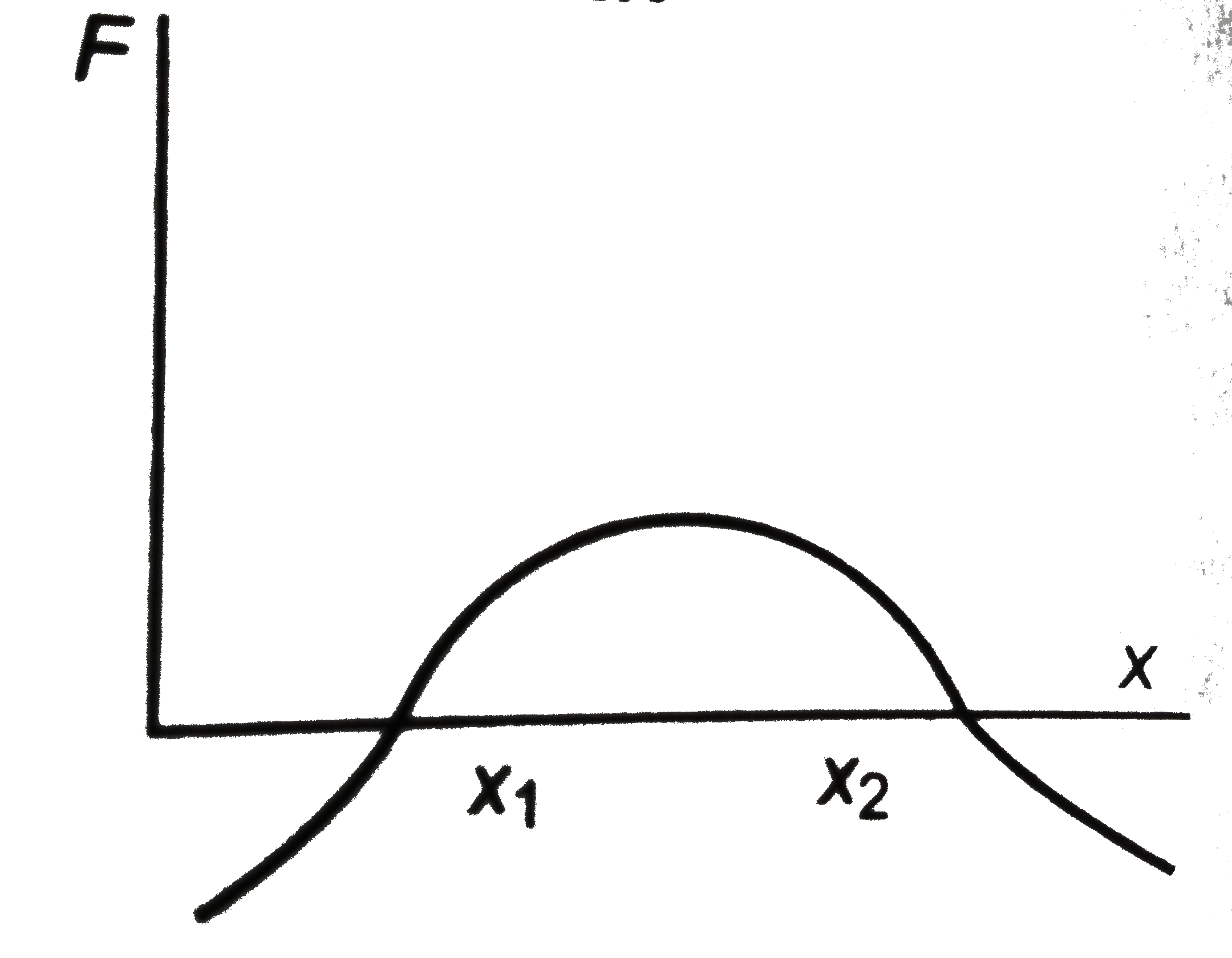
The force acting on a body moving along x-axis varies with the position of the particle shown in the figure. The body is in stable equilibrium at
.

A

`x = x _(1)`

B

`x = x _(2)`

C

both `x _(1) and x _(2)`

D

neither `x _(1) and x _(2)`

Text Solution

Verified by Experts

The correct Answer is:

B

Conservative force is equal to negative gradient of potential energy function, so `F =- (dU)/(dx)`
It means slope of potential energy curve is equal to negative of conservative force.
Now, for stable equilibrium
`(d ^(2) U )/( dx ^(2)) = (d)/(dx) ((dU )/(dx )) = ` Positive
i.e. About position of stable equilibruim the rate of change of slope of potential energy curve with respect to x must be positive. Now
(i) Just before `x_(2):`
Force is positive, so slope of potential energy curve is negative
(ii) At `x _(2):`
Force is zero so slope of potential energy curve is zero.
(iii) Just after `x_(2) :`
Force is negative so slope of potential energy curve is positive.
It means about `x_(2)` rate of change of slope of potential energy curve bis positive.
Promotional Banner

Topper's Solved these Questions

  • NTA TPC JEE MAIN TEST 51

    NTA MOCK TESTS|Exercise PHYSICS |30 Videos
  • NTA TPC JEE MAIN TEST 53

    NTA MOCK TESTS|Exercise PHYSICS |30 Videos

Similar Questions

Explore conceptually related problems

The force acting on a body moving along x -axis varies with the position of the particle as shown in the fig. The body is in stable equilibrium at.

The variation of potential energy U of a body moving along x - axis varies with its position (x) as shown in figure The body is in equilibrium state at

The variation of potential energy U of a body moving along x - axis varies with its position (x) as shown in figure The body is in equilibrium state at

The force acting on a body moving along X-axis varies as shown.Its stable equilibrium position is :

The kinetic energy of a body moving along a straight line varies with time as shown in figure. The force acting on the body:

The velocity (upsilon) of a particle moving along X-axis varies with its position x as shown in figure. The acceleration (a) of particle varies with position (x) as

The kinetic energy K of a particle moving along x - axis varies with its position (x) as shown in figure The magnitude of force acting on particle at x = 9 mis

The magnitude of force acting on a particle moving along x-axis varies with time (t) as shown in figure. If at t = 0 the velocity of particle is v_(0) , then its velocity at t=T_(0) will be

NTA MOCK TESTS-NTA TPC JEE MAIN TEST 52-PHYSICS
  1. The value of magnetic field at O is

    Text Solution

    |

  2. The surface tension of soap solution is 0.03 N//m . The work done in b...

    Text Solution

    |

  3. Diameter of plano-convex lens is 6 cm and thickness at the centre is 3...

    Text Solution

    |

  4. To increase both the resolving power and magnifying power of a telecsc...

    Text Solution

    |

  5. Three identical thin rods each of length l and mass M are joined toget...

    Text Solution

    |

  6. Find the moment of inertia of the system of three solid spheres of mas...

    Text Solution

    |

  7. The fall in temperature of helium gas initially at 20^(@) when it is...

    Text Solution

    |

  8. Two periodic waves of intensities I(1) and I(2) pass through a region ...

    Text Solution

    |

  9. The force acting on a body moving along x-axis varies with the positio...

    Text Solution

    |

  10. Power applied to a particle varies with time as P =(3t^(2)-2t + 1) wat...

    Text Solution

    |

  11. Find the ratio of the respective kinetic energies of a photon to that ...

    Text Solution

    |

  12. What is the peak voltage (in V) of the modulating signal that modulate...

    Text Solution

    |

  13. Consider a mole of a monoatomic gas which occupies a volume of 100 c. ...

    Text Solution

    |

  14. The magnetic field at the point of intersection of diagonals of a squa...

    Text Solution

    |

  15. The wavelength of light used in a biprism experiment is 6000 Å and Io ...

    Text Solution

    |

  16. Consider a pair of identical pendulums, which oscillates with equal am...

    Text Solution

    |

  17. We would like to find a relation between mass of black hole and the ar...

    Text Solution

    |

  18. Relation for a bubble is PV = C pi T r ^(2). Find the value of C if r...

    Text Solution

    |

  19. A solid rod is just fits between two walls having gap of 2m. If the te...

    Text Solution

    |

  20. Two rigid boxes are initially placed separately on a table, box A cont...

    Text Solution

    |
