Home
Class 11
PHYSICS
Three rods of material X and three rods ...

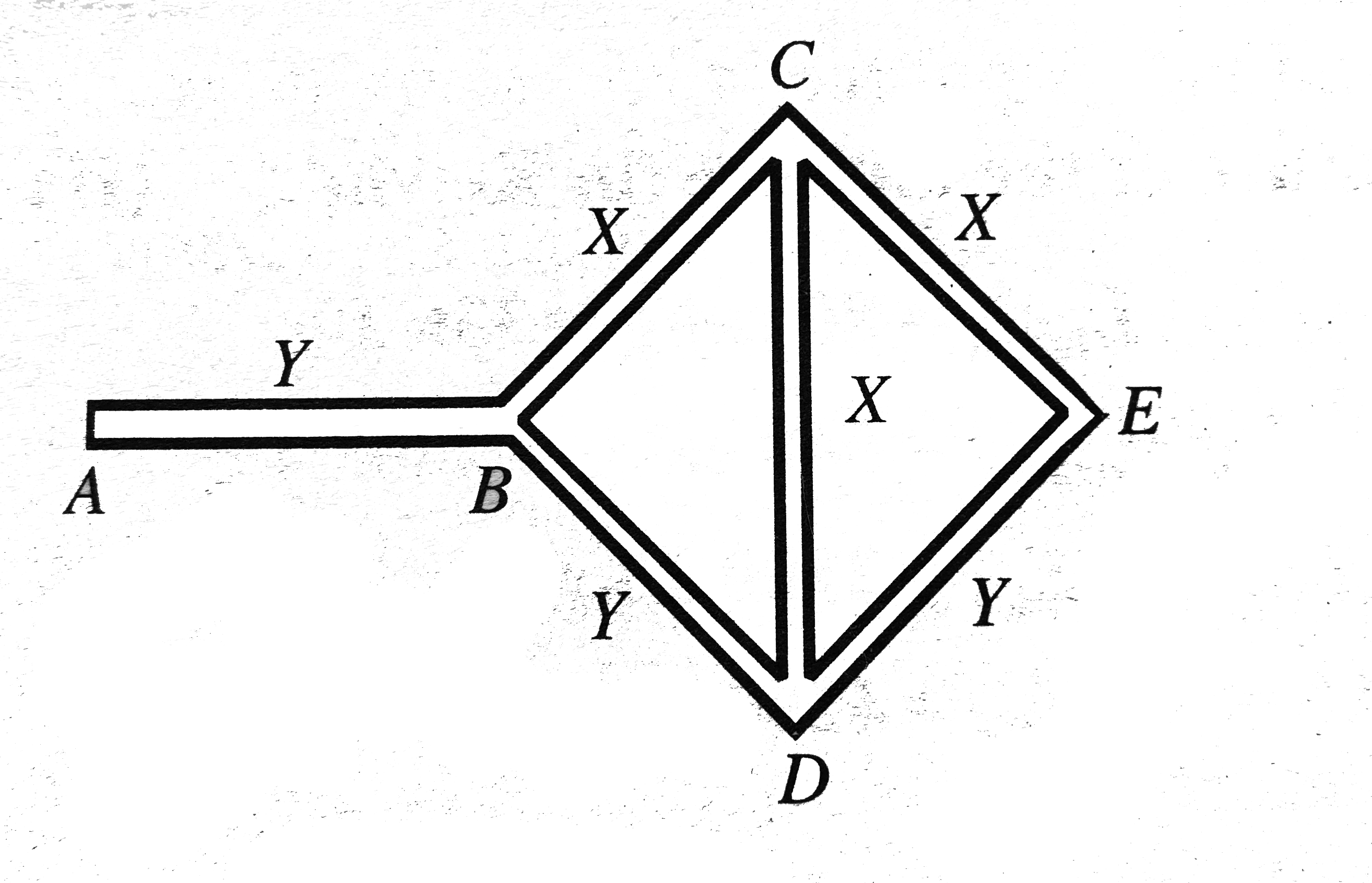
Three rods of material X and three rods of material Y are connected as shown in Fig. 1.62. All the rods are of identical lengths and cross-sectional areas, If the rod are of idnetical lengths and cross-sectional areas. If the rod end A is maintained at 60^(@)C` and the jucntion E at `10^(@)C`, calculate the temperature of jusnction B, C and D, the thermal conductivity of X is `9.2xx10^(-2)"kcal"//m//^(@)C` and that of Y is `4.6xx10^(-2) "kcal"//m//s//^(@)C`.

Text Solution

Verified by Experts

Let `theta_(B), theta_(C)` and `theta_(D)` be the temperature of junction B,C and D respectively at staady state . Let `K_(x)` and `k_(y)`
be thermal conductivites of rods of material X and Y respectively .
The concept in solving the problem is that in steady state heat entering per second at any junction must be equal to that leaving the junction.

As `K_(x) = 9.2 xx 10^(-2)`
ans `K_(y) = 4.6 xx 10^(-2) kilocal m^(-1) (""^(@)C)^(-1) (sec)^(-1)`
i.e.., `(K_(x))/(K_(y)) = (9.2 xx 10^(-2))/(4.6 xx 10^(-2)) 2 `
Let `K_(x) = 2K, K_(y) = K`
(or) `(K_(y)A(60-theta_(B)))/(l) = (K_(x)A(theta_(B) - theta_(C)))/(l) + (K_(y) A(theta_(B) - theta_(C)))/(l)`
(or) `K (60 - theta_(B)) = 2K(theta_(B) - theta_(C)) + K(theta_(b) - theta_(D)) therefore (60-theta_(B)) = 2(theta_(B) - theta_(C)) + theta_(B) - theta_(D)`
`therefore 4 theta_(B) - 2 theta_(C) - 2 theta_(D) = 60...........(1)`
For junction `C_(1),H_(1) = H_(3) + H_(5) therefore (K_(y)A(theta_(B) - theta_(C)))/(l) = (K_(x)A(theta_(c) - 10))/(l) + (k_(y)A(theta_(D) - 10))/(l)`
This gives `therefore theta_(B) - 3 theta_(C) + theta_(D) = - 10..........(2)`
For junction D, `H_(2) + H_(3) = H_(5) therefore (k_(y) A(theta_(B) - theta_(D)))/(l) + (k_(y)A(theta_(C) - theta_(D)))/(l) = (k_(y) A(theta_(D) - 10))/(l)`
(or) ` K(theta_(B) - theta_(D)) + 2K(theta_(C) - theta_(D)) = k(theta_(D) - 10)`
This gives `theta_(B) + 2theta_(C) - 4 theta_(D) = - 10..............(3)` from (2) and (3)
`theta _(B)-3theta_(C) - theta_(D) = theta_(B) + 2 theta_(C) - 4 theta_(D)`
i.e., `5theta_(C) = 5 theta_(D) " " or " " theta_(C) = theta_(D) ............(4)` Substituting this in (1) and (2), we get .
` 4 theta_(B) - 3 theta_(C) = 60.............(5) , theta_(B) - 2theta_(C) = - 10............(6)`
Solving (5) and (6) , we get `theta_(B) = 30^(@)C, theta_(C) = 20^(@)C`
As `theta_(c) = theta_(D) " " therefore " " theta_(C) = theta_(D) = 20^(@)C`
`therefore` Thus the temperature of junction , B, C and D are `30^(@),20^(@)C and 20^(@)C` respectively.
Promotional Banner

Similar Questions

Explore conceptually related problems

Three rods of material X and three rods of material Y are connected as shown in the figure. All the rods are of identical length and cross-sectional area. If the end A is maintained at 60^@C and the junction E at 10^@C . Calculate the temperature of the junction B, C and D. The thermal conductivity of X is 0.92cal//sec-cm^@C and that of Y is 0.46cal//sec-cm-^@C .

Three rods of material x and three of material y are connected as shown in figure. All the rods are identical in length and cross sectional area. If the end A is maintained at 60^(@)C and the junction E at 10^(@)C , calculate the temperature of the junction B. The thermal conductivity of x is 800Wm^(-1)C^(-1) and that of y is 400Wm^(-1)C^(-1) .

Three rods of material x and three of material y are connected as shown in figure. All the rods are identical in length and cross sectional area. If the end A is maintained at 60^(@)C and the junction E at 10^(@)C , calculate the temperature of the junction B . The thermal conductivity of x is 800Wm^(-1).^(@)C^(-1) and that of y is 400Wm^(-1).^(@)C^(-1) .

Seven identical rods of material of thermal conductivity k are connected as shown in Fig. All the rods are of identical length l and cross sectional area A If the one end A is kept at 100^@C and the other end is kept at 0^@C what would be the temperatures of the junctions C, D and E(theta_C , theta)D and theta_E ) in the steady state?

The ends of copper rod of length 1m and area of cross section 1cm^(2) are maintained at 0^(@)C and 100^(@)C . At the centre of rod, there is a source of heat of 32W . The thermal conductivity of copper is 400W//mK

Figure shows a copper rod joined to a steel rod. The rods have equal length and and the equal cross sectional area. The free end of the copper rod is kept at 0^(@)C and that of the steel rod is kept at 100^(@)C . Find the temperature at the junction of the rods. conductivity of copper =390Wm^(-1)C^(-1) and that of steel =46Wm^(-1)C^(-1) .

Figure shows a copper rod joined to a steel rod. The rods have equal length and and the equal cross sectional area. The free end of the copper rod is kept at 0^(@)C and that of the steel rod is kept at 100^(@)C . Find the temperature at the junction of the rods. conductivity of copper =390WM^(-1).^(@)C^(-1) and that of steel =46Wm^(-1).^(@)C^(-1) .

A uniform cylindrical rod of length L and cross-sectional area by forces as shown in figure. The elongation produced in the rod is

Two rods of similar area of cross section and length are joined as shown in the figure. The ratio of their thermal conductivity is 2:3. The free ends are maintained at 100^(@)C and 0^(@)C respectivley. THE temperature at junction in steady state is

Three rods A, B and C of the same length and same cross-sectional area are joined as shown. Their thermal conductivities are in the ratio 1:2:3/2. If the open ends of A and C are at 200^@ C and 18^@ C, respectively, then the temperature at the junction of A at steady state is

