Home
Class 11
CHEMISTRY
Arrange the following in decreasing orde...

Arrange the following in decreasing order as directed.
(a) Decreasing order of `EN: H, O, Al,F`
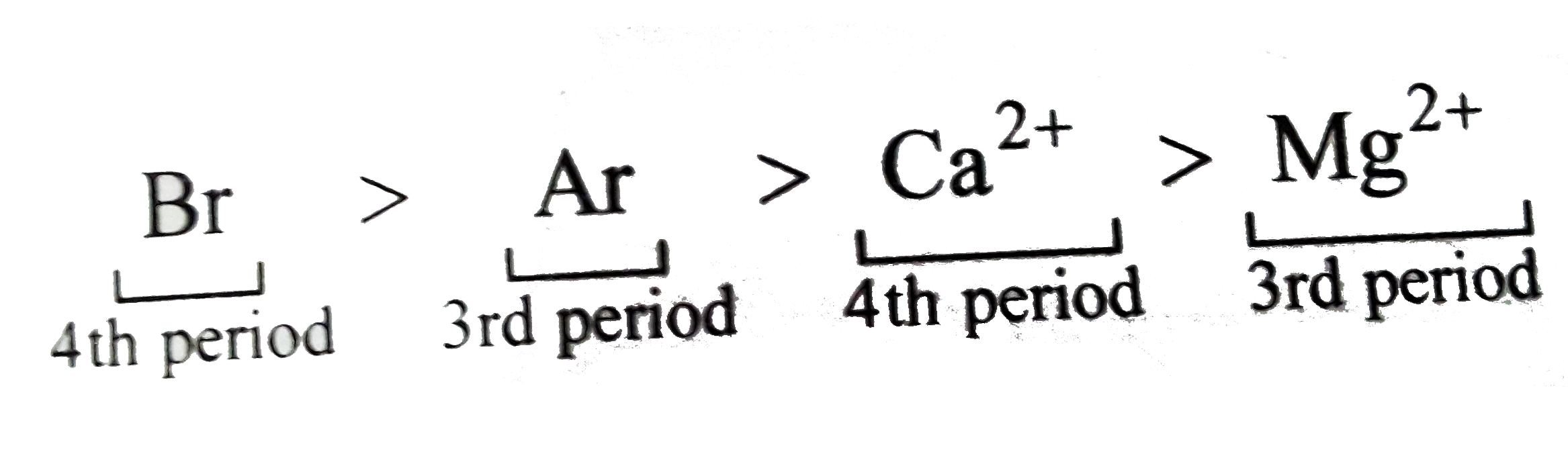
b. Decreasing order of radii: `Ar, Br, Ca^(2+),Mg^(2+)`
c. Decreasing order of `EA:C,N,Be,F,O,CI`
d. Decreasing order of `IE` and `EA:F, Cl,Br,I`
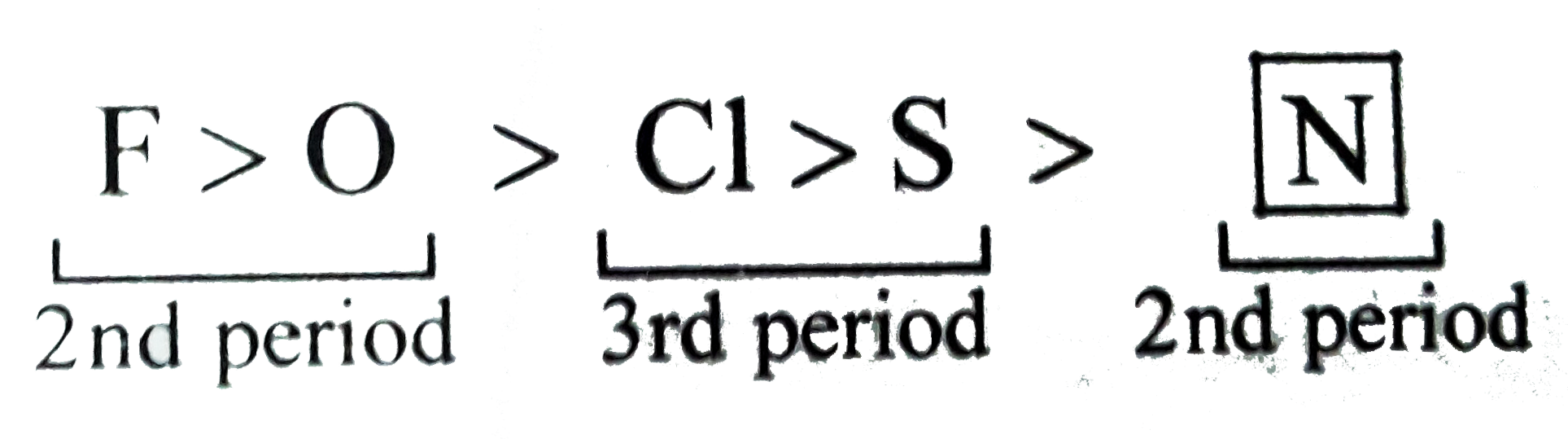
e Decreasing order of `EN:F,N,O,Cl,S`
f. Decreasing order of `IE:Ne,O,Na,Na^(o+)`
g. Decreasing electropositive character: `Na, Cu, Zn`

Text Solution

Verified by Experts
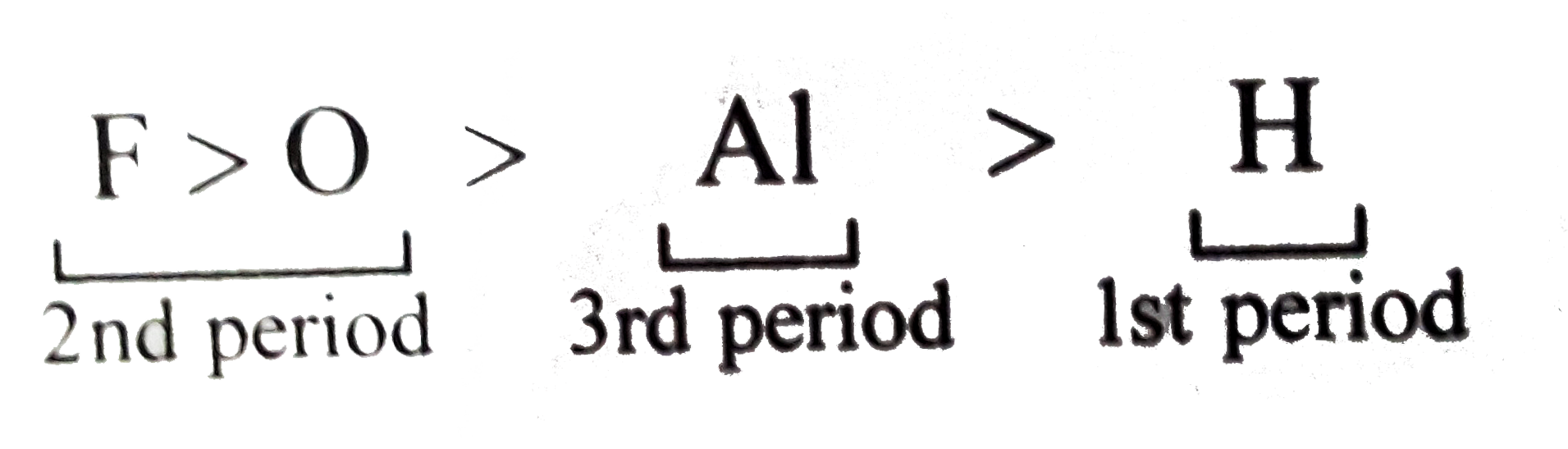

[`EN` increase along the period, `:. EN` of `F gt O`]
Aluminium `(Al)` belongs to `3rd` period. [ `EN` decreases down the group `(darr)`]

Althogh size of an atom decreases along the period `(darr)` but in a period, size of nolbe gas in highest. `Ar` belongs to `3 rd` period whereas `Br` belongs to `4 th` period.
`:.` Size of `Br gt` Size of `Ar`
Similarly, although both `Ca^(2+)` and `Mg^(2+)` ions have same charge, but `Ca` belongs to `4 th` period and `Mg` belongs to `3rd` period.
`:.` Size of `Ca^(2+) gt` size of `Mg^(2+)`
c. `EA:Cl gt F gt O gt C gt N gt Be`
Among halogens decreasing order of `EA` or `Delta_(Ag)H^(ɵ)=Cl gt F gt I`
Generally `EA` increase along the period `(rarr)`
Therefore, order of `EA` should be `O gt N gt C`
But there is exception in the `EA` of `N` and `C`, Since `N` has half-filled stable configuration, so it is difficult to add electron to `N` as compared to `C`.
`:. EA` of `C gt N`
Among `Be, C,N,O` and `F` (all of them belong to `2 nd` period) `EA` of `Be` is the least. Hence the order is as given above.
d. ` IE gt Cl gt Br gt I [{:("Generally" IE"decreases"),("down the group""("darr")"):}]`
`EA:Cl gtF gt Br gtI [{:("Exception in case"),("of" Cl gt F):}]`
e. EN:

Generally `EN` increases along the same period `(rarr)`.
Therefore , `EN` of `2 nd` period `gt EN` of `3 rd` period. But `EN` of `N` ( 2nd period) is the least, and is an exception due to half-filled stable configuration.

`IE` increases along the same period `(rarr)` and `IE` of noble gas `(Ne)` is the highest.
`IE` of alkali metal `(Na)` is less as compared to `Na^(o+)` ion, since it is very difficult to remove an electron from a positve ion.
Generally, `IE` decreases down the group `(darr)`. so `IE` of `O gt Na`.
Hence the order is as given above.
g. Electropositive character: `Na gt Zn gt Cu`
Group `1` is more metallic ( or electropositive character) than group `2`. So, `Na` is most metallic than `Zn` and `Cu`. Similarly, `d`-block elements have more electropositive character than `p`-block elements.
Hence the electropositve character is as given below.
Note: In the metallic character series, the electropositve character (or reducing character is in the order)
`Na gt Mg gtZn gtFe gtNi gt Cu gt Ag`
Note that in metallic character series, PSBC MAZINTL CHAAP. `Zn` comes after `s`-block elements.
Promotional Banner

Topper's Solved these Questions

  • PERIODIC CLASSIFICATION OF ELEMENTS AND GENERAL INORGANIC CHEMISTRY

    CENGAGE CHEMISTRY|Exercise Ex 1.1|14 Videos
  • PERIODIC CLASSIFICATION OF ELEMENTS AND GENERAL INORGANIC CHEMISTRY

    CENGAGE CHEMISTRY|Exercise Ex 1.1 (Very Short)|22 Videos
  • PERIODIC CLASSIFICATION OF ELEMENTS AND GENERAL INORGANIC CHEMISTRY

    CENGAGE CHEMISTRY|Exercise Exercises (Archives )Subjective|4 Videos
  • P-BLOCK GROUP 14 - CARBON FAMILY

    CENGAGE CHEMISTRY|Exercise Exercises Archives (Subjective)|9 Videos
  • PURIFICATION OF ORGANIC COMPOUNDS AND QUALITATIVE AND QUANTITATIVE ANALYSIS

    CENGAGE CHEMISTRY|Exercise Assertion Reasoning Type|5 Videos

Similar Questions

Explore conceptually related problems

Arrange the following in decreasing order E_(2) reaction :

Arrange the following in decreasing order of E_(2) reaction :

Arrange the followign metals in the decreasing order to reactivity Na, K, Cu and Ag.

Arrange the following in decreasing atomic size : (i) Na, Mg, K (ii) N, F, O (iii) N, S, P

Arrange F,Cl,O,N in the decreasing order of electronegativy

Arrange the following elements in the order of their decreasing metallic charcter Na, Si, Cl, Mg, Al.

CENGAGE CHEMISTRY-PERIODIC CLASSIFICATION OF ELEMENTS AND GENERAL INORGANIC CHEMISTRY-Solved Examples
  1. Identify the three elements A, B and C from the data given below a. ...

    Text Solution

    |

  2. Among the elements, Ar, Si, Na and Cl. Select an elements with a. Hi...

    Text Solution

    |

  3. Arrange the following in decreasing order as directed. (a) Decreasin...

    Text Solution

    |

  4. Predict from each set, the atom/ion which has the greatest IE(1) with ...

    Text Solution

    |

  5. The Delta(eg)H^(ɵ) of Br is 3.4 eV. How much energy in kcal is release...

    Text Solution

    |

  6. Predict from each set, the element which has the more negative electro...

    Text Solution

    |

  7. (a) The EN of cesium (Cs) is 0.7 and that of chlorine (Cl) is 3.5. Pre...

    Text Solution

    |

  8. Among the elements with Z = 9, 12 and 36, identify by atomic number of...

    Text Solution

    |

  9. Explain the following question (based on ionisation energy): (a) Why...

    Text Solution

    |

  10. Answer the following question (Based on EA, Delta(eg)H^(ɵ) and IE). ...

    Text Solution

    |

  11. Explain the following question (based on size of atoms or ions and oth...

    Text Solution

    |

  12. For the gaseous reaction K+F rarrK^(o+)+F^(ɵ) Delta H = 19 kcal mo...

    Text Solution

    |

  13. For the reaction K(g)+F(g) +K^(o+)+F^(Theta) (separated ions DeltaH = ...

    Text Solution

    |

  14. From N atoms of an element A, when half the atoms transfer one electro...

    Text Solution

    |

  15. The conservation of gaseous atoms K and F to K^(o+) and F^(ɵ) absorbs ...

    Text Solution

    |

  16. Explain the following: a. Which of the following Na, Mg, Si and P wo...

    Text Solution

    |

  17. Classify the following oxides as a. Strongly acidic b. Weakly acidic...

    Text Solution

    |

  18. Select the strongest and weakest acid in each of the following sets: ...

    Text Solution

    |

  19. A 0.10 M aqueous solution of which salt in each of the following pairs...

    Text Solution

    |

  20. Identify: a. The good oxidising agent (s) b. The good reducing age...

    Text Solution

    |