Home
Class 12
CHEMISTRY
Reimer-Tiemann reaction introduces an al...

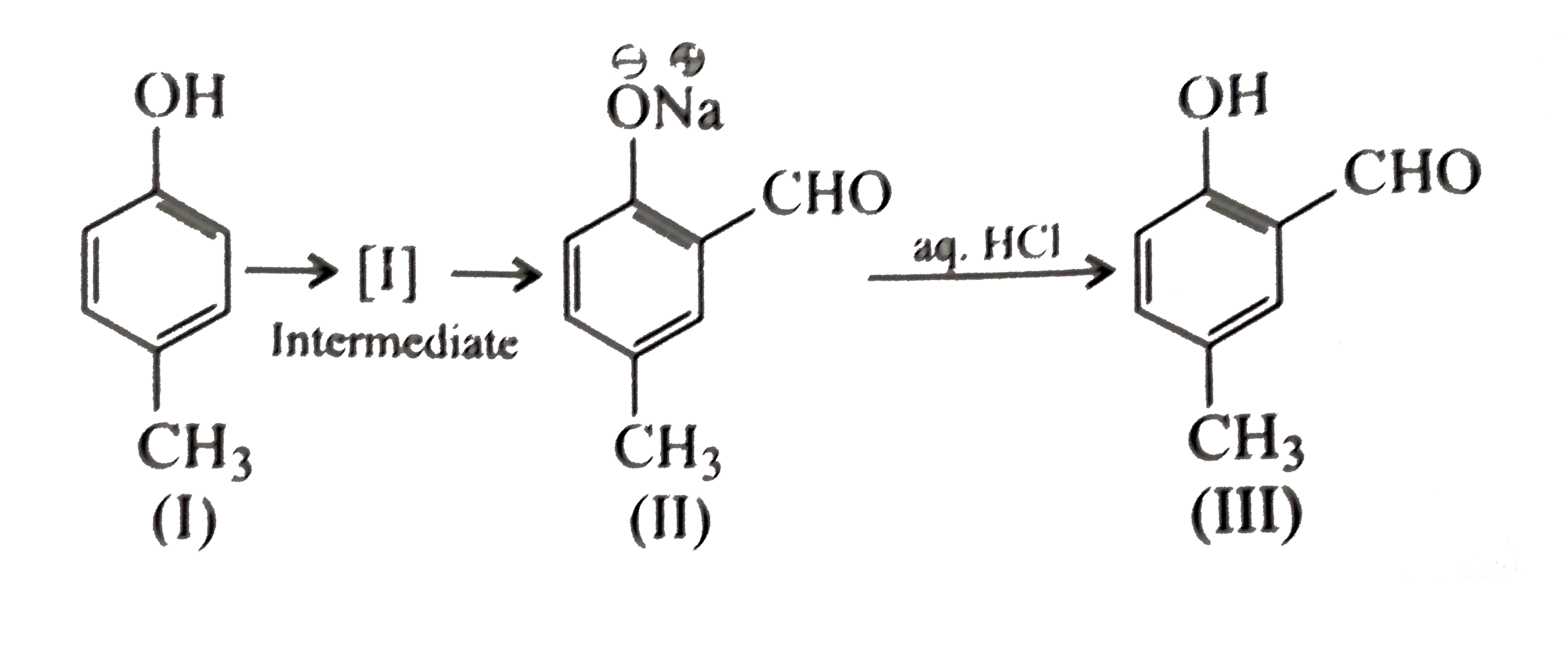
Reimer-Tiemann reaction introduces an aldehyde group on to the aromatic ring of phenol, ortho to the hydroxyl group. This reacrtion involves electrophilic aromatic subsititution. It is a general method for the synthesis of subsituted salicyladehydes as depiced below:

Which one of the following reagents is used in the above reaction ?

A

`aq. NaOH+CH_(3)CI`

B

`aq. NaOH+CH_(2)CI_(2)`

C

`aq. NaOH+CHCI_(3)`

D

`aq. NaOH+CCI_(4)`

Text Solution

Verified by Experts

The correct Answer is:

C

NA
Promotional Banner

Topper's Solved these Questions

  • ALCOHOL,PHENOL AND ETHERS

    CENGAGE CHEMISTRY|Exercise Archives Multiple Correct|4 Videos
  • ALCOHOL,PHENOL AND ETHERS

    CENGAGE CHEMISTRY|Exercise Archives Fill In The Blanks|6 Videos
  • ALCOHOL,PHENOL AND ETHERS

    CENGAGE CHEMISTRY|Exercise Archives Assertion-Reasoning|2 Videos
  • ALIPHATIC AND AROMATIC ALDEHYDES AND KETONES

    CENGAGE CHEMISTRY|Exercise Archives Subjective|29 Videos

Similar Questions

Explore conceptually related problems

Reimer-Tiemann reaction introduces an aldehyde group on to the aromatic ring of phenol, ortho to the hydroxyl group. This reacrtion involves electrophilic aromatic subsititution. It is a general method for the synthesis of subsituted salicyladehydes as depiced below: The structure of the intremediate (I) is:

Reimer-Tiemann reaction introduces an aldehyde group on to the aromatic ring of phenol, ortho to the hydroxyl group. This reacrtion involves electrophilic aromatic subsititution. It is a general method for the synthesis of subsituted salicyladehydes as depiced below: The electrophile in this reaction is:

Reimer -Tiemann reaction introduces an aldehyde group on to the aromatic ring of phenol, ortho to the hydroxyl group. This reaction involves electrophilic aromatic substitution. This is a general method for the synthesis of substituted salicyladehydes as depicted below. The structure of the intermediate I is

Reimer -Tiemann reaction introduces an aldehyde group on to the aromatic ring of phenol, ortho to the hydroxyl group. This reaction involves electrophilic aromatic substitution. This is a general method for the synthesis of substituted salicyladehydes as depicted below. The electrophile in this reaction is
