Home
Class 12
CHEMISTRY
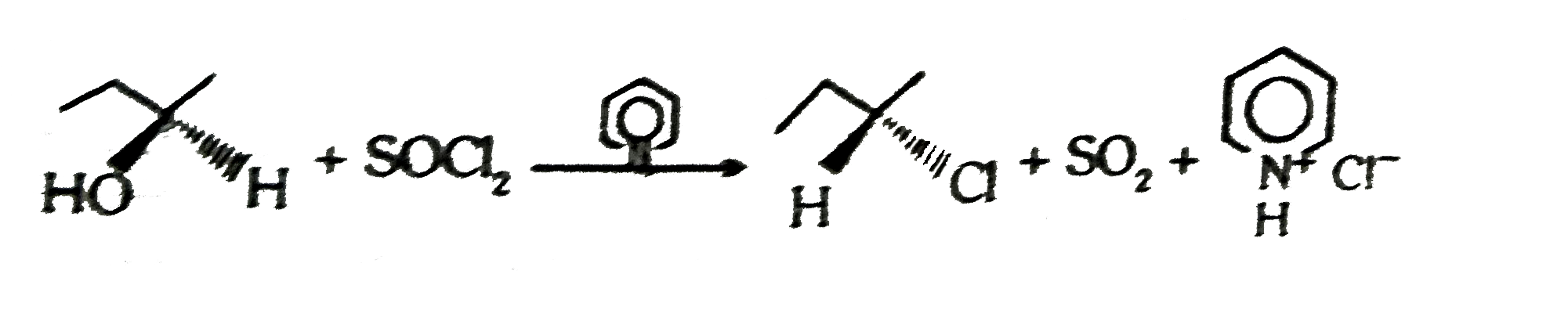
The reaction proceeds by the mechanis...

The reaction
proceeds by the mechanism

A

`S_(N^(1))`

B

`S_(N^(2))`

C

`S_(N^(I))`

D

`S_(E^(2))`

Text Solution

Verified by Experts

The correct Answer is:

B
Promotional Banner

Topper's Solved these Questions

  • ALKYL AND ARYL HALIDE

    ALLEN|Exercise EXERCISE-04 [A]|1 Videos
  • ALKYL AND ARYL HALIDE

    ALLEN|Exercise EXERCISE-04 [B]|1 Videos
  • ALKYL AND ARYL HALIDE

    ALLEN|Exercise EXERCISE-03|1 Videos
  • ALKENE, ALKANE & ALKYNE

    ALLEN|Exercise EXCERSISE-3|28 Videos
  • Atomic Structure

    ALLEN|Exercise All Questions|59 Videos

Similar Questions

Explore conceptually related problems

The reaction proceed by the mechanism :

The reaction proceed by the mechanism :

Assertion (A) : Both H_(2)(g)+Cl_(2)(g) rarr 2HCl(g) and H_(2)(g)+Br_(2)(g) rarr 2HBr(g) have the same order of reaction. Reason (R ): Both reaction proceed by the same mechanism.

In the follwing reactionsL the rate of reaction (I) and (II) are some. Both reactions proceeds by which mechanism.

Refer to Q. No.24 and find out which of the reactions proceeds by SN^i mechanism.

For the reaction: X(g) rarr Y(g)+Z(g) , the following data were obtained at 30^(@)C : {:("Experiment",[X](mol L^(-1)),"Rate" (mol L^(-1) hr^(-1))),(I,0.17,0.05),(II,0.34,0.10),(III,0.68,0.20):} The equilibrium constant for the reaction is 0.50 . Assuming that the reaction proceeds by one-step mechanism. Find the rate constant of reverse reaction?

Knowledge Check

  • The reaction proceed by the mechanism :

    A
    `S_(N^(1))`
    B
    `S_(N^(2))`
    C
    `S_(E^(2))`
    D
    `S_(N^(i))`
  • The reaction proceed by the mechanism :

    A
    `S_(N^(1))`
    B
    `S_(N^(2))`
    C
    `S_(E)`
    D
    `S_(N^(i))`
  • Assertion (A) : Both H_(2)(g)+Cl_(2)(g) rarr 2HCl(g) and H_(2)(g)+Br_(2)(g) rarr 2HBr(g) have the same order of reaction. Reason (R ): Both reaction proceed by the same mechanism.

    A
    If both `(A)` and `(R )` are correct, and `(R )` is the correct explnation of `(A)`.
    B
    If both `(A)` and `(R )` are correct, but `(R )` is noth the correct explanation of `(A)`.
    C
    If `(A)` is correct, but `(R )` is incorrect.
    D
    If both (A) and (R ) are incorrect.
  • ALLEN-ALKYL AND ARYL HALIDE-EXERCISE
    1. The reaction proceeds by the mechanism

      Text Solution

      |

    2. 1,3-Dibromopropane reacts with metallic zinc to form

      Text Solution

      |

    3. Consider the following reaction sequence, CH(3)C-= CH overset(aq.H(2...

      Text Solution

      |

    4. Which of the following has highest dipole moment:

      Text Solution

      |

    5. In S(N^(1)) the first step involves the formation of

      Text Solution

      |

    6. To form alkane isonitrile, alkyl halide is reacted with:

      Text Solution

      |

    7. Which one of the following compounds most radily undergoes substitutio...

      Text Solution

      |

    8. (sec-Butyl bromide) undergoes alkaline hydrolysis by :

      Text Solution

      |

    9. Grignard reagent can be prepared by

      Text Solution

      |

    10. Most stable carbocation formed from (CH(3))(3)C-Br,(C(6)H(5))(3)CBr,(C...

      Text Solution

      |

    11. For the reaction

      Text Solution

      |

    12. The products of reaction of alcoholic silver nitrite with enthyl bromi...

      Text Solution

      |

    13. The reaction , CH(3)Br +OH^(-)rarrCH(3)OH+Br^(-) obeys the mechanism

      Text Solution

      |

    14. Ethylidene chloride can be prepared by the reaction of HCI and

      Text Solution

      |

    15. 1-phenyl-2-chloropropane on treating with alc. KOH gives mainly

      Text Solution

      |

    16. Grignard reagent is obtained when magnesium is treated with

      Text Solution

      |

    17. Ethylene reacts bromine to form-

      Text Solution

      |

    18. C(2)H(4) overset(Br(2))rarr X overset(KCN)rarr Y, Y is

      Text Solution

      |

    19. Reactivity order of halides of dehydrohalogenation is

      Text Solution

      |

    20. Which of the following is least reactive in a nucleophilic substiution...

      Text Solution

      |
