Home
Class 12
PHYSICS
Draw three equipotential surfaces corres...

Draw three equipotential surfaces corresponding to a field that uniformly increases in magnitude but remains constant along z-direction. How are these surfaces different from that of a constant electric field along z-direction?

Text Solution

Verified by Experts
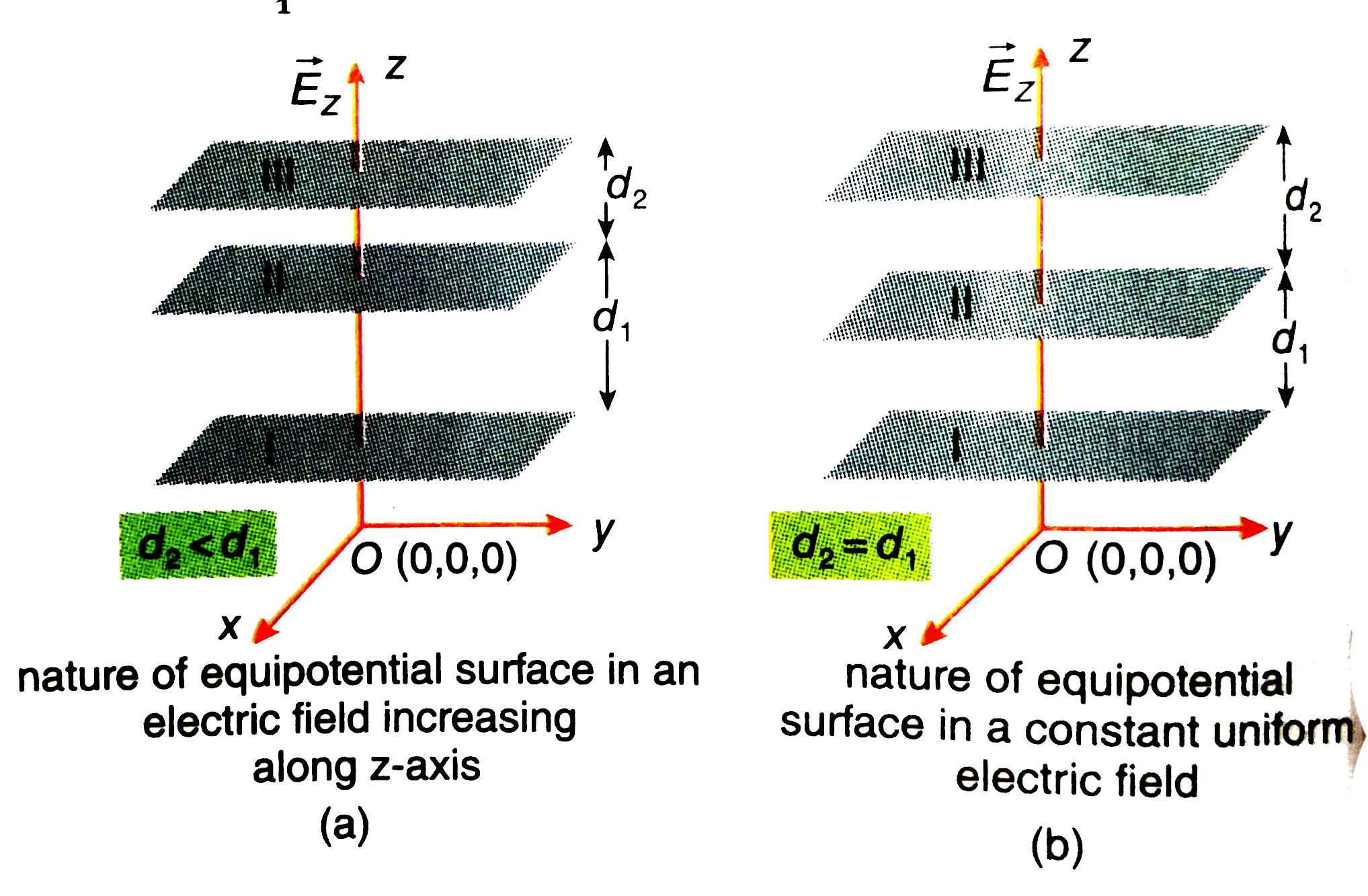
The separation between the equipotential surfaces will gradually decrease along the direction of increment of the electric field (in cas z - axis).
In case of a constant uniform electric field, the equipotential surfaces are equally spaced.
Promotional Banner

Topper's Solved these Questions

  • ELECTRIC POTENTIAL

    CHHAYA PUBLICATION|Exercise NCERT textbook questions with answer hint|14 Videos
  • ELECTRIC POTENTIAL

    CHHAYA PUBLICATION|Exercise NCERT examplar questions with answer hint (MCQ -1 single option correct)|3 Videos
  • ELECTRIC POTENTIAL

    CHHAYA PUBLICATION|Exercise Section related questions|25 Videos
  • ELECTRIC FIELD

    CHHAYA PUBLICATION|Exercise CBSE SCANNER|31 Videos
  • ELECTROMAGNETIC INDUCTION & ALTERNATING CURRENT

    CHHAYA PUBLICATION|Exercise CBSE SCANNER|28 Videos

Similar Questions

Explore conceptually related problems

Describe schematically the equipotential surfaces corresponding to (b) A field that uniformly increases in magnitude but remains in a constant (say, z) direction.

Describe, schematically the equipotential surfaces corresponding to : a field that uniformly increases in magnitude but remains in a constant (say, Z) direction,

Describe schematically the equipotential surfaces corresponding to (a) a constant electric field in the z-direction.

Describe, schematically the equipotential surfaces corresponding to : a constant electric field in the Z-direction,

Some equipotential lines are shown in figure. What can you say about the magnitude and the direction of the electric field ?

Explain why, for any charge configuration the equipotential surface through a point is normal to the electric field at that point. Draw a sketch of equipotential surfaces due to a single charge (-q), depicting the electric field lines due to the charge.

Show that the normal component of electrostatic field has a discontinuity from one side of a charged surface to another given by (oversetrarr(E_2)-oversetrarr(E_1))overset^n=sigma//epsilon_0 where overset^n isa unit vecotr normal to the surface at a point and ct is the surface charge density at that point. (The direction of overset^n is from side 1 to side 2.) Hence, show that just outside a conductor, the electric field is sigmaoverset^n//epsilon_0 .

A uniform electric field and a uniform magnetic field are acting along the same direction in a certain region. If an electron is projected in the region with a velocity along the direction of fields, then

The electric field intensity at a point near a sphere of radius r and surface density of rho in a medium of dielectric constant K is

CHHAYA PUBLICATION-ELECTRIC POTENTIAL -Higher order thinking skill (HOTS) questions
  1. Potential difference between two conductors is very large. What will h...

    Text Solution

    |

  2. Potential difference between two conductors is very large. What will h...

    Text Solution

    |

  3. Potential difference between two conductors is very large. What will h...

    Text Solution

    |

  4. Give an example of a line in the electric field of an electric dipole ...

    Text Solution

    |

  5. Can two different equipotential surfaces intersect each other?

    Text Solution

    |

  6. In fig., two pairs of planes A,B and A', B' are kept in two uniform el...

    Text Solution

    |

  7. A positively charged and a negatively charged body are connected to th...

    Text Solution

    |

  8. When a body is connected with earth, electrons are found to move from ...

    Text Solution

    |

  9. In vacuum, equal charges of the same nature are placed at the vertices...

    Text Solution

    |

  10. Draw three equipotential surfaces corresponding to a field that unifor...

    Text Solution

    |

  11. A unit positive charge is moving along PQR in an electric field of int...

    Text Solution

    |

  12. Fig. shows the variation of electric potential V with 1/r for two char...

    Text Solution

    |

  13. Fig. shows the variation of electric potential V with 1/r for two char...

    Text Solution

    |

  14. Two electric charges q and -2q are placed 6m apart on a horizontal pla...

    Text Solution

    |

  15. A charge Q is uniformly distributed over a long rod AB of length L as ...

    Text Solution

    |

  16. A conducting bubble of radius a, thickness t ( lt lt a) has a potentia...

    Text Solution

    |

  17. Some equipotential surfaces are shown in fig. What can you say about t...

    Text Solution

    |

  18. The radii of two concentric metal spheres are a and b (b gt a). The ou...

    Text Solution

    |

  19. In fig., +Q, +q, +q charges are placed on the vertices of an isosceles...

    Text Solution

    |

  20. Discuss the variation of electric potential due to positive and negati...

    Text Solution

    |

