Home
Class 12
CHEMISTRY
Explain inductive effect with a suitable...

Explain inductive effect with a suitable example.

Text Solution

Verified by Experts
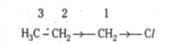
Consider,the molecule `CH_(3)-CH_(2)-CH_(2)-Cl`. There is a `sigma` bond between 'C' atom and 'Cl' atom. The electron pair between them is not equally shared. The more electro `-ve` 'Cl' atom tends to attract the shared pair more towards itself. Due to this, the electron density tends to the greater near the 'Cl' atom than C atom. It is represented as `-C--)Cl`. But carbon atom bounded to chlorine atom is itself attached to ther carbon atoms. Therefore the effect can be transmitted further.

The effect of the 'Cl' atom is to leave `C_(1)` slightly electron deficient. `C_(1)` in turn tries to rectify this by approprlating slightly more than its share of electron of the `sigma` bond joining it to `C_(2)` and this continues down the carbon chain. However, the effect of `C_(1)` on `C_(2)` is less than the effect of Cl on `C_(1)` and the transmission quickly falls down away in a saturated chain and is generally too small to be noticeable beyond `C_(3)`. These influences on the electron distribution in `sigma` bonds are known as inductive effects.
Thus, inductive effect can be defined as ''The electron - donating or electron - with - drawing effect of an atom or group of atoms that is transmitted by the polarisation of electrons in `sigma` bonds''.
Inductive effect is a measure of the ability of substituents to either withdraw or donate electron density of the attaced carbon atom. Based on this ability. The substituents are classified as electron - withdrawing orelectron - donating groups relative to hydrogen. Electron - withdrawing groups are said to exhibit `-ve` inductive effect `(-I)` and electron - donating groups are said to exhibit `+ve` inductive effect `(+I)`.
Inductive effect influences chemical reactivity and physical properties.
Promotional Banner

Topper's Solved these Questions

  • ORGANIC CHEMISTRY

    VGS PUBLICATION-BRILLIANT|Exercise Short Answer Questions|17 Videos
  • MOST IMPORTANT QUESTIONS

    VGS PUBLICATION-BRILLIANT|Exercise ORGANIC CHEMISTRY (LONG ANSWER TYPE QUESTIONS)|11 Videos
  • STATES OF MATTER : GASES AND LIQUIDS

    VGS PUBLICATION-BRILLIANT|Exercise ADDITIONAL QUESTION & ANSWERS|10 Videos

Similar Questions

Explore conceptually related problems

Explain borax bead test with a suitable example

Explain Antiferromagnetism with suitable example .

Explain brood parasitism with a suitable example

Explain the terms aerosol with suitable examples.

Define an ecosystem. Explain it with a suitable example.

Explain two tropic movements with suitable examples.

Explain the following terms with suitable examples: (i) Schottky defect (ii) Frenkel defect (iii) Interstitials and (iv) F-centres.

Explain the following terms with suitable examples (i) cationic detergents (ii) anionic detergents and (iii) non-ionic detergents.

VGS PUBLICATION-BRILLIANT-ORGANIC CHEMISTRY-Long Answer Questions
  1. Explain the estimation of nitrogen of an organic compound by a) Duma...

    Text Solution

    |

  2. Explain the estimation of nitrogen of an organic compound by b) Kjel...

    Text Solution

    |

  3. Explain inductive effect with a suitable example.

    Text Solution

    |

  4. Write a note on mesomeric effect.

    Text Solution

    |

  5. Describe resonance effect with one example.

    Text Solution

    |

  6. Explain how many types of organic reactlons are possible.

    Text Solution

    |

  7. Write the possible conformations of ethane and explain which is more s...

    Text Solution

    |

  8. Explain aromatic electroplhilic substitution reactions of benzene.

    Text Solution

    |

  9. Explain electrophilic addition reactions of ethylene with mechanism.

    Text Solution

    |

  10. With the help of mechamism explain free radical halogenationis of allk...

    Text Solution

    |

  11. Discuss Markovnikov's rule and Kharash effect.

    Text Solution

    |

  12. How would you convert the following compounds into benzene ? Chloro...

    Text Solution

    |

  13. How would you convert the following compounds into benzene ? Toluene

    Text Solution

    |

  14. How would you convert the following compounds into benzene ? p - nit...

    Text Solution

    |

  15. Why is Wurtz reaction not preferred for the preparation of alkanes con...

    Text Solution

    |

  16. Write the equations involved in the detection of Nitrogen, Halogens an...

    Text Solution

    |

  17. How are carbon and hydrogen of an organic compound estimated?

    Text Solution

    |

  18. Describe Dumans and Kjeldhahl's method for the estimation of Nitrogen ...

    Text Solution

    |

  19. How do you determine Sulphur , Phosphorous and Oxygen quantitatively i...

    Text Solution

    |

  20. Explain Carius method for the determination of Halogens quantitatively...

    Text Solution

    |

