Home
Class 11
PHYSICS
The temperature of the two outer surface...

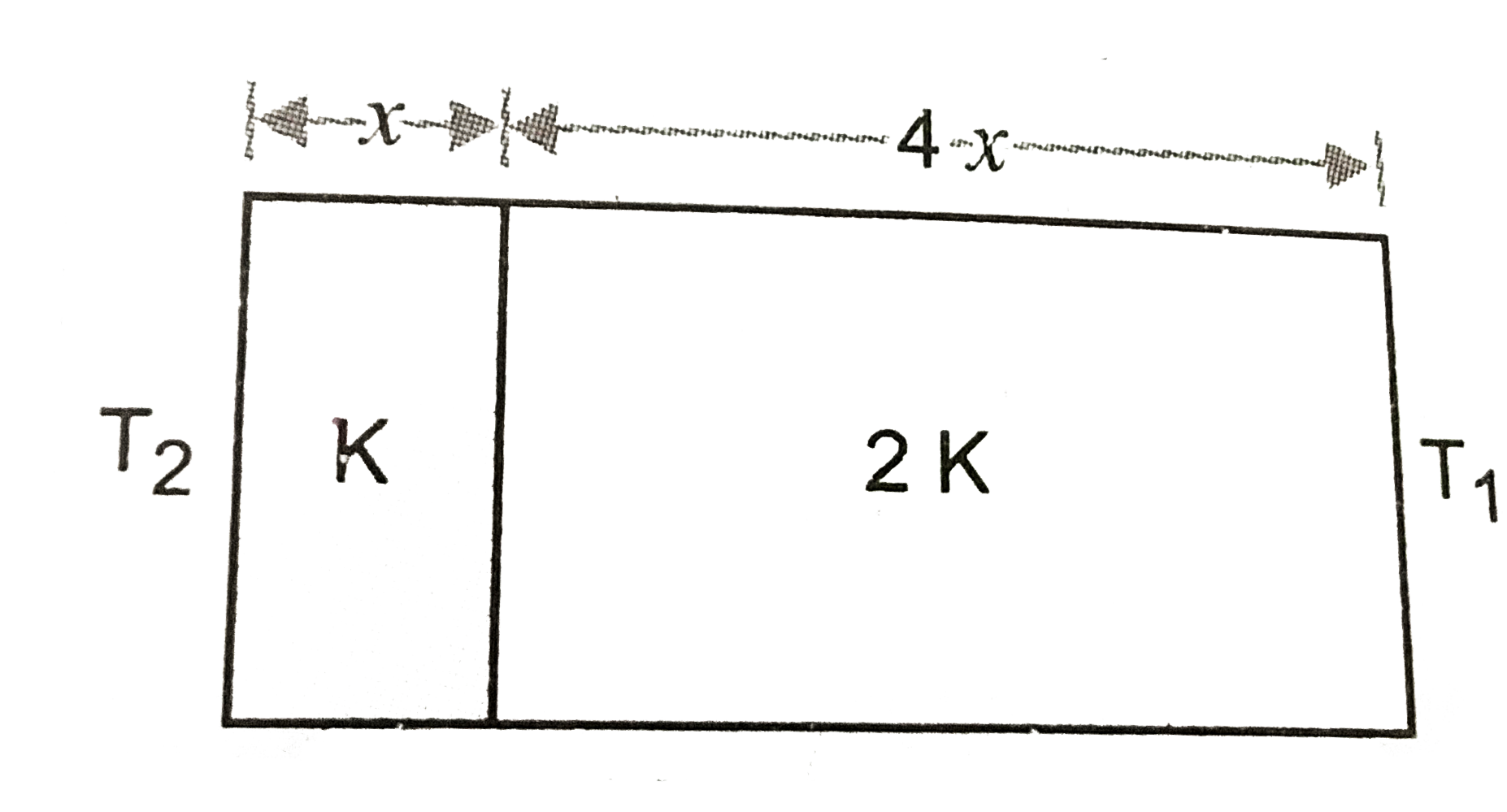
The temperature of the two outer surfaces of a composite slab, consisting of two materials having coefficients of thermal conductivity K and 2K and thickness x and 4x respectively. Temperatures on the opposite faces of composite slab are `T_(1) and T_(2)` where `T_(2)gtT_(1)`, as shown in fig. what is the rate of flow of heat through the slab in a steady state?

A

1

B

`1/2`

C

`2/3`

D

`1/3`

Text Solution

Verified by Experts

The correct Answer is:

D

Let the temperature of common interface be T K
Rate of heat flow `H = (Q)/(t) = (KA DeltaT)/(l)`
`:. H = (Q/t)_(1) = (2KA(T-T_(1)))/(4x)`
and `H_(2) = (Q/t)_(2) = (KA(T_(2) - T))/(x)`
In steady state the rate of heat flow should be same in whole system i.e.,
`H_(1) = H_(2)`
or `(2Ka(T-T_(1)))/(4x) = (KA(T_(2)-T))/(x)`
`(T-T_(1))/(2) = T_(2) - T` or `T - T_(1) = 2T_(2) - 2T`
`T = (2T_(2) + T_(1))/(3) "....."(i)`
Hence, heat flow composite slab is
`H = [(Ka(T_(2)-T))/(x)] = (KA)/(x) (T_(2) - (2T_(2) - T_(1))/(3))` [From eqn. (i)]
`= (KA)/(3x) (T_(2) - T_(1))`
According to question, `H = [(A(T_(2) - T_(1))K)/(x)]f"....."(iii)`
By comparing eqs. (ii) and (iii), we get `f = 1/3`
Promotional Banner

Topper's Solved these Questions

  • THERMAL PROPERTIES OF MATTER

    NCERT FINGERTIPS|Exercise NCERT Exemplar|8 Videos
  • THERMAL PROPERTIES OF MATTER

    NCERT FINGERTIPS|Exercise Assertion And Reason|10 Videos
  • THERMAL PROPERTIES OF MATTER

    NCERT FINGERTIPS|Exercise Newton'S Law Of Cooling|3 Videos
  • SYSTEM OF PARTICLES AND ROTATIONAL MOTIONS

    NCERT FINGERTIPS|Exercise Assertion And Reason|15 Videos
  • THERMODYNAMICS

    NCERT FINGERTIPS|Exercise Assertion And Reason|15 Videos

Similar Questions

Explore conceptually related problems

The temperature of the two outer surfaces of a composite slab consisting of two materials having coefficient of thermal conductivity K and 2K and thickness x and 4x respectively are T_2 and T_1(T_2gtT_1) . The rate of heat transfer through the slab in steady state is ((AK(T_2 -T_1))/x)f . where, f is equal to .

The temperature of the two outer surfaces of a composite slab, consisting of two materials having coefficients of thermal conductivity K and 2K and thicknesses x and 4x, respectively are T_(2) and T_(1)(T_(2)gtT_(1)) . The rate of heat of heat transfer through the slab, in ? steady state is [(A(T_(2)-T_(1))/(x)]f , with f equal to :-

The temperature of the two outer surfaces of a composite slab, consisting of two materails having coefficients of two materails having coefficients of termal conductivity K and 2K and thickness x and 4x, respectively, are T_2 and T_1(T_1gtT_1) . The rate of heat transfer through the slab, in a steady state is ((A(T_2-T_1)K)/2)f , with f equal to

Consider a compound slab consisting of two different material having equal thickness and thermal conductivities K and 2K respectively. The equivalent thermal conductivity of the slab is

Two materials having coefficients of thermal conductivity ‘3 K’ and ‘K’ and thickness ‘d’ and ‘3 d’, respectively, are joined to form a slab as shown in the figure. The temperatures of the outer surfaces are theta_(2) and theta_(1) respectively, (theta_(2) gt theta_(1)) The temperature at the interface is:

A composite slab consists of two rectangular slabs of different materials, having coefficients of conductivity 2K and K. The two ends of the slabs are at temperatures T_1 and T_2 (where T_1 gt T_2 ). How will the rate of heat flow depend on a where 3a and a are the lengths of two slabs? Consider that the two slabs have equal thickness.

The temperature across two different slabs A and B are shown I the steady state (as shown Fig) The ratio of thermal conductivities of A and B is
