Home
Class 12
PHYSICS
Two slabs are of the thicknesses d(1) an...

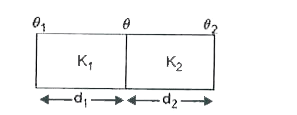
Two slabs are of the thicknesses `d_(1)` and `d_(2)`. Their thermal conductivities are `K_(1)` and `K_(2)` respectively They are in series. The free ends of the combination of these two slabs are kept at temperatures `theta_(1)` and `theta_(2)`. Assume `theta_(1)gttheta_(2)`. The temperature `theta` of their common junction is

A

`(K_(1)theta_(1)+K_(2)theta_(2))/(theta_(1)+theta_(2))`

B

`(K_(1)theta_(1)d_(1)+K_(2)theta_(2)d_(2))/(K_(1)d_(2)+K_(2)d_(1))`

C

`(K_(1)theta_(1)d_(2)+K_(2)theta_(2)d_(1))/(K_(1)d_(2)+K_(2)d_(1))`

D

`(K_(1)theta_(1)+K_(2)theta_(2))/(K_(1)+K_(2))`

Text Solution

Verified by Experts

The correct Answer is:
C

For first slab

Heat current, `H_(1)=(K_(1)(theta_(1)-theta)A)/(d_(1))`
For second slab,
Heat current, `H_(2)=(K_(2)(theta-theta_(2))A)/(d_(2))`
As slabs are in series
`H_(1)=H_(2)`
`:.(K_(1)(theta_(1)-theta)A)/(d_(1))=(K_(2)(theta-theta_(2))A)/(d_(2))`
`rArr" "theta=(K_(1)theta_(1)d_(2)+K_(2)theta_(2)d_(1))/(K_(2)d_(1)+K_(1)d_(2))`
So, correct choice is (c ).
Promotional Banner

Topper's Solved these Questions

  • TRANSFERENCE OF HEAT

    MODERN PUBLICATION|Exercise Multiple Choice Questions (Level - III) Questions From AIEEE/JEE Examination)|5 Videos
  • SOLIDS & SEMICONDUCTOR DEVICES

    MODERN PUBLICATION|Exercise Revision Test|28 Videos
  • UNIFORM CIRCULAR MOTION

    MODERN PUBLICATION|Exercise Revision Test |57 Videos

Similar Questions

Explore conceptually related problems

Two small spheres of masses M_(1) and M_(2) are suspended by weightless insulating threads of lengths L_(1) and L_(2) The spheres carry charges Q_(1) and Q_(2) respectively. The spheres are suspended such that they are in level with one another and the threads are inclined to the vertical at angles of theta_(1) and theta_(2) as shown. Which one of the following conditions is essential, if theta_(1)=theta_(2) ?

(sin 2 theta)/(1-cos 2 theta)=cot theta

(1+cos 2 theta)/(sin 2 theta)=cot theta

Prove that (sec theta + tan theta)^(2) = (cosec theta +1)/(cosec theta -1) .

