Home
Class 12
CHEMISTRY
What is meant by the following terms ? G...

What is meant by the following terms ? Give an example of the reaction in each case.
(i) Cyanohydrin
(ii) Acetal
(iii) Semicarbazone
(iv) Aldol
(v) Hemiacetal
(vi) Oxime
(vii) Ketal
(vii) Imine
(ix) 2,4-DNP-derivative
(x) Schiff’s base

Text Solution

Verified by Experts
(I ) The compounds containing hydroxyl and cyano group on the carbon atom are called cyanohydrins these are also called gem-hydroxynitrilies . These are obtained of HCN to a carbonyl group in weeakly basic medium :
` (##MOD_SPJ_CHE_XII_P2_C12_E03_009_S01.png" width="80%">
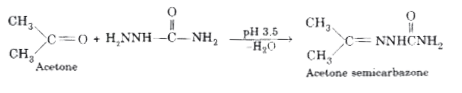
(ii ) semicarbozones are the derivatives of aldehydes and ketons obtained by the action of semicarbazide on them in wealky acidic medium .

these are used for identification and characterization of aldehyes and ketons
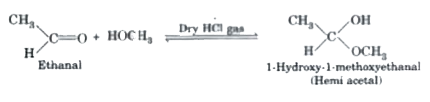
( iii ) Gem- alkony alcohols are called hemiactals these are obtained by the addition of one molecule of monohydric alcohol to an aldehyde in the presence of dry HCI gas

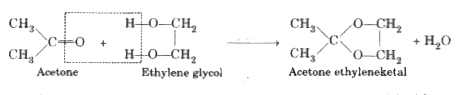
( iv ) Gem-dialkoxy alkanes are called ketons on these compounds , the two alkoxy are present on the same carbon within the chain these are produced by the reaction of ketons with ethylene in the pressure of dry HCI gas .

these are readily hydrolysed by dilute mineral acids to regnerate the original ketons therefore ketons are used for the protections of keto groups in organic aynthesis
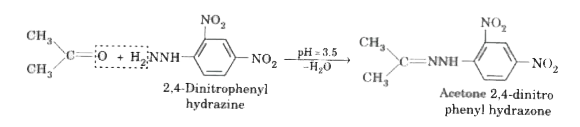
(ii ) 2,4-dinitrophenyl hydrozones ( 2,4 derivative are produced when aldehydes or ketons react with 2,4 dinitrophenyl hydrazine in wekly acidic medium .

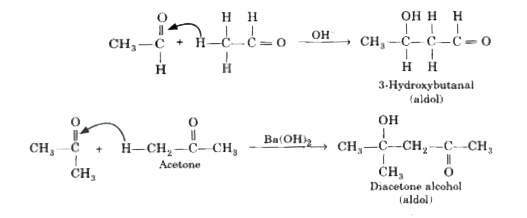
(vi ) Aldols are ` beta ` - hydroxyaldehydes or ketons which are produced by the condensaton of two molecules of aldehydes or ketons containg ` alpha` - hdrogen atoms in the pressure of a dilute aqueous base .

(vii) Acetal . these are dialkoxy compounds in which two alkoxy group are present on the terminal carbon , these are product by the action of an aldehyde with two equivalents of a monohydric alcohol in the presence of dry HCI gas

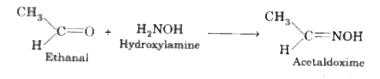
( viii ) Oximea are formed when aldehydes or ketons react with hydroxyl amines in weakly acidic medium

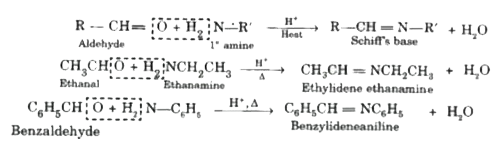
( ix) Imines . these are the compounds containing `-CH=N-` group and are produced when aldehyes and ketons react . with ammonia derivatives

`z=-NH,-OH ,-NHC_6 - NHCHCONH_2 , ` etc
(x ) shiffs base aldehydes and ketons react with primary aliphiatic or aromatic to form azomethines which are also called schiffs base
Promotional Banner

Topper's Solved these Questions

  • ALDEHYDES ,KETONES AND CARBOXYLIC ACIDS

    MODERN PUBLICATION|Exercise NCERT FILE (NCERT EXEMPLAR PROBLEMS ) (MULTIPLE CHOICE QUESTIONS ( TYPE -I)|12 Videos
  • ALDEHYDES ,KETONES AND CARBOXYLIC ACIDS

    MODERN PUBLICATION|Exercise NCERT FILE (NCERT EXEMPLAR PROBLEMS ) (MULTIPLE CHOICE QUESTIONS ( TYPE -II)|6 Videos
  • ALDEHYDES ,KETONES AND CARBOXYLIC ACIDS

    MODERN PUBLICATION|Exercise NCERT FILE (NCERT IN TEXT QUESTIONS )|8 Videos
  • ALCOHOLS, PHENOLS AND ETHERS

    MODERN PUBLICATION|Exercise UNIT PRACTICE TEST (FOR BOARD EXAMINATION)|12 Videos
  • BIOMOLECULES

    MODERN PUBLICATION|Exercise UNIT PRACTICE TEST FOR BOARD EXAMINATION|13 Videos

Similar Questions

Explore conceptually related problems

(a) What is meant by the following terms ? Give an example of the reaction in each case. (i)"Aldol"" "(ii)"Semicarbazone" (b) Complete the following : (i) CH_(3)COCl overset(H_(2)Pd-BaSo_(4))to (ii) CH_(3)-CH=CH-CNoverset(DIBAl-H)to

I In the following expressions, write a letter and a binary expression. (i) 3x + 4y (ii) 9 + 3y (iii) 4a - 7b 5r +1 (v) a-30 (vi) 4ab (vii) abc - 1 (vii) 3xy (ix) ab + bc (viii)a + abc

The total number of carbonate ores among the following is . ltBRgt (i) Argentite (ii) Calamine (iii) Malachite (iv) Siderite (v) Galena (vi) Magnetite (vii) Dolomite (viii) Cassiterite (ix) Bauxite

How many among the following are biodegradable polymers? (i) Polyhydroxybutyrate (PHB) (ii) PHBV (iii) SBR (iv) Polyglycolic acid (v) Bakelite (vi) Thiokol (vii) Nylon-2-Nylon-6 (vii) PMMA (ix) Nylon-6, 6.

Knowledge Check

  • The total number of carbonate ores among the following is . ltBRgt (i) Argentite (ii) Calamine (iii) Malachite (iv) Siderite (v) Galena (vi) Magnetite (vii) Dolomite (viii) Cassiterite (ix) Bauxite

    A
    4
    B
    5
    C
    6
    D
    7
  • Which of the following molecules are diatomic ? (i) Nitrogen (ii) Neon (iii) Oxygen (iv) Sulphur (v) Phosphorus (vi) Ozone (vii) Fluorine (viii) Hydrogen (ix) Fullerene

    A
    ii,iv,v and vi
    B
    iv,v and ix
    C
    ii and vi
    D
    I,iii,vii and viii
  • MODERN PUBLICATION-ALDEHYDES ,KETONES AND CARBOXYLIC ACIDS-NCERT FILE (NCERT TEXTBOOK EXERCISES )
    1. What is meant by the following terms ? Give an example of the reaction...

      Text Solution

      |

    2. Name the following compounds according to IUPAC system of nomoen...

      Text Solution

      |

    3. Draw the structures of following compound: i. 3-Methylbutanal ii. ...

      Text Solution

      |

    4. Write the IUPAC names of the ketons and aldehydes wherever poss...

      Text Solution

      |

    5. Draw the structure of following derivatives: i. 2,4-Dinitrophylhydra...

      Text Solution

      |

    6. Predict the product formed when cyclohexanecarbaldehyde reacts wi...

      Text Solution

      |

    7. Which of the following compounds would undergo aldol condensation or t...

      Text Solution

      |

    8. How will you convert ethnal into the following compounds ? i. Butane...

      Text Solution

      |

    9. Write structure formulae and names of four possible aldol condensation...

      Text Solution

      |

    10. An organic compound with the molecular folmula C(9)H(10)O form 2,4-DNP...

      Text Solution

      |

    11. An organic compound (A) (molecular formula C(8)H(16)O(2)) was hydrolys...

      Text Solution

      |

    12. Arrange the following compounds in the increasing order of their prope...

      Text Solution

      |

    13. Give simple chemical test to distinguish between the following pairs o...

      Text Solution

      |

    14. How will you prapare the following compounds from benzene ? You may us...

      Text Solution

      |

    15. How will you bring about the following conversions in not more than tw...

      Text Solution

      |

    16. Describe the following i. Acetylation ii. Cannizzaro reaction i...

      Text Solution

      |

    17. complete each synthesis by giving missing starting material , r...

      Text Solution

      |

    18. Giving plausible explanation for each of the following: i. Cyclohexa...

      Text Solution

      |

    19. An organic compound contains 69.77% carbon, 11.63% hydrogen, and rest ...

      Text Solution

      |

    20. Although phenoxide ion has more number of resonating structures than c...

      Text Solution

      |