Home
Class 12
CHEMISTRY
Study the following isotherms of carbond...

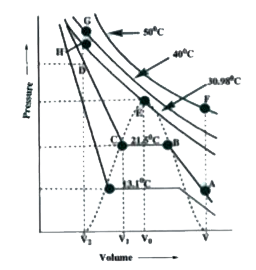
Study the following isotherms of carbondioxide at various temperature and answer the following questions based on that:

Choose the temperature above which `CO_(2)` cannot be liquified whatsoever applied pressure is

A

290K

B

294.5 K

C

302K

D

304 K

Text Solution

Verified by Experts

Promotional Banner

Topper's Solved these Questions

  • STATES OF MATTER

    AAKASH SERIES|Exercise ADDITIONAL PRACTICE EXERCISE (LEVEL-II LECTURE SHEET (ADVANCED)) (LINKED COMPREHENSION TYPE QUESTIONS) (PASSAGE-II)|3 Videos
  • STATES OF MATTER

    AAKASH SERIES|Exercise ADDITIONAL PRACTICE EXERCISE (LEVEL-II LECTURE SHEET (ADVANCED)) (MATRIX MATCHING TYPE QUESTIONS)|1 Videos
  • STATES OF MATTER

    AAKASH SERIES|Exercise ADDITIONAL PRACTICE EXERCISE (LEVEL-II LECTURE SHEET (ADVANCED)) (MORE THAN ONE CORRECT ANSWER TYPE QUESTIONS)|5 Videos
  • SOLUTIONS

    AAKASH SERIES|Exercise Objective Exercise -4|50 Videos
  • STOICHIOMETRY

    AAKASH SERIES|Exercise PRACTICE SHEET (ADVANCED) (INTEGER TYPE QUESTION)|2 Videos

Similar Questions

Explore conceptually related problems

Study the following isotherms of carbondioxide at various temperature and answer the following questions based on that: Carbondioxide present at F can be liquified

Study the following isotherms of carbondioxide at various temperature and answer the following questions based on that: At 21.5°C decrease in volume(B-C) doesn't result into increase in pressure because

The temperature above which a gas cannot be liquified even on application of high pressure is called

The temperature above which a gas cannot be liquified even on application of high pressure is called

Refer the above part periodic table and answer the following questions Which element has least I.P.E value ?

Read the paragraph and answer the following question Choose the state in which coir industry is located

Study sequence of the reactions above and answer the following questions . The reagent 'B' is

Study sequence of the reactions above and answer the following questions . The reagent 'A' is

