Home
Class 12
PHYSICS
Two point charges q(1) and q(2), of magn...

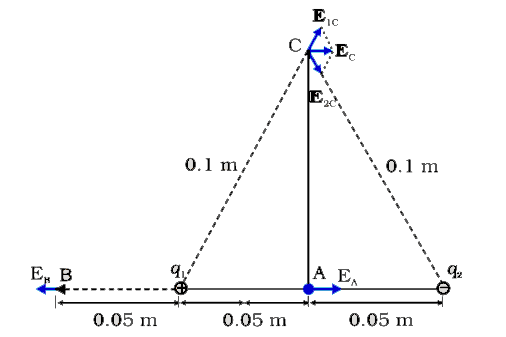
Two point charges `q_(1) and q_(2)`, of magnitude `+10^(–8) C and –10^(–8)C`, respectively, are placed 0.1 m apart. Calculate the electric fields at points A, B and C shown in Fig. 1.14.

A

`E_(A)= 7.2xx10^(4)NC^(-1)` `E_(B)=3.2xx10^(4)NC^(-1)`
`E_(B)` is directed towards the RIGHT.`

B

`E_(A)= 7.2xx10^(-4)NC^(-1)` `E_(B)=3.2xx10^(4)NC^(-1)`
`E_(B)` is directed towards the left.`

C

`E_(A)= 7.2xx10^(4)NC^(-1)` `E_(B)=3.2xx10^(4)NC^(-1)`
`E_(B)` is directed towards the left.`

D

`E_(A)= 7.2xx10^(4)NC^(-1)` `E_(B)=3.2xx10^(-4)NC^(-1)`
`E_(B)` is directed towards the left.`

Text Solution

Verified by Experts

The correct Answer is:

C

The electric field vector E1A at A due to the positive charge q1 points towards the right and has a magnitude
`E_(1A)=((9xx10^(9)NmC^(2))xx(10^(-8)C))/((0.05m^(2)))=3.6cc10^(4)NC^(-1)`
The electric field vector E2A at A due to the negative charge q2 points towards the right and has the same magnitude. Hence the magnitude of the total electric field EA at A is
`E_(A)=E_(1A)+E_(2A)=7.2xx10^(4)NC^(-1)`
`E_(A)` is directed toward the light.
The electric field vector E1B at B due to the positive charge q1 points towards the left and has a magnitude
`E_(1B)=((9xx10^(9)Nm^(2)C^(-2))xx(10^(-8C)))/((0.05m)^(2))=3.6xx10^(4)NC^(-1)`
The electric field vector E2B at B due to the negative charge q2 points towards the right and has a magnitude
`E_(1B)=((9xx10^(9)Nm^(2)C^(-2))xx(10^(-8C)))/((0.15m)^(2))=4xx10^(3)NC^(-1)`
The magnitude of the total electric field at B is
`E_(B)=E_(1B)-E_(2B)=3.2xx10^(4)NC^(-1)`
`E_(B)` is directed towards the left.
The directions in which these two vectors point are indicated in Fig. 1.14. The resultant of these two vectors is
`E_(C)=E_(1) cos (pi)/(3)+ E_(2) "Cos" (pi)/(3)=9xx10^(-3)NC^(-1)`
`E_(c)` points towards the right.
Promotional Banner

Topper's Solved these Questions

  • ELECTRIC CHARGES AND FIELDS

    NCERT ENGLISH|Exercise Exercise|34 Videos
  • DUAL NATURE OF RADIATION AND MATTER

    NCERT ENGLISH|Exercise All Questions|32 Videos
  • ELECTROMAGNETIC INDUCTION

    NCERT ENGLISH|Exercise Exercise|17 Videos

Similar Questions

Explore conceptually related problems

Two point charges +10^(-7) C and -10^(-7)C are placed at A and B 20 cm apart as shown in the figure. Calculate the electric field at C, 20 cm apart from both A and B.

Two charges +5mu C and +10 mu C are placed 20 cm apart. The net electric field at the mid-point between the two charges is

Two point charges q_(A)= 3mu C and q_(B) = - 3muC are located 20cm apart in vacuum. What is the electric field at the mid point of the line joining the two charges.

Two point charges q_(A) = 3 mu C and q_(B) = -3 muC are located 20 cm apart in vaccum (a) what is the electric field at the mid point O of the line AB joining the two charges ? (b) If a negative test charge of magnitude 1.5xx10^(-9) C is placed at the point, what is the force experienced by the test charge ?

In figure, the charges on C_(1),C_(2) , and C_(3) , are Q_(1), Q_(2) , and Q_(3) , respectively. .

Three large identical conducting parallel plates carrying charge +Q , -Q, and +2Q , respectively, are placed as shown in figure. If E_A, E_b, and E_C refer to the magnitudes of the electric field at points A, B, and C, respectively. Then

Two point charges Q_1 = 400 muC and Q_2 = 100 muC are kept fixed, 60 cm apart in vacuum. Find intensity of the electric field at midpoint of the line joining Q_1 and Q_2 .

Two charges q_(1) and q_(2) are placed at (0,0,d) and (0,0,-d) respectively. Find locus of points where the potential is zero.

Two point charges +8q and -2q are located at x=0 and x=L respectively. The location of a point on the x axis at which the net electric field due to these two point charges is zero is

The positions of two point charges q_(1) and q_(2) are vecr_(1) and vecr_(2) , respectively. Find the position of the point where the net field is zero due to thses charges.

NCERT ENGLISH-ELECTRIC CHARGES AND FIELDS-Exercise
  1. Two point charges q(1) and q(2), of magnitude +10^(–8) C and –10^(–8)C...

    Text Solution

    |

  2. What is the force between two small charged spheres having charges of...

    Text Solution

    |

  3. The electrostatic force on a small sphere of charge 0.4 muC due to ano...

    Text Solution

    |

  4. Check that the ratio ke2/G memp is dimensionless. Look up a Table of P...

    Text Solution

    |

  5. (a) Explain the meaning of the statement ‘electric charge of a body is...

    Text Solution

    |

  6. When a glass rod is rubbed with a silk cloth, charges appear on both. ...

    Text Solution

    |

  7. Four point charges q(A) = 2 mu C , q(B) = -5 mu C, q(C) = 2 mu C and ...

    Text Solution

    |

  8. (a) An electrostaic field line is a continous curve. That is a field l...

    Text Solution

    |

  9. Two point charges q(A) = 3 mu C and q(B) = -3 muC are located 20 cm ...

    Text Solution

    |

  10. A system has two charges q(A)= +2.5xx10^(-7)C and q(B)= -2.5xx10^(-7)C...

    Text Solution

    |

  11. An electrtic dipole with dipole moment 4xx10^(-9) C m is aligned at ...

    Text Solution

    |

  12. A polythene piece rubbed will wool is found to have a negative charge ...

    Text Solution

    |

  13. (a) Two insulated charged copper spheres A and B have their center...

    Text Solution

    |

  14. Suppose the spheres A and B in the above question have identical sizes...

    Text Solution

    |

  15. Figure shows tracks of three charged particles crossing a uniform elec...

    Text Solution

    |

  16. Consider a uniform electric field E = 3xx10^(3) hat(i) N//C. (a) What...

    Text Solution

    |

  17. What is the net flux of the uniform electric field of the above questi...

    Text Solution

    |

  18. Careful measurement of the electric field at the surface of a black...

    Text Solution

    |

  19. A point charge +10 mu C is at distance of 5cm directly above the cente...

    Text Solution

    |

  20. A point charge of 2.0 muC is at center of a cublic Gaussian surface 9...

    Text Solution

    |

  21. A point charge causes an electric flux of -1.0xx10^(3) N m^(2)//C to p...

    Text Solution

    |
