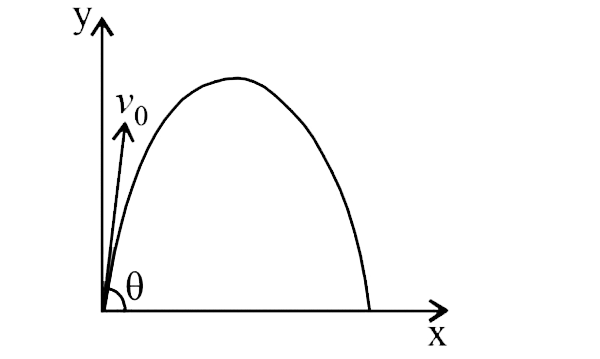
A small particle of mass ` m` is projected at an angle `theta` with the ` x`- axis with an initial velocity ` v_(0)` in the ` x-y `plane as shown in the figure . At a time ` t lt ( v_(0) sin theta)/(g) `, the angular momentum of the particle is where `hat (i) , hat (j) and hat(k)` are unit vectors along `x , y and z` - axis respectively.
A
`-mgv_(0)t^(2)cos thetahatj`
B
`mgv_(0)t cos theta hatk`
C
`-(1)/(2)mgv_(0)t^(2)cos theta hatk`
D
`(1)/(2)mgv_(0) t^(2)cos theta hati`
Text Solution
Verified by Experts
The correct Answer is:
C
Topper's Solved these Questions
JEE MAINS
JEE MAINS PREVIOUS YEAR ENGLISH|Exercise Chemistry|1 Videos
JEE MAIN
JEE MAINS PREVIOUS YEAR ENGLISH|Exercise All Questions|452 Videos
JEE MAINS 2020
JEE MAINS PREVIOUS YEAR ENGLISH|Exercise PHYSICS|250 Videos
Similar Questions
Explore conceptually related problems
If x(hat(i) + hat(j) + hat(k)) is a unit vector then x equals ?
A small particle of mass m is projected at an angle 0 with the x- axis, with initial velocity V_0 in the x - y plane. Just before time (2V_0sin0)/g ,the angular momentum of the particle about the point of projection is
Find the value of x for which x( hat i+ hat j+ hat k) is a unit vector.
The angle which the vector vec(A)=2hat(i)+3hat(j) makes with the y-axis, where hat(i) and hat(j) are unit vectors along x- and y-axis, respectively, is
Find the value of x for which x\ ( hat i+ hat j+ hat k) is a unit vector.
Find the value of x for which x\ ( hat i+ hat j+ hat k) is a unit vector.
Unit vector along the vector hat(i) + hat(j) + hat(k) is
Find the angle between x-axis and the vector hat(i) + hat(j) + hat(k)
A particle of mass m moves in the XY plane with constant velocity v along the straight line PQ as shown in the figure. Its angular momentum with respect to origin O is( theta is angle between vec v and x-axis)
The angles with a vector hat(i)+hat(j)+sqrt(2hat(k)) makes with X,Y and Z axes respectively are
JEE MAINS PREVIOUS YEAR ENGLISH-JEE MAINS-Chemistry