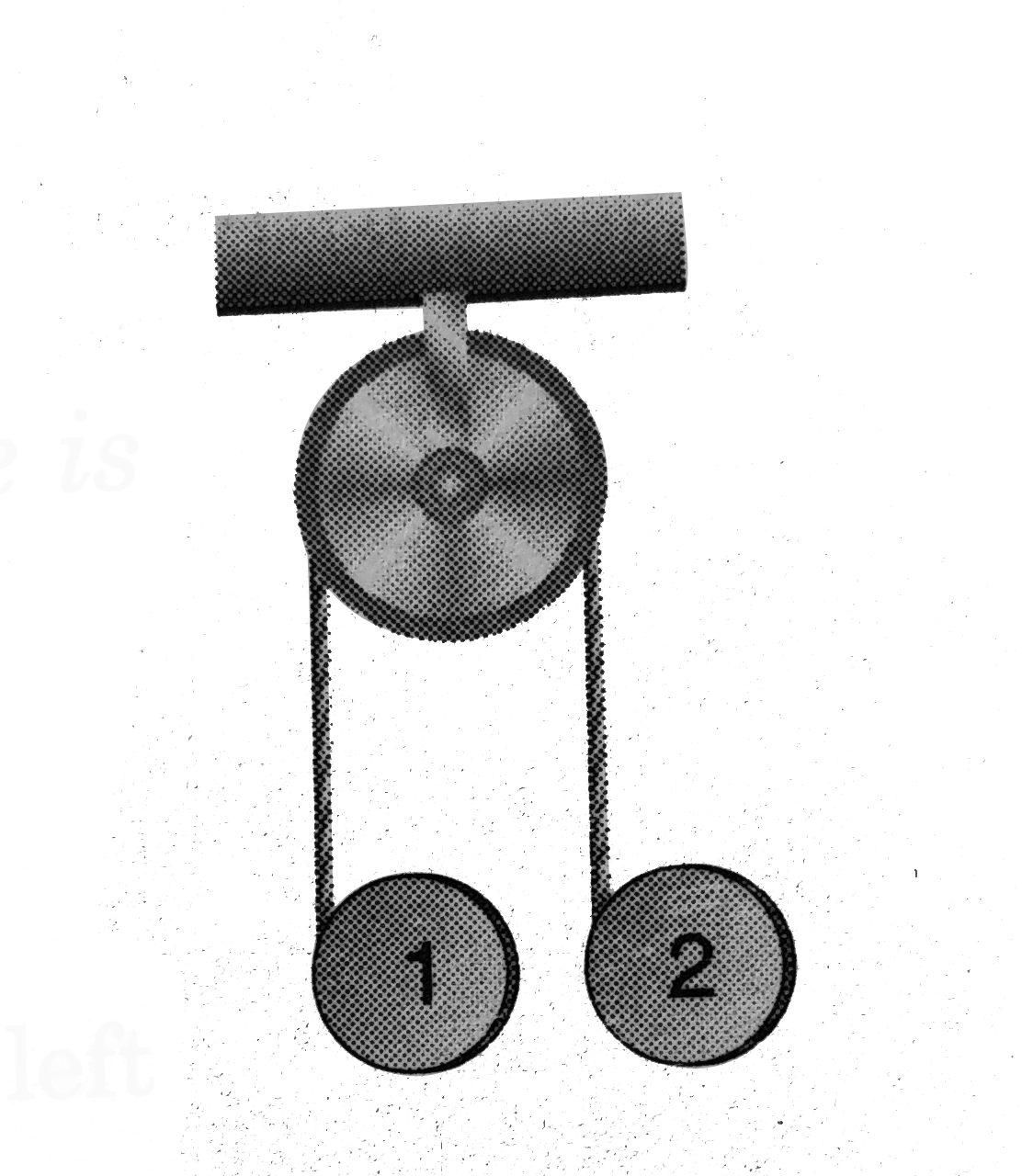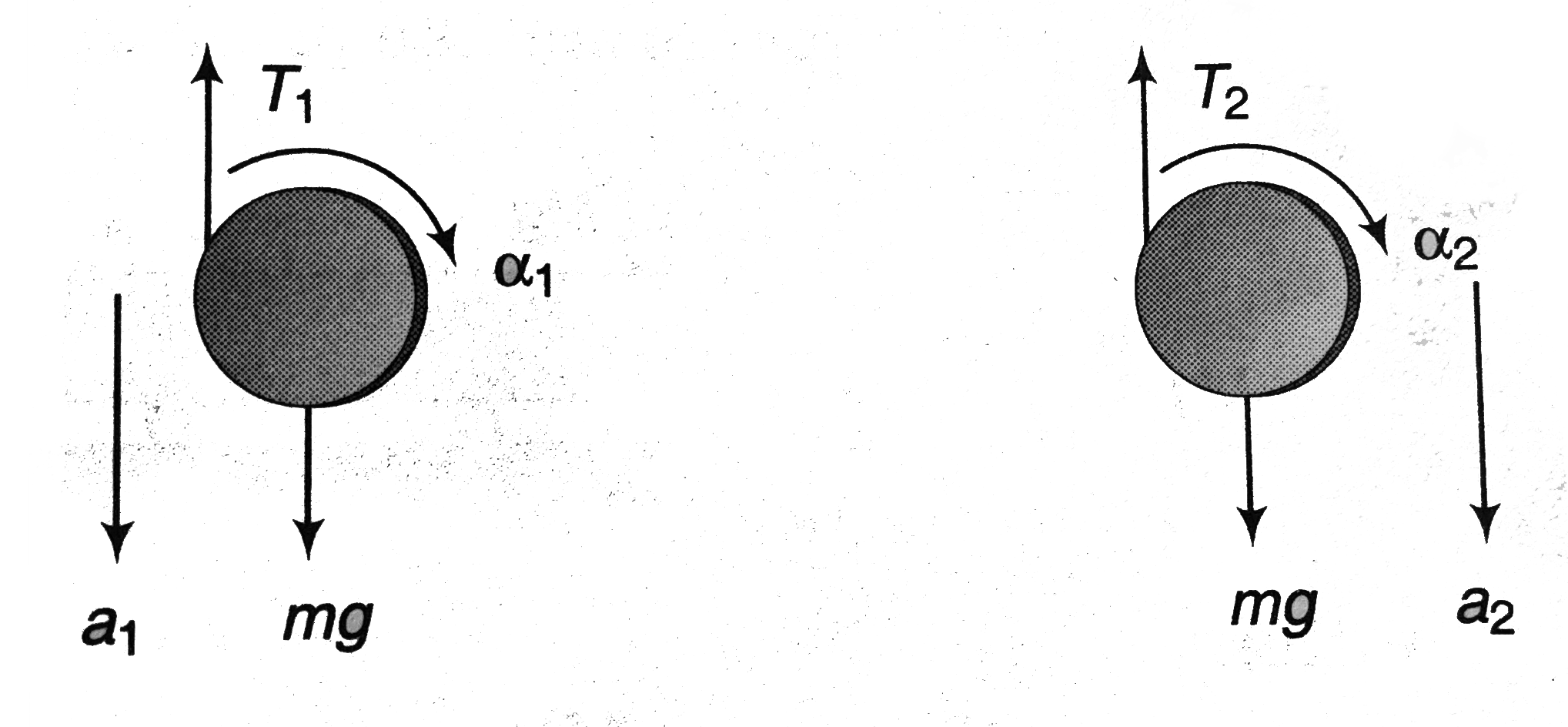
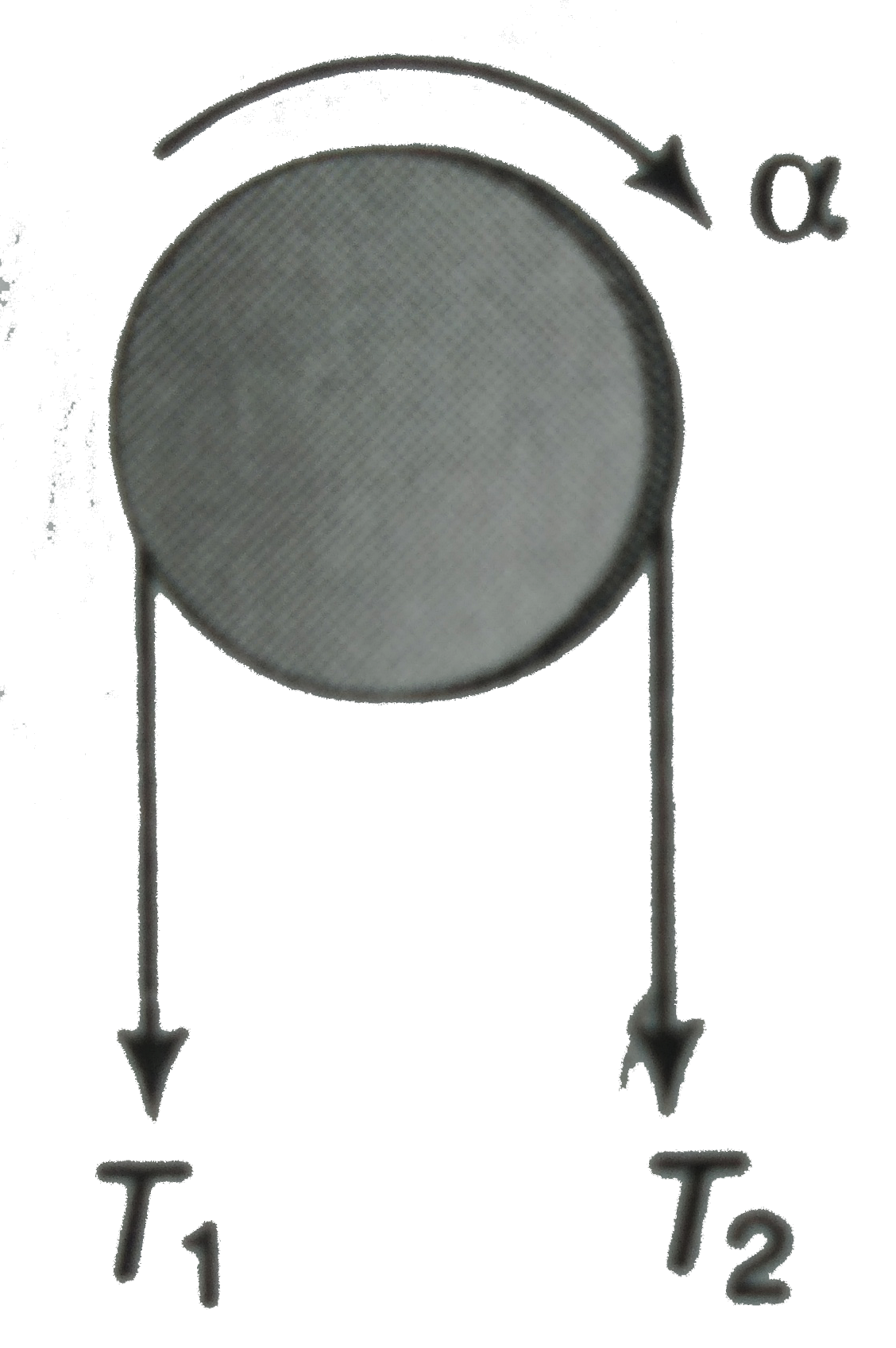
Let R be the radius of the disc and `T_(1)` and `T_(2)` be the tensions in the left and right segments of the rope
Acceleration of disc 1,
`a_(1)=(mg-T_(1))/(m)` ..(i)
Acceleration of disc 2, `a_(2)=(mg-T_(2))/(m)` ..(ii)
Angular acceleration of disc 1, `alpha_(1)=(tau)/(I)=(T_(1)R)/((1)/(2)mR^(2))=(2T_(1))/(mR)` ..(iii)
Similarly, angular acceleration of disc 2, `alpha_(2)=(2T_(2))/(mR)` ..(iv)
Both `alpha_(1)` and `alpha_(2)` are clockwise.
Angular acceleration of pulley
`alpha=((T_(2)-T_(1))R)/((1)/(2)mR^(2))=(2(T_(2)-T_(1)))/(mR)` ..(v)
For no slipping `Ra_(1)=a_(2)-Ralpha_(2)=Ralpha` ..(vi)
Solving these equation we get
`a=0` and `a_(1)=a_(2)=(2g)/(3)`
Alternate solution
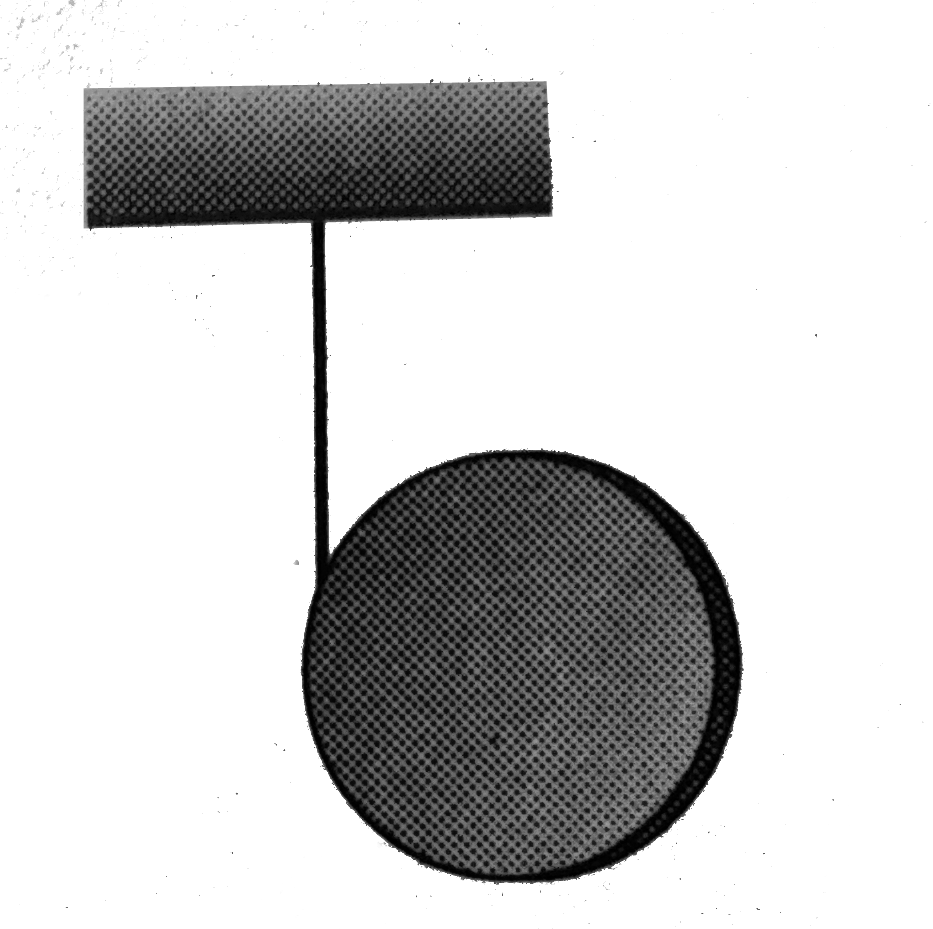
As both the discs are in identical situation `T_(1)=T_(2)` and `alpha=0` i.e, each of the discs falls independently and identically. therefore this is exactly similar to the problem shown in figure.