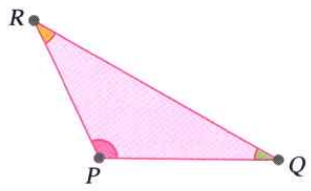
In the given triangle, name the following: (a). The vertices of the triangle (b). The sides of the triangle (c) the side opposite to vertex Q (d) the vertex opposite to side PQ (e) the three angles using three letters (f) the three angles using a single letter
In the adjoining figure : Name the vertex opposite to side PQ.
In the adjoining figure : Name the side opposite the vertex Q.
In a triangle the greater angle has the longer side opposite to it.
Three identical positive charges Q are arranged at the vertices of an equilateral triangle. The side of the triangle is a. Find the intensity of the field at the vertex of a regular tetrahedron of which the triangle is the base.
If a vertex of an equilateral triangle is the origin and the side opposite to it has the equation x+y=1, then orthocentre of the triangle is :
Which of the following statements are true (T) and which are false (F): Side opposite to equal angles of a triangle may be unequal. Angle opposite to equal sides of a triangle are equal. The measure of each angle of an equilateral triangle is 60^0 If the altitude from one vertex of a triangle bisects the opposite side, then the triangle may be isosceles. The bisectors of two equal angles of a triangle are equal. If the bisector of the vertical angle of a triangle bisects the base, then the triangle may be isosceles. The two altitudes corresponding to two equal sides of a triangle need not be equal. If any two sides of a right triangle are respectively equal to two sides of other right triangle, then the two triangles are congruent. Two right triangles are congruent if hypotenuse and a side of one triangle are respectively equal to the hypotenuse and a side of the other triangle.
If one side of a triangle is double the other, and the angles on opposite sides differ by 60^0, then the triangle is equilateral (b) obtuse angled (c) right angled (d) acute angled
Prove that in a triangle if the square of one side is equal to the sum of the squares of the other two side then the angle opposite to the first side is a right angle.
Prove that in a triangle, if the square of one side is equal to the sum of the squares of the other two sides, then the angles opposite to the first side is a right angle.
If the square of one side of a triangle is equal to the sum of the squares of the other two sides then the triangle is a right triangle with the angle opposite the first sides as right angle.
ICSE-THE TRIANGLE AND ITS PROPERTIES-WARM UP EXERCISE