Home
Class 12
CHEMISTRY
Which of the following compound will giv...

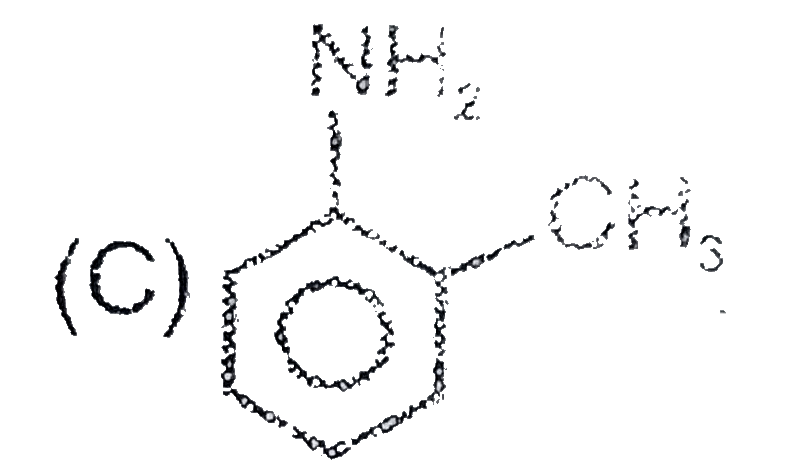
Which of the following compound will give smell of `NH_(3)` with conc. `NaOH`.

A

`CH_(3)-CH_(2)-underset(O)underset(||)C-NH_(2)`

B

`CH_(3)-underset(O)underset(||)C-CH_(2)-NH_(2)`

C

D

`CH_(3)-CH_(2)-underset(O)underset(||)C-OH`

Text Solution

AI Generated Solution

The correct Answer is:

To determine which compound will give the smell of ammonia (NH₃) when treated with concentrated sodium hydroxide (NaOH), we need to analyze the behavior of different types of compounds when they react with strong bases. ### Step-by-Step Solution: 1. **Identify the Compounds**: The question mentions several compounds, including an amide, an amine, and possibly others. We need to focus on their structures and functional groups. 2. **Understand the Reaction with NaOH**: When a compound reacts with concentrated NaOH, we need to consider how the functional groups will interact with the base. Specifically, we are looking for a reaction that produces ammonia gas. 3. **Analyze the Amide Reaction**: - Amides (like propanamide) can undergo hydrolysis in the presence of a strong base. - The reaction can be represented as: \[ \text{RCONH}_2 + \text{NaOH} \rightarrow \text{RCOONa} + \text{NH}_3 \] - Here, the amide is converted into a sodium salt of the corresponding carboxylic acid and ammonia gas is released. 4. **Analyze the Amine Reaction**: - Amines do not produce ammonia when treated with NaOH. Instead, they may form an ammonium salt but do not release NH₃ gas. 5. **Analyze Other Functional Groups**: - For carboxylic acids, the reaction with NaOH leads to the formation of a carboxylate salt and water, but no ammonia is produced. - Other compounds may also not yield ammonia upon reaction with NaOH. 6. **Conclusion**: Based on the analysis, the only compound that produces ammonia gas when treated with concentrated NaOH is an amide. Therefore, the correct answer is the compound that is an amide. ### Final Answer: The compound that will give the smell of NH₃ with concentrated NaOH is **the amide** (option 1).

To determine which compound will give the smell of ammonia (NH₃) when treated with concentrated sodium hydroxide (NaOH), we need to analyze the behavior of different types of compounds when they react with strong bases. ### Step-by-Step Solution: 1. **Identify the Compounds**: The question mentions several compounds, including an amide, an amine, and possibly others. We need to focus on their structures and functional groups. 2. **Understand the Reaction with NaOH**: When a compound reacts with concentrated NaOH, we need to consider how the functional groups will interact with the base. Specifically, we are looking for a reaction that produces ammonia gas. ...
Promotional Banner

Topper's Solved these Questions

  • STRUCTURAL IDENTIFICATION

    RESONANCE ENGLISH|Exercise Exercise - 2 (Part-I)|10 Videos
  • STRUCTURAL IDENTIFICATION

    RESONANCE ENGLISH|Exercise Exercise - 2 (Part-II)|8 Videos
  • STRUCTURAL IDENTIFICATION

    RESONANCE ENGLISH|Exercise Exercise-1 (Part-I)|23 Videos
  • STEREOISOMERISM

    RESONANCE ENGLISH|Exercise EXERCISE (PART III : PRACTICE TEST-2 (IIT-JEE (ADVANCED PATTERN))|23 Videos
  • SURFACE CHEMISTRY

    RESONANCE ENGLISH|Exercise Section - 5|1 Videos

Similar Questions

Explore conceptually related problems

Which of the following compounds will dissolve in aq. NaOH ?

Which of the following compounds will not dissolve in aqueous NaOH?

Which of the following compound will given yellow precipitate on shaking with aqueous solution of NaOH followed by the addition of AgNO_(3) solution ?

Which one of the following compounds readily reacts will NaOH ?

Which of the following compounds does not react with NaOH ?

Which of the following compound will not turn black on adding NH_(4)OH to it ?

Which of the following carbonyl compound will give two products after reaction with NH_(2)OH :

Which of the following metal(s) in liquid NH_(3) with low conc. Is not paramagnetic?

Which of the following compound gives a product with foul smell when reacted with chloroform in presence of a alkali ?

RESONANCE ENGLISH-STRUCTURAL IDENTIFICATION-Exercise-1 (Part-II)
  1. Which of the following compounds gives red ppt with Cu(2)Cl(2)//NH(4)O...

    Text Solution

    |

  2. Identify the hydrocarbon having molecular formula C(5)H(6) which gives...

    Text Solution

    |

  3. The group reagent for the test of alcohols is :

    Text Solution

    |

  4. The following two compounds I and II can be distinguished by using rea...

    Text Solution

    |

  5. Which of the following compound will not react with l(2)//OH^(-).

    Text Solution

    |

  6. A compound A gives following reactions. Its structure can be

    Text Solution

    |

  7. An organic compound X (C(4)H(8)O(2)) gives positive test with NaOH an...

    Text Solution

    |

  8. Which of the following compound will give smell of NH(3) with conc. Na...

    Text Solution

    |

  9. Which of the following will not give positive test with CHCl(3)//KOH.

    Text Solution

    |

  10. A positive carbylamine test is shown by :

    Text Solution

    |

  11. The Hinsberg's method is used for :

    Text Solution

    |

  12. The IUPAC name for the following compound is

    Text Solution

    |

  13. , Instant turbidity Identyfy X :

    Text Solution

    |

  14. Which of the following would produce effervescence with sodium bicarbo...

    Text Solution

    |

  15. A compound is heated with zinc dust and ammonium chloride followed by ...

    Text Solution

    |

  16. In the Lassaigne's test , one of the organic compound gave red colour ...

    Text Solution

    |

  17. Lassaigne's test is used in the qualitative analysis to detect

    Text Solution

    |

  18. The compound that does not give a blue colour in Lassaigne’s test is:

    Text Solution

    |

  19. Nitrogen containing organic compound when fused with sodium metal form...

    Text Solution

    |

  20. The sodium extract of an organic compound on acidified with acetic aci...

    Text Solution

    |
