


Home
Class 11
CHEMISTRY
Resonance stabilized cation is:...

Resonance stabilized cation is:

A

B

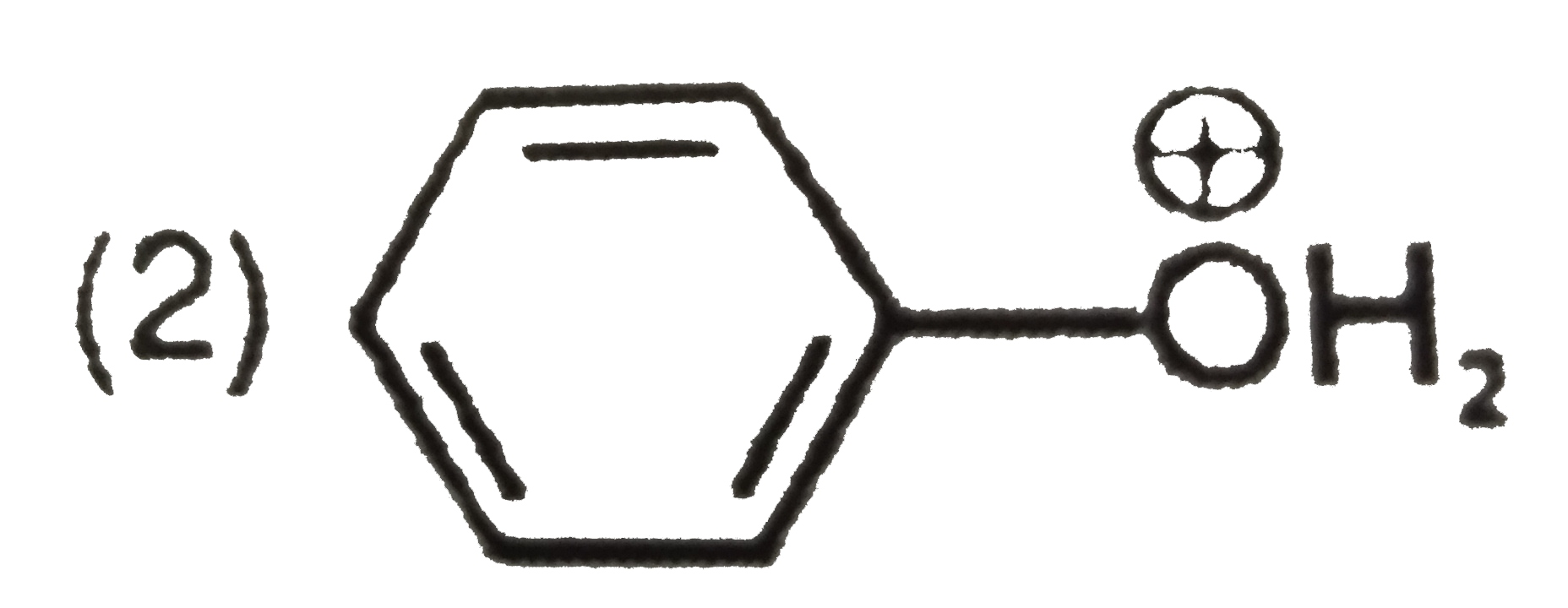
C

D

Text Solution

AI Generated Solution

The correct Answer is:

To determine which cation is resonance stabilized, we need to analyze the given options based on the concept of resonance, which involves the delocalization of pi electrons. Here’s a step-by-step solution: ### Step 1: Understand Resonance Resonance occurs when electrons can be delocalized across multiple atoms, allowing for different structural representations (resonance structures) of the same molecule. This delocalization stabilizes the molecule. ### Step 2: Analyze Each Option We will analyze each option to see if the cation can be resonance stabilized. #### Option A: Cation with Nitrogen and Benzene Ring - The nitrogen in this cation has three bonds with hydrogens and one bond with the benzene ring, making it sp³ hybridized. - Nitrogen can form a maximum of four bonds. If we try to delocalize electrons from the benzene ring to nitrogen, nitrogen would exceed its bonding capacity (five bonds), which is not possible. - **Conclusion**: This cation is not resonance stabilized. #### Option B: Cation with Oxygen - This cation has oxygen with three bonds (two with hydrogens and one with carbon), making it sp³ hybridized. - Similar to nitrogen, oxygen can form a maximum of three bonds. It cannot participate in resonance as it also lacks d orbitals for delocalization. - **Conclusion**: This cation is also not resonance stabilized. #### Option C: Cation with Nitrogen and Resonance Structures - This cation can form multiple resonance structures. The nitrogen can donate its lone pair to form a double bond with a neighboring carbon, creating a positive charge on the adjacent carbon. - The resonance structures can shift the positive charge around, allowing for stabilization through delocalization. - **Conclusion**: This cation is resonance stabilized. #### Option D: Another Cation with Nitrogen - This cation is similar to option A, where nitrogen is sp³ hybridized and already has four bonds. - It cannot participate in resonance as it would also exceed its bonding capacity. - **Conclusion**: This cation is not resonance stabilized. ### Final Answer The resonance stabilized cation is **Option C**.

To determine which cation is resonance stabilized, we need to analyze the given options based on the concept of resonance, which involves the delocalization of pi electrons. Here’s a step-by-step solution: ### Step 1: Understand Resonance Resonance occurs when electrons can be delocalized across multiple atoms, allowing for different structural representations (resonance structures) of the same molecule. This delocalization stabilizes the molecule. ### Step 2: Analyze Each Option We will analyze each option to see if the cation can be resonance stabilized. ...
Promotional Banner

Topper's Solved these Questions

  • GENERAL ORGANIC CHEMISTRY-I

    RESONANCE ENGLISH|Exercise PART-2(NSEC)|24 Videos
  • GENERAL ORGANIC CHEMISTRY-I

    RESONANCE ENGLISH|Exercise PART-III : PRACTICE TEST-2|1 Videos
  • GENERAL ORGANIC CHEMISTRY-I

    RESONANCE ENGLISH|Exercise JEE(MAIN) ONLINE PROBLEMS|2 Videos
  • GENERAL ORGANIC CHEMISTRY II

    RESONANCE ENGLISH|Exercise Part-III: Section-5: Matching List Type|1 Videos
  • HYDROGEN AND ITS COMPOUNDS

    RESONANCE ENGLISH|Exercise INORGANIC CHEMISTRY(Hydrogen & its compunds Y environment chemistry)|33 Videos

Similar Questions

Explore conceptually related problems

In the following questions, a statement of assertion (A) is followed by a statement of reason (R ) A : CO_(2) is resonance stabilized molecule. R : Bond length of C-O I CO_(2) is intemediate of single and double bond length.

Resonance is delocalisation of :

Resonance involves :

Resonance is not possible in

The concept of resonance explains various properties of compounds.The molecule with conjugated system of pi bonds, are stabilized by resonance and have low heat of hydrogenation .Hyperconjugative stabilization also decreases heat of hydrogenation. In aromatic rings a functional group with a lone pair of electron exerts +m effect.Some functional groups like -NO, -NC, -CH=CH_2 can function both as electrons releasing (+m,+R) or electron withdrawing (-m,-R) groups.More extended conjugation provides more stabilization. The correct heat of hydrogenation order is (p)1,3-Pentadiene , (q)1,3-Butadiene , (r)2,3-Dimethyl-1,3-butadiene , (s)Propadiene

RESONANCE ENGLISH-GENERAL ORGANIC CHEMISTRY-I-PRACTICE TEST-1
  1. Which of the following compounds is not aromatic ?

    Text Solution

    |

  2. Which compound has least e^(-) density in benzene ring

    Text Solution

    |

  3. The order of heat of hydrogenation in following compounds is:

    Text Solution

    |

  4. Resonance stabilized cation is:

    Text Solution

    |

  5. In HCOO^(-) , the two carbon- oxygen bonds to be of equal length. What...

    Text Solution

    |

  6. Compare C-N bond length in the following :

    Text Solution

    |

  7. Which of the following is false for order of -l effect :

    Text Solution

    |

  8. underset("x")(H-N=C=O)harrunderset("y")(H-overset(o+)N-=C-overset(Thet...

    Text Solution

    |

  9. would be :

    Text Solution

    |

  10. Number of delocalized e^(-) pairs in squaric acid and dianion of squar...

    Text Solution

    |

  11. Which of the following benzene ring has greater electron density than ...

    Text Solution

    |

  12. Which of the following has the miximum number of resonating structure ...

    Text Solution

    |

  13. Among the following the aromatic compound is

    Text Solution

    |

  14. overset(Theta)overset(..)CH(2)-underset(O)underset(||)C-CH(3) and CH(2...

    Text Solution

    |

  15. Which is not stable

    Text Solution

    |

  16. Correct order of stability of following alkenes is

    Text Solution

    |

  17. All the carbon-carbon bond lengths are equal in

    Text Solution

    |

  18. The kind of delocalisation involving sigma bond orbitals is called……

    Text Solution

    |

  19. Which of the following has the highest dipole moment.

    Text Solution

    |

  20. in C(1)-H, C(2)-H and C(3)-H the homolytic bond dissociation energy or...

    Text Solution

    |
