Home
Class 7
CHEMISTRY
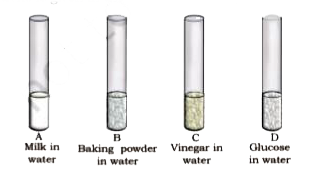
Look at Figure 5.1 which shows soluti...

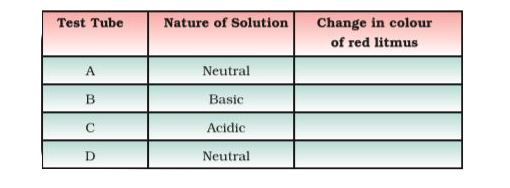
Look at Figure 5.1 which shows solutions taken in test tubes A,B,C and D . What colour is expected when a piece of red litmus paper is dropped in each test tube ? Nature of the solutions is given in the table for your help .

Text Solution

Verified by Experts

According to the given condition:
A - Neutral - No Change
B - Basic - Colour will change to blue
C - Acidic - No change
D - Neutral - No change
Promotional Banner

Topper's Solved these Questions

  • ACIDS , BASES AND SALTS

    NCERT EXEMPLAR|Exercise LONG ANSWER QUESTIOS |7 Videos
  • ACIDS , BASES AND SALTS

    NCERT EXEMPLAR|Exercise VERY SHORT ANSWER QUESTIONS |9 Videos
  • FIBRE TO FABRIC

    NCERT EXEMPLAR|Exercise LONG ANSWER QUESTIONS|11 Videos

Similar Questions

Explore conceptually related problems

You are provided with three test tubes A,B and C as shown in Figure 5.3 with different liquids . What will you observe when you put (a) a piece of blue litmus paper in each test tube . (b) a piece of red litmus paper in each test tube . (c ) a few drops of phenolphthalein solution to each test tube .

What changes are observed when a soap solution is tested with a red and a blue litmus paper ?

(a) You are provided with three test tubes A,B,C which contain distilled water , acidic and basic solutions . If you are given blue litmus paper only , how will you identify the nature of the solutions in three tubes? (b) How will you prove that a given salt is a carbonate of a metal ?

A student was given four unknown solutions in test tubes marked A,B,C and D and asked to test them with universal indicator solution. He observed that on putting universal indicator solution, the solutions A,B,C and D turned blue, orange, green and red respectively. The test tube which contains sodium chloride solution is:

2 mL each of conc. HCl, conc. HNO3 and a mixture of conc.HCl and HNO_3 in the ratio of 3:1 were taken in test tubes labelled as A, B and C. A small piece of metal was put in each test tube. No change occurred in test tubes A and B but the metal got dissolved in test tube C. the metal could be

2mL of ethanoic acid was taken in each of test tube I and test tube II. A red litmus paper was introduced in test tube I and a pH paper was introduced in test tube II. The experiment was performed by four students A,B,C and D and they reported their observations as given below: The correct set of observations was made by the student:

2 mL each of conc. HCl, HNO_(3) and a mixture of conc. HCl and conc. HNO_(3) in the ratio of3 : 1 were taken in test tubes labelled as A, B and C. A small piece of metal was put in each test tube. No change occurred in test tubes A and B but the metal got dissolved in test tube C. The metal could be
