Two particle A and B are moving in XY-plane. Their positions vary with time t according to relation `x_(A)(t)=3t, x_(B)(t)=6` `y_(A)(t)=t, y_(B)(t)=2+3t^(2)` The distance between two particle at `t=1` is :
Text Solution
Verified by Experts
The correct Answer is:
B
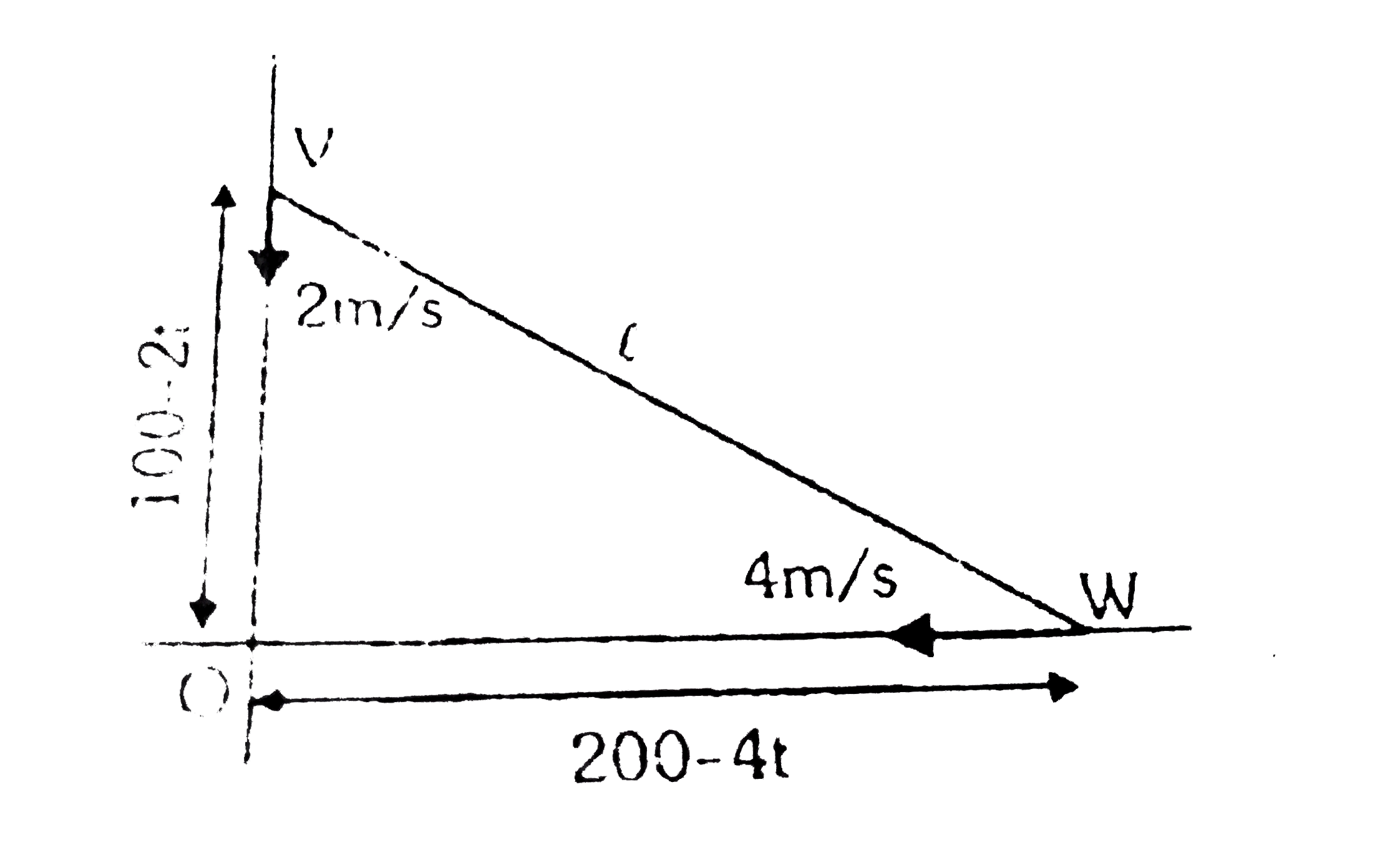
`l=sqrt((100-2t)^(2)+(200-4t)^(2))`
Topper's Solved these Questions
BASIC MATHS
ALLEN |Exercise Comprehension 3|3 Videos
BASIC MATHS
ALLEN |Exercise Comprehension 4|3 Videos
BASIC MATHS
ALLEN |Exercise Comprehension 1|5 Videos
AIIMS 2019
ALLEN |Exercise PHYSICS|39 Videos
CIRCULAR MOTION
ALLEN |Exercise EXERCISE (J-A)|6 Videos
Similar Questions
Explore conceptually related problems
A particle moves in the x-y plane. It x and y coordinates vary with time t according to equations x=t^(2)+2t and y=2t . Possible shape of path followed by the particle is
A particle moving in a straight line has its velocit varying with time according to relation v = t^(2) - 6t +8 (m//s) where t is in seconds. The CORRECT statement(s) about motion of this particle is/are:-
The position of a particle moving in space varies with time t according as :- x(t)=3 cosomegat y(t)=3sinomegat z(t)=3t-8 where omega is a constant. Minimum distance of particle from origin is :-
A particle moves in a straight line and its position x at time t is given by x^(2)=2+t . Its acceleration is given by :-
The coordinates of a particle moving in XY-plane very with time as x=4t^(2),y=2t . The locus of the particle is
The displacement of a particle varies with time according to the relation y= a sin omega t+b cos omega t ……………
A particle moves along X-axis in such a way that its coordinate X varies with time t according to the equation x = (2-5t +6t^(2))m . The initial velocity of the particle is
The displacement of a particle is given by x(t) = (4t ^(2) +8) meter. The instantaneous velocity of a particle at t = 2s is
The displacement (in metre) of a particle varies with time (in second) according to the equation y =- (2)/(3) t ^(2) + 16 t +2. How long does the particle take to come to rest ?
A particle moves along a straight line and its position as a function of time is given by x = t6(3) - 3t6(2) +3t +3 , then particle