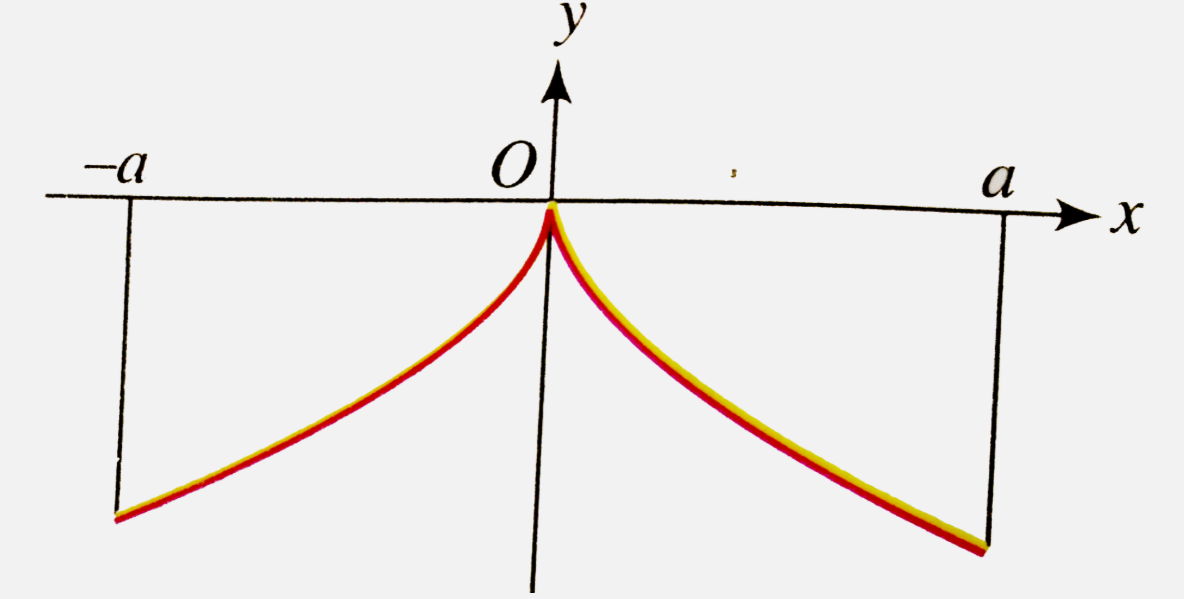
Following is the graph of y = f'(x) and f(0) = 0 . (a) What type of function y = f'(x) is ? Odd or even? (b) What type of function y = f(x) is ? Odd or even? (c) What is the value of `int_(-a)^(a) f(x) dx`? (d) Has y = f(x) point of inflection? (e) What is the nature of y = f(x)? Monotonic or non-monotonic?
Text Solution
Verified by Experts
(a) The graph of y = f'(x) is symmetrical about the y-axis, so f(x) is an even function. (b) f(0) = 0, so f(x) is an odd function [derivative of an odd function is even]. (c) As f(x) is odd, so `underset(-a)overset(a) int f(x) dx = 0` (d) `f''(x) gt 0 as x lt 0 and f''(x) lt 0 "as " x gt 0`. Therefore, x = 0 is the point of inflexion. (e) ` f'(x) le 0, forall x, ` so f(x) is always decreasing.
If f(x) is an odd function of x, then show that, int_(-a)^(a)f(x)dx=0 .
Which of the following is true about point of extremum x=a of function y=f(x)? (a) At x=a , function y=f(x) may be discontinuous. (b) At x=a , function y=f(x) may be continuous but non-differentiable. (c) At x=a ,function y=f(x) may have point of inflection. (d) none of these
Following is the graph of y = f' (x) , given that f(c) = 0. Analyse the graph and answer the following questions. (a) How many times the graph of y = f(x) will intersect the x - axis? (b) Discuss the type of roots of the equation f (x) = 0, a le x le b . (c) How many points of inflection the graph of y = f(x), a le x le b , has? ,(d) Find the points of local maxima/minima of y = f(x), a le x le b , , (e) f"(x)=0 has how many roots?
If f(0) = 0 ,f'(0) = 2 , then the value differentiable at x = 0 of function y = f[f{f(x)}] is _
If y=f{f(x)} , f(0) =0 and f'(0)=5, then the value of [(dy)/(dx)]_(x=0) is-
If f(x) is an odd function then int_(-a)^(a)f(x) is equal to-
Statement 1: If f(x) is an odd function, then f^(prime)(x) is an even function.
If f (x/y)= f(x)/f(y) , AA y, f (y)!=0 and f' (1) = 2 , find f(x) .
If f is an odd function, then evaluate I=int_(-a)^a(f(sinx)dx)/(f(cosx)+f(sin^2x))
If f is an odd function, then evaluate I=int_(-a)^a(f(sinx)dx)/(f(cosx)+f(sin^2x))
CENGAGE PUBLICATION-GETTING STARTED WITH GRAPHS-Exercises 1.18