Home
Class 12
PHYSICS
Define electric fied intensity and deriv...

Define electric fied intensity and derive an expression for it at a point on the neuttral axis of a dipole. Also determine its direction.

Text Solution

Verified by Experts
Electric field intensity at a point is defined as the force experienced by a unit positive charge placed at that point.
In S.I., the unit of E is (`NC^(-1)` or `Vm^(-1)`).
Axial line of an electric dipole is a line joining the centre of two charges and extended on either side. It is also known as End-on-position.
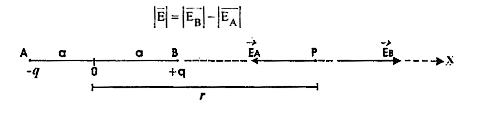
Consider an electric dipole consisting of charges `- q and +q`, separated by distance 2a and placed in the free space. Let P be a point on the axial line joining the two charges of the dipole at a distance r from the centre O of the dipole.
So `OP = r, AP = r + a` and `BP = r - a `
The electric field `vecE` at point P due to dipole will be the resultant of the electric field `vecE_A` (due to charge - q at point A) and `vecE_B` (due to charge + q at point B) i.e.,
`vecE = vec(E_A) + vec(E_B)`
Now, `|vecE_A| = 1/(4pi in_0) . q/(AP^2) = 1/(4pi in_0) . (q)/((r + a)^2) " " ` (along PA)
and `|vecE_B| = 1/(4pi in_0) . q/(BP^2) = 1/(4pi in_0) . q/((r - a)^2) " " `(along PX)
Obviously `|vecE_B|` is greater than `|vecE_A|` .
Since `vecE_A` and `vecE_B`, act along the same line but in opposite direction, the magnitude of the net electric field at point P is given by

or `E = 1/(4pi in_0) . q/((r - a)^2) - 1/(4pi in_0) . q/((r + a)^2) " " ` (along PX)
`= 1/(4 pi in_0) . q[((r + a)^2 - (r - a)^2)/((r^2 - a^2)^2)]`
or `E = 1/(4 pi in_0) . (q(4ra))/((r^2 - a^2)^2) = 1/(4pi in_0) (q(2a)(2r))/((r^2 - a^2)^2)`
Now, `q (2a)= p`, the magnitude of the electric dipole moment of the dipole. Therefore,
`E = 1/(4pi in_0) . (2pr)/((r^2 - a^2)^2)` (along PX)
It may be noted that direction of electric field at a point on axial line of the dipole is from charge `-q` to `+q`, same as that of electric dipole moment of the dipole. If dipole is of very short length or when the point P is very far away from the electric dipole, then `r^2 gt gt a^2` and hence `a^2` can be neglected
`E = 1/(4pi in_0) . (2pi r)/(r^4)`
`E = 1/(4pi in_0) . (2pi r)/(r^3)`
Promotional Banner

Topper's Solved these Questions

  • ELECTRIC FIELD

    BETTER CHOICE PUBLICATION|Exercise NUMERICAL PROBLEMS |10 Videos
  • ELECTRIC FIELD

    BETTER CHOICE PUBLICATION|Exercise NUMERICAL PROBLEMS (MOST EXPECTED QUESTIONS)|4 Videos
  • ELECTRIC FIELD

    BETTER CHOICE PUBLICATION|Exercise SHORT ANSWER TYPE QUESTIONS |7 Videos
  • ELECTRIC CURRENT, RESISTANCE AND E.M.F.

    BETTER CHOICE PUBLICATION|Exercise MOST EXPECTED QUESTIONS |14 Videos
  • ELECTRICAL DEVICES

    BETTER CHOICE PUBLICATION|Exercise (MOST EXPECTED QUESTIONS 2 MARK)|2 Videos

Similar Questions

Explore conceptually related problems

Define electric field intensity and derive a expressionm for it at a point on the neutal and a dipole. Also determine its direction.

Define electric field intensity at a point.

Define magnetic field intensity at a point and derive an expression for it at a point on the axial line of magnetic dipole. Also deduce the expression for small dipole.

Define electric field intensity and find an expression for it at a point due to a thin infinite long sheet of charge.

What is electric field intensity? Give its SI units. Derive an expression for it at a point on the equitorial line of an electric dipole. What is field, when dipole is short?

