Home
Class 11
PHYSICS
Acceleration of particle moving in strai...

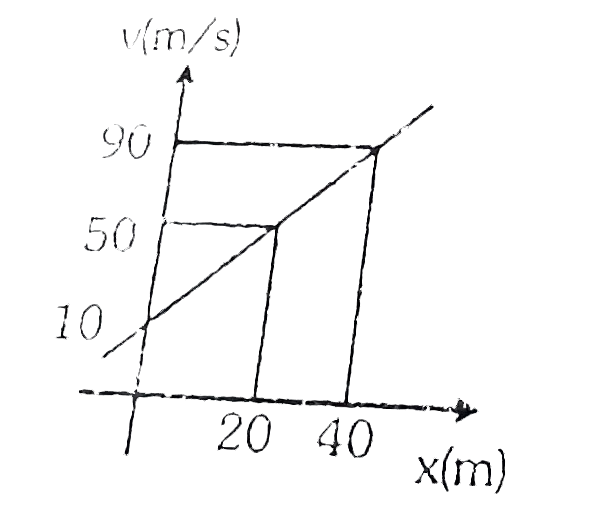
Acceleration of particle moving in straight line can be written as `a=(dv)/(dt)=v(dv)/(dx)`. From the given graph find acceleration at `x=20 m`.

Text Solution

Verified by Experts

The correct Answer is:

`100 m//s^(2)`

From graph `(dv)/(dx)=(90-50)/(40-20)=40/20(dv)/(dx)=2`
`("at " x=20)=50 m//s`
`a=v(dv)/(dx) rArr a=50xx2=100 m//s^(2)`
Promotional Banner

Topper's Solved these Questions

  • MISCELLANEOUS

    ALLEN|Exercise Exersice-4[B]|14 Videos
  • MISCELLANEOUS

    ALLEN|Exercise EXERCISE-5(A)|15 Videos
  • MISCELLANEOUS

    ALLEN|Exercise DATA SUFFICIENCY QUESTIONS|3 Videos
  • KINEMATICS (MOTION ALONG A STRAIGHT LINE AND MOTION IN A PLANE)

    ALLEN|Exercise BEGINNER S BOX-7|8 Videos
  • PHYSICAL WORLD, UNITS AND DIMENSIONS & ERRORS IN MEASUREMENT

    ALLEN|Exercise EXERCISE-IV|8 Videos

Similar Questions

Explore conceptually related problems

The acceleration of a particle moving in straight line is defined by the relation a= -4x(-1+(1)/(4)x^(2)) , where a is acceleration in m//s^(2) and x is position in meter. If velocity v = 17 m//s when x = 0 , then the velocity of the particle when x = 4 meter is :

Assertoin : If acceleration of a particle moving in a straight line varies as a prop t^(n) , then S prop t^(n+2) Reason : If a-t graph is a straight line, then s-t graph may be a parabola.

Let v and a be the instantaneous velocity and acceleration of a particle moving in a plane. Then rate of change of speed (dv)/(dt) of the particle is equal to

(A): Plotting the acceleration-time graph from a given position time graph a particle moving along a straight line is possible. (R): From position time graph sign of acceleration can not be determined.

For a particle moving in straight line with increasing speed the appropriate sign of acceleration a and velocity v can be:

A particle moves in a straight line and its position x at time t is given by x^(2)=2+t . Its acceleration is given by :-

The acceleration of a particle moving along a straight line at any time t is given by a = 4 - 2v, where v is the speed of particle at any time t The maximum velocity is

The acceleration-time graph of a particle moving in a straight line is as shown in figure. The velocity of the particle at time t = 0 is 2 m//s . The velocity after 2 seconds will be

The acceleration-time graph of a particle moving in a straight line is as shown in figure. The velocity of the particle at time t = 0 is 2 m//s . The velocity after 2 seconds will be

A particle moves in straight line. Acceleration of particle changes with velocity as showns in graph:

ALLEN-MISCELLANEOUS-Exercise-04 [A]
  1. A ardius vector of point A relative to the origin varies with time t a...

    Text Solution

    |

  2. Answer the following : (i) A vector has magnitude & direction. Does ...

    Text Solution

    |

  3. A room has dimensions 3 m xx 4 m xx5 m. A fly starting at one cronet e...

    Text Solution

    |

  4. Vector vec(a) has components a(x) = 3, a(y) = 4. The components of a v...

    Text Solution

    |

  5. Find: (i) "north cross west" " " (ii) "down dot south" (iii) "we...

    Text Solution

    |

  6. The position vector of a particle of mass m= 6kg is given as vec(r)=[(...

    Text Solution

    |

  7. A plane body has perpendicular axes OX and OY marked on it and is acte...

    Text Solution

    |

  8. State with reasons, whether the following algebraic operations with sc...

    Text Solution

    |

  9. A car travels due east on a level road for 30 km. It then turns due no...

    Text Solution

    |

  10. Write the vector representation of the vectors A and B with respect to...

    Text Solution

    |

  11. Find the kinetic energy of a particle of mass 200 g moving with veloci...

    Text Solution

    |

  12. Acceleration of particle moving in straight line can be written as a=(...

    Text Solution

    |

  13. The position vector of an object moving in X-Z plane is vec(r)=v(0)tha...

    Text Solution

    |

  14. The position x of a particle at time t is given by x = (V(0))/(a) (1 -...

    Text Solution

    |

  15. The related equations are : Q=mc(T(2)-T(1)), l(1)=l(0)[1+alpha(T(2)-T(...

    Text Solution

    |

  16. A particle of mass m is in a uni-directional potential field where the...

    Text Solution

    |

  17. Assume that the largest stone of mass 'm' that can be moved by a flowi...

    Text Solution

    |

  18. A projectile fired at an angle of 45^(@) travels a total distance R, c...

    Text Solution

    |

  19. In the formula , p = (nRT)/(V-b) e ^(a/(RTV)) find the dimensions of ...

    Text Solution

    |

  20. If instead of mass, length and time as fundamental quantities we choos...

    Text Solution

    |
