Home
Class 12
PHYSICS
For a particle moving along x-axis, spee...

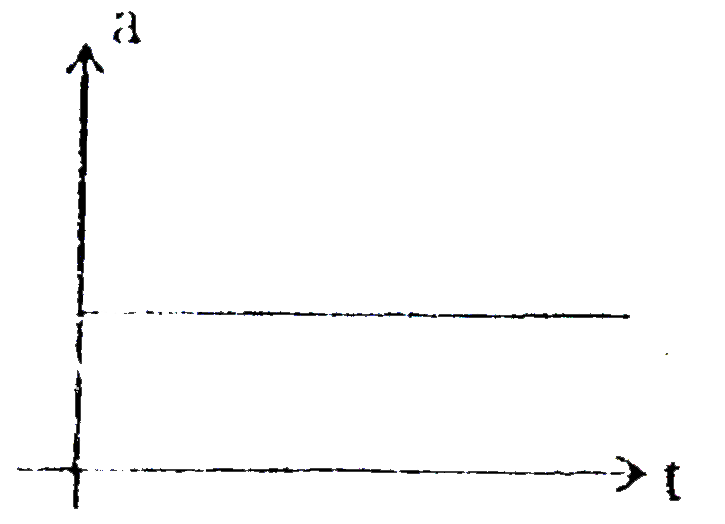
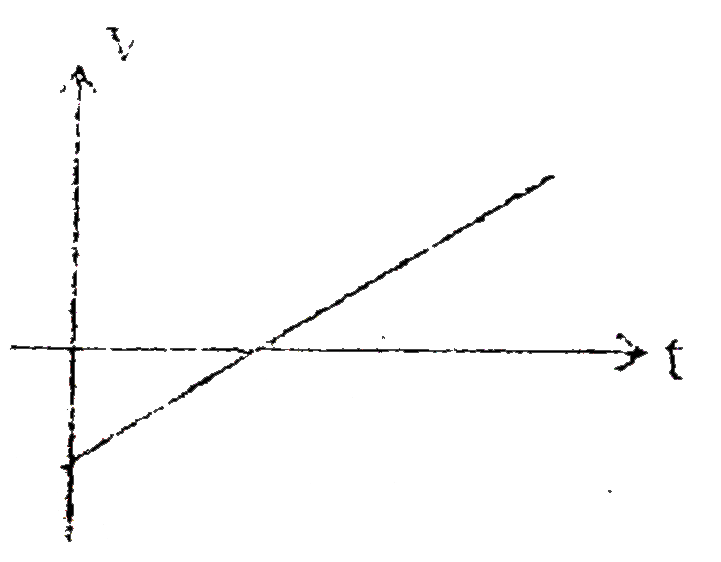
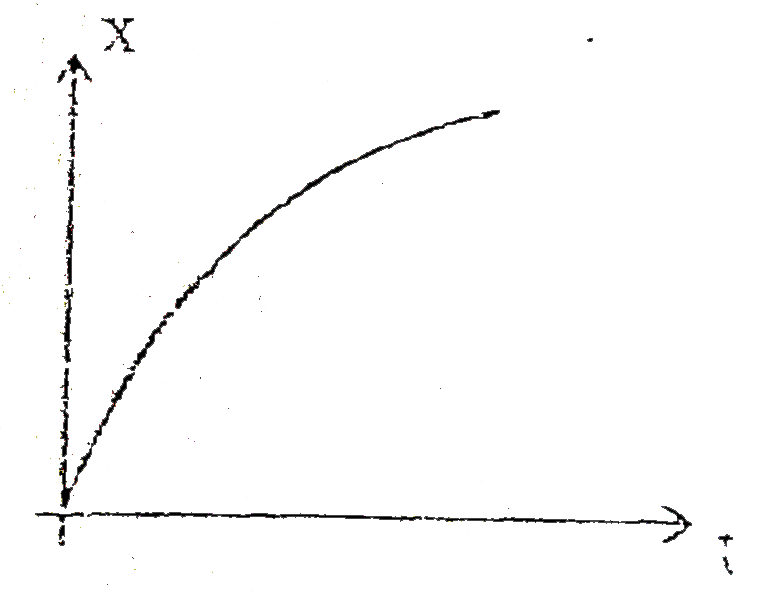
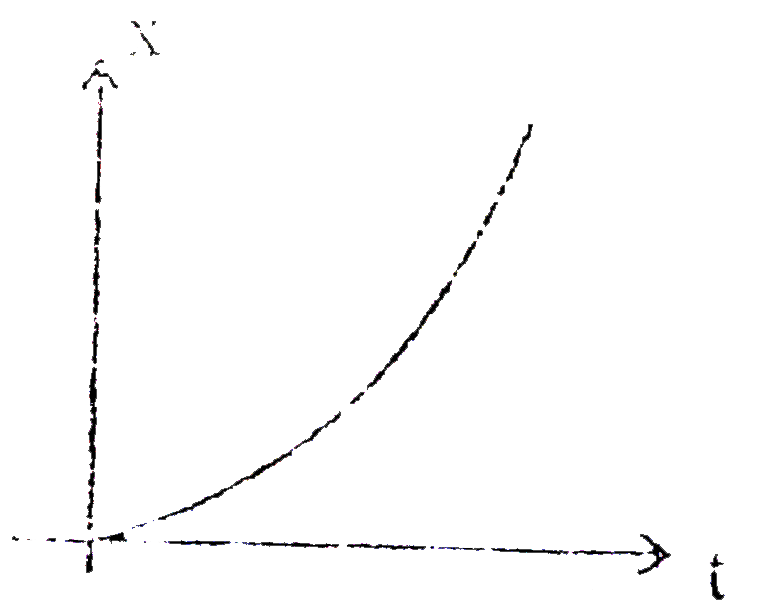
For a particle moving along `x-`axis, speed must be increasing for the following graph `:`

A

B

C

D

Text Solution

AI Generated Solution

The correct Answer is:

To determine when the speed of a particle moving along the x-axis is increasing, we need to analyze the relationship between velocity and acceleration. The speed of a particle increases when the velocity and acceleration have the same sign, meaning both are either positive or negative. ### Step-by-Step Solution: 1. **Understanding Speed and Velocity**: - Speed is the magnitude of velocity. For speed to increase, the particle must be moving in the same direction as its acceleration. 2. **Identifying Conditions for Increasing Speed**: - Case 1: If the velocity is positive and the acceleration is also positive, the speed is increasing. - Case 2: If the velocity is negative and the acceleration is also negative, the speed is also increasing. 3. **Analyzing the Graph**: - Look at the graph provided. The slope of the graph represents the velocity of the particle. - A positive slope indicates positive velocity, while a negative slope indicates negative velocity. 4. **Determining the Slope**: - Identify sections of the graph where the slope is positive (indicating positive velocity) and where the slope is negative (indicating negative velocity). - Check the acceleration (the slope of the velocity graph). If the slope is increasing (positive), the acceleration is positive. 5. **Conclusion**: - The speed of the particle is increasing when both the velocity and acceleration are either positive or negative. - From the analysis, if the graph shows sections where both the velocity and acceleration are positive or both are negative, then the speed is increasing. ### Final Answer: The correct answer is D, where the conditions for increasing speed are satisfied.

To determine when the speed of a particle moving along the x-axis is increasing, we need to analyze the relationship between velocity and acceleration. The speed of a particle increases when the velocity and acceleration have the same sign, meaning both are either positive or negative. ### Step-by-Step Solution: 1. **Understanding Speed and Velocity**: - Speed is the magnitude of velocity. For speed to increase, the particle must be moving in the same direction as its acceleration. 2. **Identifying Conditions for Increasing Speed**: ...
Promotional Banner

Topper's Solved these Questions

Similar Questions

Explore conceptually related problems

The potential energy U(x) of a particle moving along x- axis is shown in figure. Which one of the following graphs represents the variation of kinetic energy of this particel if its total mechanical enery is E_(0)

If a particle is moving along straight line with increasing speed, then

For a particle moving along the x-axis, mark the correct statement(s).

The velocity versus time graph of two particles moving along x-axis varies are shown in the following two plots. Then

For a particle moving along the x-axis, x-t graph is as given as graph in figure. Mar the correct statement (s). (#BMS_V01_MAA_E01_052_Q01.png" width="80%">

For a particle moving along x-axis, a scaled x-6 graph is shown in figure. Mark the correct statement (s).

The figure shows a particle moving along x - axis subjected to three particles of acceleration (a). Rank the periods according to the increase they produce in the particle velocity, greatest first.

The velocity (v) - time (t) graph for a particle moving along x - axis is shown in the figure. The corresponding position (x) - time (t) is best represented by

A particle moves along x-axis as x=4(t-2)+a(t-2)^2 Which of the following is true?

The acceleration - time graph for a particle moving along x - axis is shown in figure, If the initial velocity of particle is -5m//s , the velocity at t = 8 s is

ALLEN-TEST PAPER-Exercise (Physics)
  1. A particle moves 21m along the vector 6hat(i)+2hat(j)+3hat(k) , then 1...

    Text Solution

    |

  2. A particle is falling freely under gravity. In frist t secnd it covers...

    Text Solution

    |

  3. For a particle moving along x-axis, speed must be increasing for the f...

    Text Solution

    |

  4. A car of mass 1000kg moves from point A to B. If kinetic energy of ca...

    Text Solution

    |

  5. Two bodies of masses m(1) and m(2) are acted upon by a constant force ...

    Text Solution

    |

  6. A body (initially at rest is falling under gravity. When it loses a gr...

    Text Solution

    |

  7. The graph below shows how the force on a mass depends on the position ...

    Text Solution

    |

  8. A particle with total energy E moves in one direction in a region wher...

    Text Solution

    |

  9. Consider the folllowing graph of potential energy (U) vs position (x) ...

    Text Solution

    |

  10. A chain of length L and mass M is held on a frictionless table with (1...

    Text Solution

    |

  11. A force of magnitude of 30N acting along hat(i)+hat(j)+hat(k), displac...

    Text Solution

    |

  12. A spring of force constant K is cut in two parts at its one third leng...

    Text Solution

    |

  13. A ball of mass m is attached to a string whose other end is fixed. The...

    Text Solution

    |

  14. A block of mass m lies on a horizontal frictionless surface and is att...

    Text Solution

    |

  15. Two blocks of masses m(1) = 1 kg and m(2) = 2 kg are connected by a n...

    Text Solution

    |

  16. Power of a force acting on a block varies with time t as shown in figu...

    Text Solution

    |

  17. Two inclined frictionless tracks, one gradual and the other steep meet...

    Text Solution

    |

  18. A body A is projected upwards with velocity v1. Another body B of same...

    Text Solution

    |

  19. Track OABCD (as shown in figure ) is smooth. What minimum speed has to...

    Text Solution

    |

  20. In the ideal atwood machine arrangement shown, what is the change in k...

    Text Solution

    |
