Home
Class 12
CHEMISTRY
Explain why [Ti (H2O)6]^(3+) is violet w...

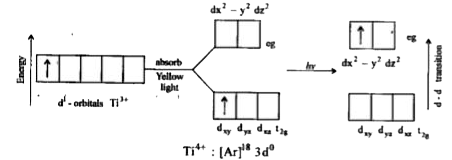
Explain why `[Ti (H_2O)_6]^(3+)` is violet while `[Ti (H_2O)_6]^(4+)` is colourless.

Text Solution

Verified by Experts
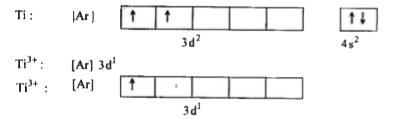
`Ti` has electrónic configuration : `[Ar]^(18) 3d^2 4s^2`

With one electron in 3d-Subshell in `Ti^(3+)`, d-d transitions are possible and hence it is coloured with electron 3d-subshell

In `Ti^(4+)`, d-d transitions are not possible and hence it is colourless.
Promotional Banner

Topper's Solved these Questions

  • D & F BLOCK ELEMENTS

    ACCURATE PUBLICATION|Exercise 1 OR 2 MARK QUESTIONS|40 Videos
  • COORDINATION COMPOUNDS

    ACCURATE PUBLICATION|Exercise 2 MARKS QUESTIONS|23 Videos
  • ELECTRO CHEMISTRY

    ACCURATE PUBLICATION|Exercise Numbericals Practice|44 Videos

Similar Questions

Explore conceptually related problems

[Ti (H_2O)_6]^(3+) is coloured while [Sc(H_2O)_6]^(3+) is colourless. Explain.

Explain [Fe(H_2O)_6]^(3+) is paramagnetic.

[Sc(H_2O_6)_6]^(3+) and [Ti(H_2O)_6]^(3+) ions are coloured why ?

A solution of [Ni(H_2O)_6]^(2+) is green but a solution of [Ni(CN)_4]^(2-) is colourless.Explain.

Explain Co^(2+) is coloured whereas Ti^(4+) is colourless. Why ?

CuSO_4 .5H_2O is blue in colour while CuSO_4 is colourless. Why ?

CuSO_4 .5H_2O is blue in colour while CuSO_4 is colourless. Why ?

[Ti(H_2O)6]^(3+) is paramagnetic in nature due to

Explain why [Fe(H_2O)_6]^(3+) has magnetic moment value of 5.92 B.M. whereas [Fe(CN)_6]^(3-) has a value of only 1.74 BM.

ACCURATE PUBLICATION-D & F BLOCK ELEMENTS -2 OR 5 MARKS QUESTIONS
  1. [Ti (H2O)6]^(3+) is coloured while [Sc(H2O)6]^(3+) is colourless. Expl...

    Text Solution

    |

  2. Explain why TiCl3 is coloured but TiCl4 is colourless ?

    Text Solution

    |

  3. Explain why [Ti (H2O)6]^(3+) is violet while [Ti (H2O)6]^(4+) is colou...

    Text Solution

    |

  4. Why Cd^(2+) salts are white ? Cd=48

    Text Solution

    |

  5. Which of the two is paramagnetic V(IV) or V(V) and why ?

    Text Solution

    |

  6. Why does Mn(II) shows maximum paramagnetic character among the dival...

    Text Solution

    |

  7. Name the elements represented by following symbols : Hg , Pb , Au , Ag...

    Text Solution

    |

  8. What is atomicity ? Explain with two examples.

    Text Solution

    |

  9. What is the atomicity of the following : oxygen

    Text Solution

    |

  10. Explain why Cu(I) is diamagnetic while Cu(II) is paramagnetic in natur...

    Text Solution

    |

  11. Transition metals have high melting points and boiling points. Why?

    Text Solution

    |

  12. What is the atomicity of the following : ozone

    Text Solution

    |

  13. What is the atomicity of the following : neon

    Text Solution

    |

  14. What is the atomicity of the following : phosphorous

    Text Solution

    |

  15. What is the atomicity of the following : sulphur

    Text Solution

    |

  16. What is the atomicity of the following : sodium

    Text Solution

    |

  17. What are lanthanoids ?

    Text Solution

    |

  18. Why are Lanthanides called inner transition metals.

    Text Solution

    |

  19. What are different oxidation states exhibited by lanthanoids ?

    Text Solution

    |

  20. What is lanthanoid contraction ?

    Text Solution

    |