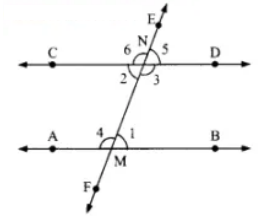
Theorem 6.2 : If a transversal intersects two parallel lines, then each pair of alternate interior angles is equal.
Text Solution
Verified by Experts
Since ray `ND` stands on line `EF`,
`/_3 + /_5=180 ` (linear pair of angles)
But, `/_ 1 = /_5` (Corresponding angles as `AB∣∣CD`)
From above equations, we get
`/_ 1+ /_ 3=180`
Again ray `CN` stands on `EF`,
...
Topper's Solved these Questions
NCERT THEOREMS
NCERT|Exercise THEOREM 6.3|1 Videos
NCERT THEOREMS
NCERT|Exercise THEOREM 6.4|1 Videos
NCERT THEOREMS
NCERT|Exercise THEOREM 6.1|1 Videos
LINES AND ANGLES
NCERT|Exercise SOLVED EXAMPLES|8 Videos
NUMBER SYSTEMS
NCERT|Exercise EXERCISE 1.4|2 Videos
Similar Questions
Explore conceptually related problems
If a transversal intersects two parallel lines; then each of alternate interior angles are equAL.
Theorem 6.3 : If a transversal intersects two lines such that a pair of alternate interior angles is equal, then the two lines are parallel.
Theorem 6.4 : If a transversal intersects two parallel lines, then each pair of interior angles on the same side of the transversal is supplementary.
If a transversal intersects two parallel lines; then each pair of consecutive interior angles are supplementary.
If a transversal intersects two parallel lines, then alternate interior angles have one common _______
Read the following statements which are taken as axioms (i) If a transversal intersects two parallel lines, then corresponding angles are not necessarily equal. (ii) If a transversal intersect two parallel lines, then alternate interior angles are equal. Is this system of axioms consistent ? Justify your answer.
If a transversal line cuts two parallel lines then bisector of internal angle formed a
Transversal to two parallel lines:
Theorem 6.5 : If a transversal intersects two lines such that a pair of interior angles on the same side of the transversal is supplementary, then the two lines are parallel.
If a Transversal intersects two lines in such a way that a pair of alternate interior angles are equal; then the two lines are parallel.