Home
Class 9
MATHS
Theorem 10.12 : If the sum of a pair of ...

Theorem 10.12 : If the sum of a pair of opposite angles of a quadrilateral is 180º, the quadrilateral is cyclic.

Text Solution

Verified by Experts


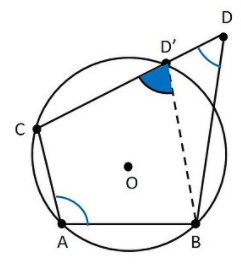
Since `A`,`B`,`C` are non-collinear, on circle passes through them. Let us draw a circle with center `O`.
Let us assume `D` does not lie on circle.
`ABCD'` is a cyclic quadrilateral.
`/_BAC+/BD'C=180`
But, given that, `/_BAC+/_BDC=180`
Thus,
`/_BD'C=/_BDC`
...

Promotional Banner

Topper's Solved these Questions

  • NCERT THEOREMS

    NCERT|Exercise THEOREM 10.11|1 Videos
  • LINES AND ANGLES

    NCERT|Exercise SOLVED EXAMPLES|8 Videos
  • NUMBER SYSTEMS

    NCERT|Exercise EXERCISE 1.4|2 Videos

Similar Questions

Explore conceptually related problems

If the sum of any pair of opposite angles of a quadrilateral is 180^(@) ; then the quadrilateral is cyclic.

Theorem 10.11 : The sum of either pair of opposite angles of a cyclic quadrilateral is 180º.

The sum of the angles of a quadrilateral is

The sum of all angles of a quadrilateral is

The sum of all the angles of a quadrilateral is

Theorem 8.3 : If each pair of opposite sides of a quadrilateral is equal, then it is a parallelogram.

The sum of either pair of opposite angles of a cyclic quadrilateral is 180^(@) OR The opposite angles of a cyclic quadrilateral are supplementary.

The sum of the angles of a quadrilateral is ......... .

Prove that the sum of opposite pair of angles of a cyclic quadrilateral is 180^(@)
