Home
Class 12
CHEMISTRY
Statement I: In any ionic solid [MX] wit...

Statement I: In any ionic solid `[MX]` with Schottky defect, the number of positive and negative ions are same.
Statement II: An equal number of cation and anion vacancies is present.

A

Statement I is true, Statement II is true, Statement II is a correct explanation of Statement I.

B

Statement I is true, Statement II is true, Statement II is not a correct explanation of Statement I.

C

Statement I is true, Statement II is false.

D

Statement I is false, Statement II is true.

Text Solution

Verified by Experts

The correct Answer is:
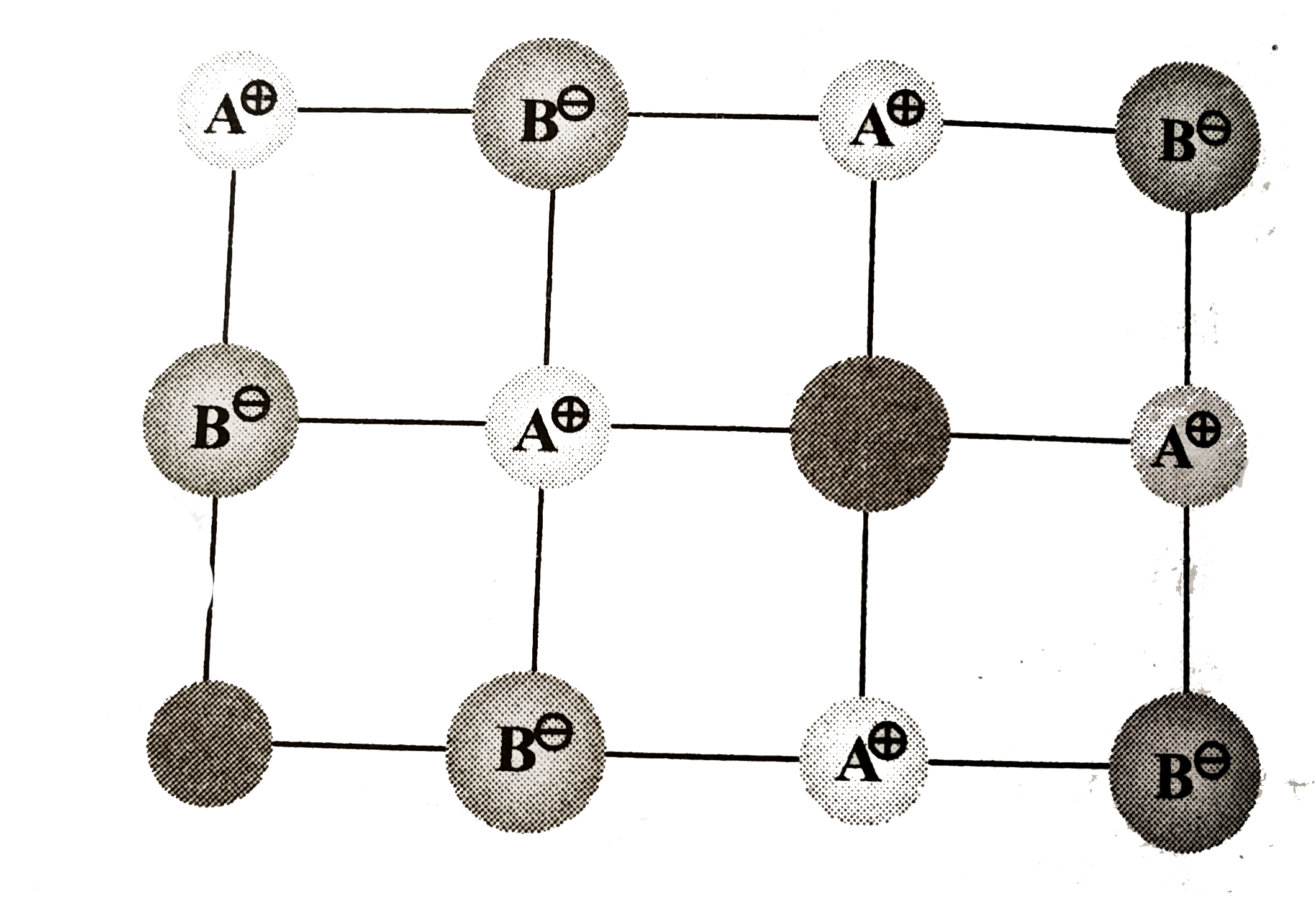
A


Schottky defect arises when elqual number and anions are missing from the lattice.
Promotional Banner

Topper's Solved these Questions

  • SOLID STATE

    CENGAGE CHEMISTRY|Exercise Exercises (Archives ) Interger|1 Videos
  • SOLID STATE

    CENGAGE CHEMISTRY|Exercise Exercises (Archives ) Subjective|9 Videos
  • SOLID STATE

    CENGAGE CHEMISTRY|Exercise Exercises (Archives ) Single Correct|10 Videos
  • REDUCTION AND OXIDATION REACTION OF ORGANIC COMPOUNDS

    CENGAGE CHEMISTRY|Exercise SUBJECTIVE TYPE|3 Videos
  • SOLUTIONS

    CENGAGE CHEMISTRY|Exercise Ex 2.3 (Objective)|9 Videos

Similar Questions

Explore conceptually related problems

Statement 1: In any ionic solid [MX] withschotty defects, the number of positive and negative ions are same Statement 2: Equals number of cation and anion vacancies are present .

Any deviation from the perfectly ordered arrangement constitutes a defect or imperfection. The compounds in which the number of irregularity are present in the arrangement of atoms or ions are called atomic imperfections or point defects. These may be stochiometric or non - stoichlometric. Stoichiometric defects are further classified into Schottky defects in which number of positive and negative ions are missing in equal ratio and Frenkel defects in which an ion leaves its correct lattice sites and occupies on interstitial site. Schottky defect is more common in ionic compounds with high co-ordination number and where the size of positive and negative ions are almost equal, while in Frenkel defects are common in ionic compounds, which have low co-ordination number and in which there is large difference in size between positive and negative ions. Which of the following defect, if present, lowers the density of the crystal ?

Any deviation from the perfectly ordered arrangement constitutes a defect or imperfection. The compounds in which the number of irregularity are present in the arrangement of atoms or ions are called atomic imperfections or point defects. These may be stochiometric or non - stoichlometric. Stoichiometric defects are further classified into Schottky defects in which number of positive and negative ions are missing in equal ratio and Frenkel defects in which an ion leaves its correct lattice sites and occupies on interstitial site. Schottky defect is more common in ionic compounds with high co-ordination number and where the size of positive and negative ions are almost equal, while in Frenkel defects are common in ionic compounds, which have low co-ordination number and in which there is large difference in size between positive and negative ions. When an ion leaves ir correct lattice and occupies interstital sites in its crystal lattice, it is called

Any deviation from the perfectly ordered arrangement constitutes a defect or imperfection. The compounds in which the number of irregularity are present in the arrangement of atoms or ions are called atomic imperfections or point defects. These may be stochiometric or non - stoichlometric. Stoichiometric defects are further classified into Schottky defects in which number of positive and negative ions are missing in equal ratio and Frenkel defects in which an ion leaves its correct lattice sites and occupies on interstitial site. Schottky defect is more common in ionic compounds with high co-ordination number and where the size of positive and negative ions are almost equal, while in Frenkel defects are common in ionic compounds, which have low co-ordination number and in which there is large difference in size between positive and negative ions. In a crystal some ions are missing from normal sites. This is an example of

Any deviation from the perfectly ordered arrangement constitutes a defect or imperfection. The compounds in which the number of irregularity are present in the arrangement of atoms or ions are called atomic imperfections or point defects. These may be stochiometric or non - stoichlometric. Stoichiometric defects are further classified into Schottky defects in which number of positive and negative ions are missing in equal ratio and Frenkel defects in which an ion leaves its correct lattice sites and occupies on interstitial site. Schottky defect is more common in ionic compounds with high co-ordination number and where the size of positive and negative ions are almost equal, while in Frenkel defects are common in ionic compounds, which have low co-ordination number and in which there is large difference in size between positive and negative ions. KBr shows, which of the following stoichiometric defects ?

CENGAGE CHEMISTRY-SOLID STATE-Exercises (Archives ) Assertion-Reasoning
  1. Statement I: In any ionic solid [MX] with Schottky defect, the number ...

    Text Solution

    |

