Home
Class 12
CHEMISTRY
Hybridisation involves the mixing of orb...

Hybridisation involves the mixing of orbitals having comparable energhies of same atom. Hybridised orbitals perform efficient overlapping than overlapping by pure s, p or orbitals.
Which of the following is not correctly match between given species and type of overlapping ?

A

`XeO_(3)` : Three `(d pi - p pi)` bonds

B

`H_(2)SO_(4)` : Two `(d pi - p pi)` bonds

C

`SO_(3)` : Three `(d pi - p pi)` bonds

D

`HClO_(4)` : Three `(d pi - p pi)` bonds

Text Solution

Verified by Experts

The correct Answer is:
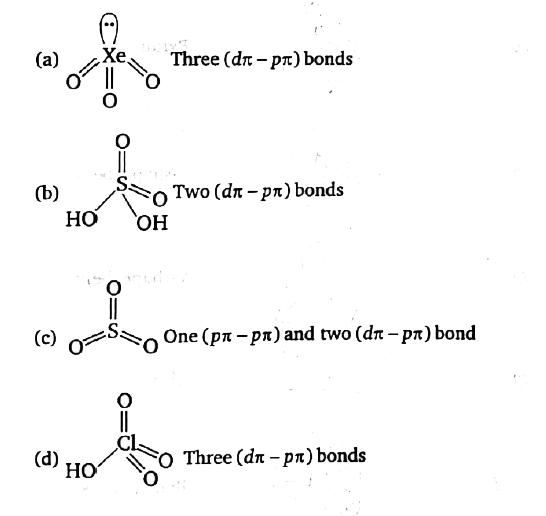
C

Promotional Banner

Topper's Solved these Questions

  • CHEMICAL BONDING (BASIC)

    VK JAISWAL|Exercise ONE OR MORE ANSWERS IS / ARE CORRECT|48 Videos
  • CHEMICAL BONDING (BASIC)

    VK JAISWAL|Exercise MATCH THE COLUMN|25 Videos
  • CHEMICAL BONDING (BASIC)

    VK JAISWAL|Exercise Level 3 (Passive 10)|6 Videos
  • CHEMICAL BONDING (ADVANCED)

    VK JAISWAL|Exercise SUBJECTIVE PROBLEMS|72 Videos
  • CO-ORDINATION COMPOUNDS

    VK JAISWAL|Exercise ASSERTION-REASON TYPE QUESTIONS|26 Videos

Similar Questions

Explore conceptually related problems

Hybridisation involves the mixing of orbitals having comparable energhies of same atom. Hybridised orbitals perform efficient overlapping than overlapping by pure s, p or orbitals. Consider the following compounds and select the incorrect statement from the following : NH_(3),PH_(3),H_(2)S,SO_(2),BF_(3),PCl_(3),IF_(7),P_(4),H_(2)

Which of the following orbitals of a diatomic molecule AB will not have positive overlap ?

Hyperconjugation involves the overlapping of the following orbitals :

Hyperconjugation involves overlap of the following orbitals :

Hyperconjugation involves overlap of which of the following orbitals?

Hybridisation is the mixing of atomic orbital of comparable energy and the number of hybrid orbitals formed is equal to the number of pure atomic orbitals mixed up and hybrid orbitals are occupied by sigma -bond pair and lone pair. ''The hybrid orbitals are at at angle of X^(@) to one another''. This statement is not valid for which of the following hybridisation?

