Home
Class 11
CHEMISTRY
Give reason for the following. a) Cova...

Give reason for the following.
a) Covalent bonds are directional bonds while ionic bonds are non-directional.
b) Wate molecules has bent whereas carbon dioxide molecule is linear.
c) Ethyne molecule is linear.

Text Solution

Verified by Experts

The correct Answer is:
a

a) A covalent bond is formed by the overlap of atomic orbitals. The direction of overlapping gives the direction of bond. In ionic bond, the electrostatic field of an ion is non-directional.
Each positive ion is surrounded by a number of anions in any direction depending upon its size and vice-versa. That's why covalent bonds are directional bonds while ionic bonds are non-directional.
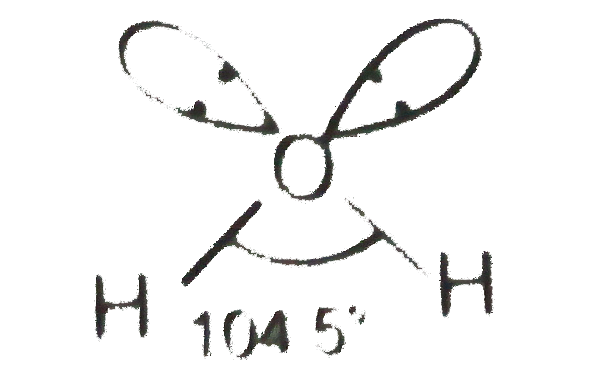
b) In `H_(2)O` oxygen atom is `sp^(3)` hybridised with two lone pairs. The four `sp^(3)` hybridised orbitals acquire a tetrahedral geometry with two corners occupied by hydrogen atoms while other two by the lone pairs.
The bond angle is reduced to `104.5^(@)` from `109.5^(@)` due to greater repulsive forces between Ip-Ip and the molecule thus acquires a V-shape or bent structure (angular structure )

In `CO_(2)` molecule, carbon atom in sp-hybridised. The two sp hybrid orbitals are oriented in opposite direction forming an angle of `180^(@)`.

Thats, why `H_(2)O` molecule has bent structure whereas `CO_(2)` molecule is linear.
c) In ethyne molecule, both the carbon atoms are sp hybridised, having two unhybridised orbitals, i.e, `2p_(x)` and `2p_(y)`. The two sp hybrid orbitals of both the carbon atoms are oriented in opposite direction froming an angle of `180^(@)`
`H-Cunderset(2pi-bond)overset(sigma)-=C-H`
That's why ethyne molecule is linear.
Promotional Banner

Topper's Solved these Questions

  • CHEMICAL BONDING AND MOLECULAR STRUCTURE

    NCERT EXEMPLAR|Exercise Matching the columns|5 Videos
  • CHEMICAL BONDING AND MOLECULAR STRUCTURE

    NCERT EXEMPLAR|Exercise Assertions and Reasons|3 Videos
  • CHEMICAL BONDING AND MOLECULAR STRUCTURE

    NCERT EXEMPLAR|Exercise Long Answer type questions|9 Videos
  • CLASSIFICATION OF ELEMENTS AND PERIODICITY IN PROPERTIES.

    NCERT EXEMPLAR|Exercise Long answer types question|7 Videos

Similar Questions

Explore conceptually related problems

Give reasons for the following : (i) Covalent bonds are directional while ionic bonds are non-directional. (ii) Water molecule has bent structure whereas carbon dioxide molecule is linear. (iii) Etyne molecule is linear.

Covalent bonds are non-directional bonds.

Ionic bonds are non-directional while covalent bonds are directional.

How many double bonds are present in carbon dioxide molecule?

Each carbon - oxygen bond in carbon dioxide molecule is polar but the molecule itself is non - polar. Explain.

Which of the following molecules has hargest bond angle ?

NCERT EXEMPLAR-CHEMICAL BONDING AND MOLECULAR STRUCTURE-Short answer types questions
  1. Using molelcular orbital theory, compare the bond energy and magnetic ...

    Text Solution

    |

  2. Explain the shape of BrF(5^.)

    Text Solution

    |

  3. Structures of molecules of two compounds are given below. a) Whic...

    Text Solution

    |

  4. Why does type of overlap given in the following figure not result in b...

    Text Solution

    |

  5. Explain why PCl(5) is trigonal bipyramidal whereas IF(5) is square pyr...

    Text Solution

    |

  6. In both water and dimethyl ether (CH(3)-underset(..)overset(..)O-CH(3)...

    Text Solution

    |

  7. Write Lewis structure of the following compounds and show format charg...

    Text Solution

    |

  8. The energy of sigma2p(z), molecular orbital is greater than pi2p(x) an...

    Text Solution

    |

  9. Give the change in bond order in the following ionisation process? i...

    Text Solution

    |

  10. Give reason for the following. a) Covalent bonds are directional bon...

    Text Solution

    |

  11. What is an ionic bond? With two suitable exmaples the difference betwe...

    Text Solution

    |

  12. Arrange the following bonds in order of increasing ionic character giv...

    Text Solution

    |

  13. Explain why CO(3)^(2-) ion cannot be represented by a single Lewis str...

    Text Solution

    |

  14. Predict the hybridisation of each carbon in the molecule of organic co...

    Text Solution

    |

  15. Group the following as linear and non-linear molecules : H(2)O,HOCl,...

    Text Solution

    |

  16. Elements X,Y and Z have 4,5 and 7 valence electrons respectively, (i) ...

    Text Solution

    |

  17. Draw the resonatin structure of (i) Ozone molecule (ii) Nitrate ion

    Text Solution

    |

  18. Presict the shapes of the following molecules on the basis of hybridis...

    Text Solution

    |

  19. All the C-O bonds in carbonate in (CO(3)^(2-)) are equal in length. Ex...

    Text Solution

    |

  20. what is meant by the term average bond enthalpy? Why is there differen...

    Text Solution

    |