Home
Class 12
CHEMISTRY
Ni^(+2) ion forms a searlet red ppt with...

`Ni^(+2)` ion forms a searlet red ppt with DMG. It is a …………. Memberd ring.

Text Solution

Verified by Experts

The correct Answer is:
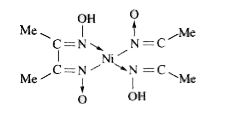
5

`HO-N=overset(CH_(3))overset(|)C-overset(CH_(3))overset(|)C=N-OH`
Dimethyl glyoxime (DMG)
The .N. atoms donate a lone pair each to the metal atom and thus two 5-membered rings are formed through chelation in `[Ni(dmg)_(2)]` complex.
Promotional Banner

Topper's Solved these Questions

  • CO-ORDINATION COMPOUNDS

    AAKASH SERIES|Exercise PRACTICE SHEET - 4 ( Single or more than one option questions C.E.T., Stability, Applications:|16 Videos
  • CO-ORDINATION COMPOUNDS

    AAKASH SERIES|Exercise PRACTICE SHEET - 4 ( Linked Comprehension type questions) Passage-I|3 Videos
  • CO-ORDINATION COMPOUNDS

    AAKASH SERIES|Exercise PRACTICE SHEET - 3 ( Match the following questions)|2 Videos
  • CHEMISTRY IN EVERYDAY LIFE

    AAKASH SERIES|Exercise PRACTICE SHEET - 2 (PRACTICE SHEET -2 (INTEGER ANSWER TYPE QUESTIONS))|7 Videos
  • COMPLEX COMPOUNDS

    AAKASH SERIES|Exercise PRACTICE EXERCISE|45 Videos

Similar Questions

Explore conceptually related problems

Cu^(2+) ions get precipitated with little H_2 S . While Ni^(2+) ions get precipitated with more H_(2) S . This is because

Dimethyl glyoxime form a square planar complex with Ni^(+2) . This complex contain how many number of unpaired electrons ?

when an primay aromatic amine is treated with NaNO_(2)+HCl at 0^(0)-5^(0)C , a diazonium salt is formed and the reaction is called diazo reaction. In this reaction mineral acid must be added to prevent the coupling reaction of diazonium salt with excess of aryl amine. Diazonium salt is highly useful in the synthesis of number of coloured dyes. For the following diazonium ion the decreasing order of reactivity of these ion in azo-coupling rcaction

Which of the following ions form a white ppt. with ammonium oxalate?

Which of the following forms black ppt. with H_(2)S in acidified solution?

A compound (A) is greenish crystalline salt, which gave the following results. i) Addition of BaCl_(2) solution to the solution of (A) results in the formation of white ppt. (B). which is insoluble in dil HCL ii) On heating (A), water vapours and two oxides of sulphur, (C) and (D) are liberated leaving a red brown residue (E) iii) (E) dissolves in warm conc. HCI to give a yellow solution (F). iv) With HS the solution (F) yields a pale yellow ppt. (G) which when filtered, leaves a greenish filtrate (H). v) Solution (F) on treatment with thiocynaate ions gives blood red coloured compound (I). White ppt (B) is of

A compound (A) is greenish crystalline salt, which gave the following results. i) Addition of BaCl_(2) solution to the solution of (A) results in the formation of white ppt. (B). which is insoluble in dil HCL ii) On heating (A), water vapours and two oxides of sulphur, (C) and (D) are liberated leaving a red brown residue (E) iii) (E) dissolves in warm conc. HCI to give a yellow solution (F). iv) With H2S the solution (F) yields a pale yellow ppt. (G) which when filtered, leaves a greenish filtrate (H). v) Solution (F) on treatment with thiocynaate ions gives blood red coloured compound (I). Compound (A) is

(A): Ethylenediaminetetraacetate ion forms a 1:1 stoichiometric complex with Co^(2+) ion (R): It has six donor atoms which coordinate simultaneously to the metal ion.

A compound (A) is greenish crystalline salt, which gave the following results. i) Addition of BaCl_(2) solution to the solution of (A) results in the formation of white ppt. (B). which is insoluble in dil HCL ii) On heating (A), water vapours and two oxides of sulphur, (C) and (D) are liberated leaving a red brown residue (E) iii) (E) dissolves in warm conc. HCI to give a yellow solution (F). iv) With HS the solution (F) yields a pale yellow ppt. (G) which when filtered, leaves a greenish filtrate (H). v) Solution (F) on treatment with thiocynaate ions gives blood red coloured compound (I). The yellow solution is of

