Home
Class 12
PHYSICS
Using Ampere's circuital law, obtain an ...

Using Ampere's circuital law, obtain an expression for the magnetic induction at a point near an infinitely long straight conductor carrying an electric current.

Text Solution

Verified by Experts
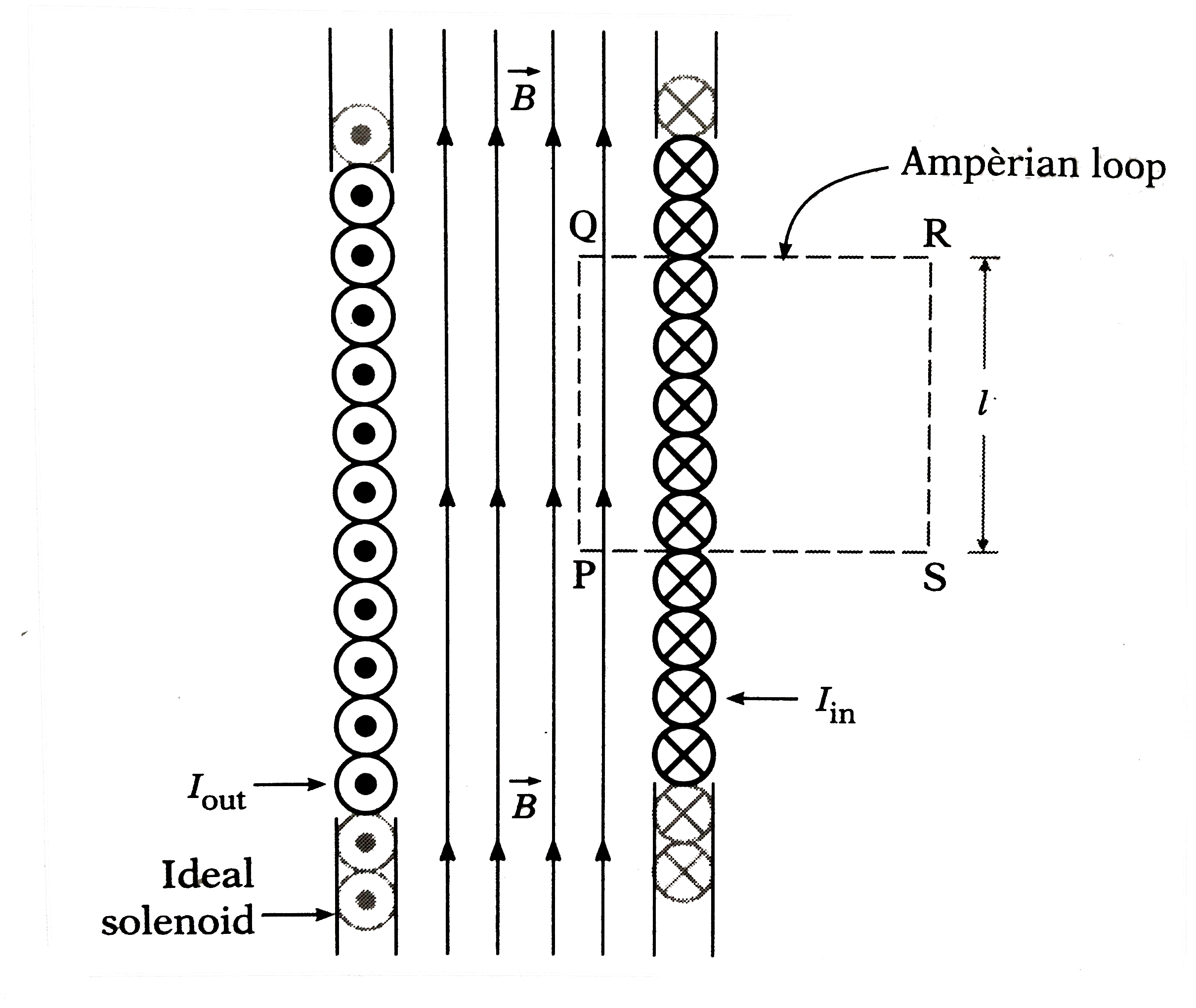
An ideal solenoid is tightly wound and infinitely long. Let n be the number of turns of wire per unit length and `I` be the steady current in the solenoid.
For an ideal solenoid, the magnetic induction `vecB` inside is reasonably uniform over the cross section and parallel to the axis throughout the volume enclosed by the solenoid, `vecB` outside is negligible.

An an Amperian loop, we choose a rectangular path PQRS of length `l` parallel to the solenoid axis. The width of the rectangle is taken to be sufficiently large so that the side RS is far from the solenoid where `vecB ~=0.`
The line integral of the magnetic induction around the Amperian loop in sense PQRSP is
`ointvecB*vec(dl)=underset(P)overset(Q)int vecB*vec(dl)+underset(Q)overset(R)intvecB*vec(dl)+underset(R)overset(S)intvecB*vec(dl)+underset(S)overset(P)intvecB*vec(dl) " " `...(1)
`vecB` has the same magnitude inside and is parallel to side PQ. Hence, as we go in the same direction as `vecB` from P to Q, `vecB and vec(dl)` are parallel so that
`underset(P)overset(Q)intvecB*vec(dl)=underset(P)overset(Q)intBdl=Bunderset(P)overset(Q)int dl=Bl " "`...(2)
Along the paths `Q to R and S to P, vecB` is perpendicular to `vec(dl)` inside the solenoid while `vecB=0` outside.
`therefore underset(Q)overset(R)int vecB*vec(dl)=underset(S)overset(P)intvecB*vec(dl)=0 " " `...(3)
Also `vecB=0` along side RS, so that
`underset(R)overset(S) vecB*vec(dl)=0 " "`...(4)
Thus, from Eqs. (1),(2), (3) and (4),
`oint vecB*vec(dl) =Bl " " ` ...(5)
The net current enclosed by the Amperian loop is
`I_("encl")=` current through each turn `xx` number of turns enclosed by the loop
`=I xx nl=nlI " " ` ...(6)
By Ampere's law, in free space,
`oint vecB*vec(dl) =mu_(0)I_("encl"), " where " mu_(0)` is the permeability of free space.
Therefore, from Eqs. (5) and (6), `Bl=mu_(0) nl I `
`therefore B=mu_(0)nI " " ` ...(7)
This is the required expression.
Promotional Banner

Topper's Solved these Questions

  • DERIVATIONS-II

    NAVNEET PUBLICATION - MAHARASHTRA BOARD|Exercise Magnetism|1 Videos
  • DERIVATIONS-II

    NAVNEET PUBLICATION - MAHARASHTRA BOARD|Exercise Electromagnetic Induction|6 Videos
  • DERIVATIONS-II

    NAVNEET PUBLICATION - MAHARASHTRA BOARD|Exercise Electrostatics|12 Videos
  • DERIVATIONS-I

    NAVNEET PUBLICATION - MAHARASHTRA BOARD|Exercise Assignments|9 Videos
  • DISTINGUISH BETWEEN

    NAVNEET PUBLICATION - MAHARASHTRA BOARD|Exercise Assingment|3 Videos

Similar Questions

Explore conceptually related problems

State Ampere's circuital law. Obtain an expression for magnetic induction along the axis of toroid.

Magnetic field at a distance r from an infinitely long straight conductor carrying steady varies as

Using Gauss’ law, derive an expression for the electric field at a point near an infinitely long straight uniformly charged wire.

The magnetic induction at any point due to a long straight wire carrying a current is

The magnitude of magnetic induction at a distance 4 cm due to straight conductor carrying a current of 10 A is

State Ampere's circuital law. By using it derive an expression for magnetic field intensity at a point due to a straight current carrying conductor.

Calculate the magnetic field at a distance of 5 cm from an infinite straight conductor carrying a current of 10 A.

Calculate the magnetic field at a point P. 0.5 m away from an infinitely long straight wire carrying current of 90 A.

The magnetic induction due to an infinitely long straight wire carrying a current i at a distance r from wire is given by

